Falcon 9 Booster Lost After Successful Landing: Implications and Future Steps
In the realm of space exploration, every launch and landing comes with inherent risks. Recently, SpaceX faced a setback when a Falcon 9 booster was lost post-landing on March 2. This incident has sparked discussions regarding the reliability of the Falcon 9, a rocket that is pivotal not only to SpaceX but also to the broader space industry.
The Launch and Landing
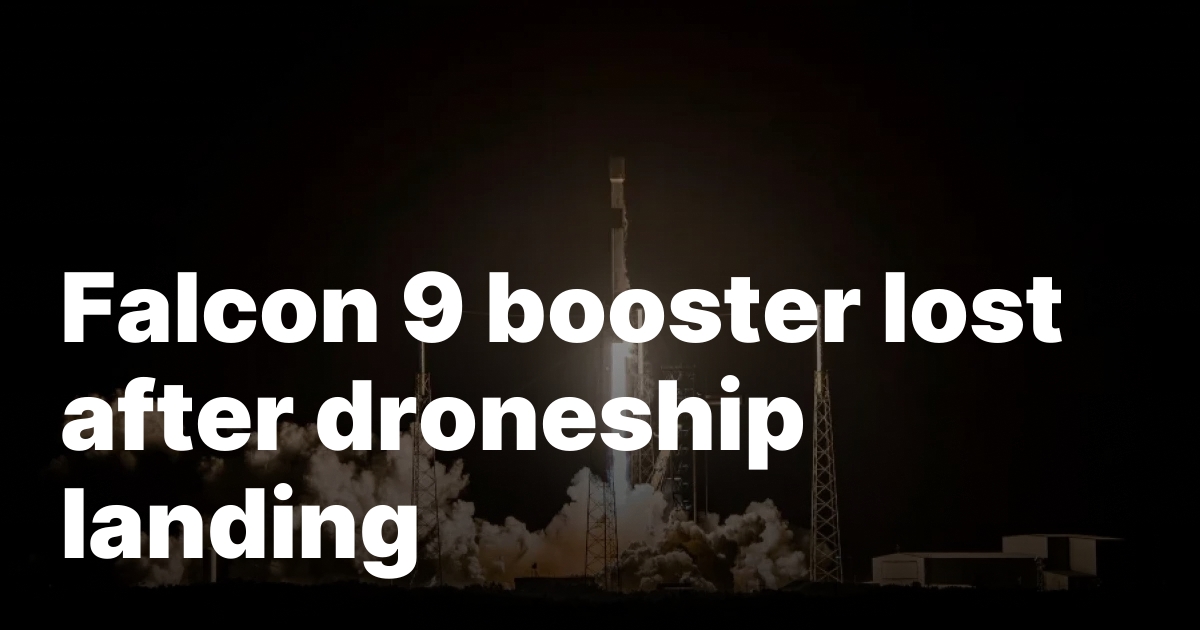
On the night of March 2, a Falcon 9 rocket took off from Space Launch Complex 40 at Cape Canaveral Space Force Station. The mission was to deliver 21 Starlink satellites into orbit, a task that the rocket successfully completed. Approximately 8 minutes and 15 seconds after liftoff, the booster landed on a droneship named "Just Read the Instructions." The successful deployment of the satellites was a significant achievement, yet the mission faced an unexpected turn post-landing.
The Incident
The booster, known as B1086, encountered a critical issue after touching down on the droneship. According to SpaceX’s statement on March 3, an unusual fire at the aft end of the rocket led to damage on one of the booster’s landing legs, causing it to tip over. This unfortunate event resulted in the loss of the booster. SpaceX highlighted the importance of learning from such failures, emphasizing that the data gathered from this incident will contribute to enhancing the reliability of the Falcon 9 during both ascent and landing phases.
Learning from Setbacks
Kiko Dontchev, SpaceX’s Vice President of Launch, reiterated the company’s commitment to improvement, viewing the setback as a learning opportunity. Every failure, he mentioned, is a chance to gather insights that could bolster the reliability of not only the Falcon 9 but other SpaceX vehicles as well.
Booster B1086’s History
The B1086 booster had completed only five flights, a relatively small number compared to the current record of 26 flights by another Falcon 9 booster. Initially constructed as a Falcon Heavy side booster, B1086 was first utilized in the June 2024 launch of the GOES-U weather satellite. It was later modified to serve as a Falcon 9 booster, participating in two Starlink missions and another mission carrying Maxar’s WorldView Legion satellites before this incident.
A Series of Challenges
This recent event is part of a series of challenges faced by the Falcon 9 rockets. In August 2024, another Falcon 9 booster experienced a landing failure on a droneship, which temporarily interrupted SpaceX’s launch schedule. Additionally, there have been issues with the Falcon 9’s upper stages. For instance, in July 2024, an upper stage engine failure led to the loss of a payload comprising Starlink satellites, pausing Falcon 9 launches for two weeks.
Other incidents include problems with deorbit burns after payload deployment. In September 2024, during the Crew-9 launch, a deorbit anomaly caused a temporary halt in Falcon 9 launches, except for missions not requiring a deorbit burn. Another incident occurred on February 1, where a propellant leak resulted in the upper stage reentering over Europe, with debris landing in western Poland. This event, however, did not lead to a suspension of Falcon 9 launches by the Federal Aviation Administration (FAA).
Manufacturing Concerns
At a NASA briefing on February 26, just hours before a successful Falcon 9 launch carrying the IM-2 lunar lander for Intuitive Machines, Bill Gerstenmaier, SpaceX’s Vice President for Build and Flight Reliability, addressed concerns regarding the Merlin engine nozzle used in the Falcon 9 upper stage. A potential manufacturing defect was identified in the nozzle, which prompted a thorough review of all nozzles to ensure they were free of defects.
Gerstenmaier assured that the defect was isolated to a single nozzle at the company’s factory in Hawthorne, California. Through meticulous examination of manufacturing records and testing data, SpaceX confirmed that other nozzles were not affected. The company remains diligent in its approach, pausing operations to investigate anomalies and ensuring robust flight rationale.
Delays in NASA Missions
The recent issues with Falcon 9 have also affected NASA missions. A mission to launch the SPHEREx astronomy spacecraft and four PUNCH space science satellites encountered delays. Initially scheduled for February 27, the launch was postponed to March 4. NASA attributed these delays to the need for additional time to evaluate the Falcon 9’s hardware data.
NASA had planned a prelaunch briefing for March 3, but it was subsequently canceled. The agency has promised to provide updates as soon as possible. As of the afternoon of March 3, further information regarding the mission’s status or confirmation of the March 4 launch has not been released.
Looking Ahead
The loss of the Falcon 9 booster post-landing is a reminder of the unpredictable nature of space exploration. While it is disappointing, it also opens avenues for learning and improvement. SpaceX continues to analyze the incident, aiming to make enhancements that will bolster the Falcon 9’s reliability in future missions.
Space enthusiasts and industry stakeholders are keenly watching how SpaceX addresses these challenges. The company’s ability to adapt and improve could set new standards for reliability in the space industry. As SpaceX continues its mission to make space more accessible, each challenge presents a unique opportunity to advance technology and safety.
For more details, you can follow updates from SpaceX and NASA on their respective websites and social media channels.
For more Information, Refer to this article.