NASA’s Nancy Grace Roman Space Telescope Nears Completion with Successful Sunshield Installation
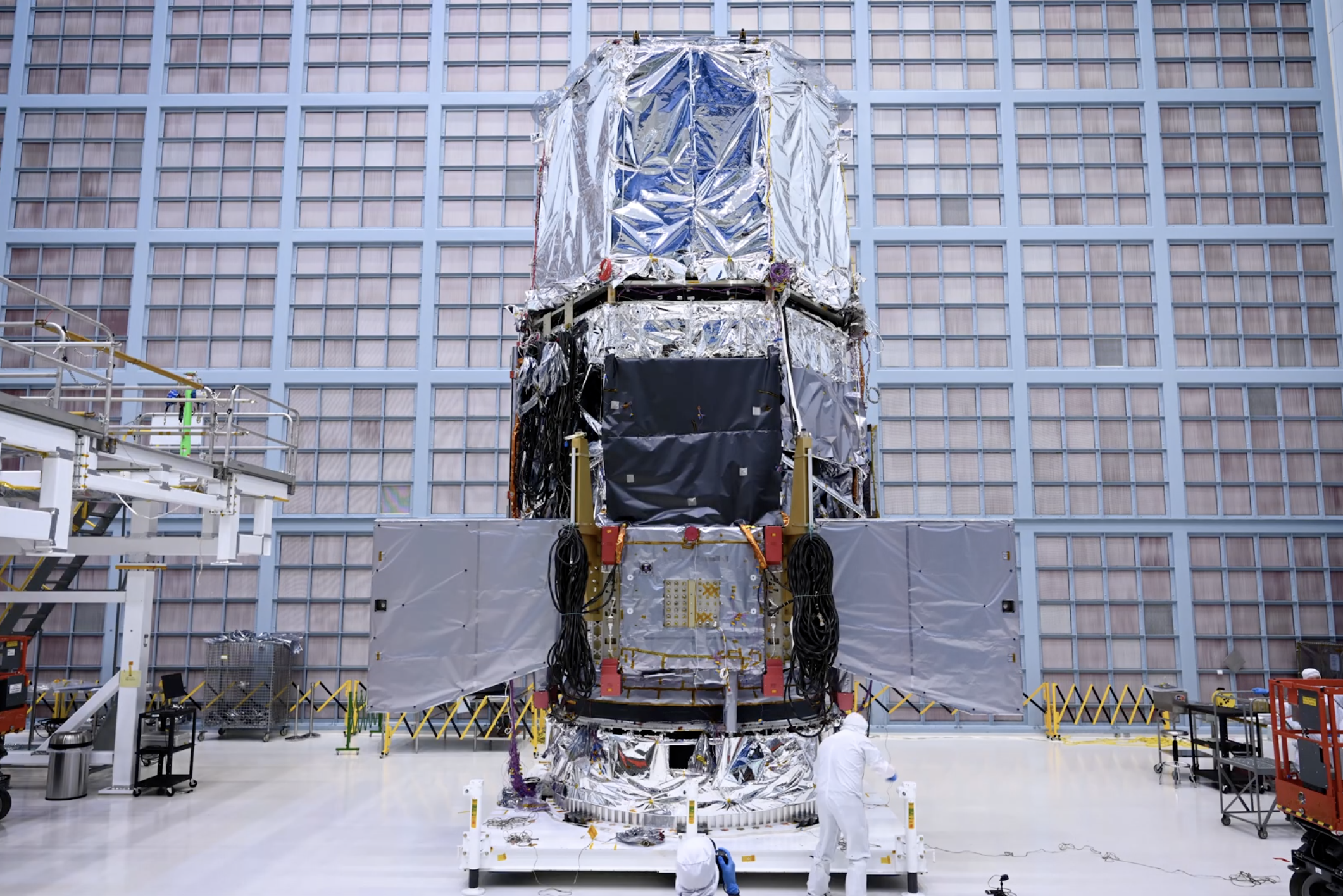
In a recent development for space exploration technology, NASA technicians have achieved a significant milestone by successfully installing two critical sunshields on the Nancy Grace Roman Space Telescope. These sunshields are part of the telescope’s inner segment and are collectively known as the Lower Instrument Sun Shade. They, along with the Solar Array Sun Shield and Deployable Aperture Cover, play an essential role in maintaining the telescope’s instruments at an optimal temperature and stability as it embarks on its mission to investigate the infrared universe.
The sunshields act much like a powerful sunscreen for the telescope’s sensitive instruments, shielding them from the Sun’s intense heat and light. Without this protection, the instruments would be overwhelmed, impairing their ability to detect faint cosmic signals. Matthew Stephens, an aerospace engineer at NASA’s Goddard Space Flight Center, illustrated the sunshield’s function by describing it as a robust barrier that guards against the Sun’s potentially disruptive influence.
The sunshade is an ingenious extension of the telescope’s solar panels, though it lacks solar cells. Designed and constructed at NASA Goddard, each flap of the sunshade measures approximately 7 by 7 feet, akin to the size of a garage door, and is 3 inches thick. Conrad Mason, another aerospace engineer at NASA Goddard, described the sunshields as "giant aluminum sandwiches." They consist of metal sheets no thicker than a credit card on both the top and bottom, with a honeycomb structure making up the core. This design ensures that the panels are both lightweight and rigid.
An engineering marvel, the material used for these panels significantly reduces heat transfer. The front side of the sunshields will face temperatures high enough to boil water, reaching up to 216 degrees Fahrenheit (102 degrees Celsius), while the rear side will remain much colder than the coldest Antarctic winter, dropping to minus 211 Fahrenheit (minus 135 Celsius). To manage this extreme temperature difference, each panel is enveloped in a specialized polymer film blanket. This blanket includes 17 layers on the Sun-facing side and a single layer on the shaded side.
The sunshade is designed to deploy smoothly about an hour after launch. The deployment mechanisms are equipped with dampers, similar to soft-close hinges found in drawers or cabinets. This feature ensures a gentle and controlled deployment, preventing any jarring or shaking of the observatory. Each panel takes around two minutes to reach its final position, marking the first system deployment after the spacecraft separates from the launch vehicle.
With the inner segment of the Roman Space Telescope now fully assembled, the next step involves a 70-day thermal vacuum test. This rigorous testing phase will evaluate the complete functionality of the spacecraft, telescope, and instruments under simulated space conditions. After this test, the sunshade will be temporarily removed to facilitate the joining of Roman’s outer and inner assemblies. Once reattached, the observatory will be complete. The team remains on track for a launch by May 2027, with an optimistic target of as early as fall 2026.
For those interested in visualizing these developments, NASA’s Scientific Visualization Studio has made available high-resolution videos and images, providing a closer look at the technical intricacies involved in this monumental project.
The Nancy Grace Roman Space Telescope is managed by NASA’s Goddard Space Flight Center in Greenbelt, Maryland, with contributions from NASA’s Jet Propulsion Laboratory in Southern California, Caltech/IPAC in Pasadena, California, and the Space Telescope Science Institute in Baltimore. The project also benefits from the expertise of a diverse science team, comprising scientists from various research institutions. Key industrial partners include BAE Systems Inc. in Boulder, Colorado; L3Harris Technologies in Rochester, New York; and Teledyne Scientific & Imaging in Thousand Oaks, California.
This milestone in the construction of the Roman Space Telescope not only marks progress in its journey towards launch but also signifies a leap forward in our ability to explore the universe. By providing a clear window into the cosmos through the infrared spectrum, the Roman Space Telescope is set to unravel some of the deepest mysteries of space, offering insights that could redefine our understanding of the universe.
For more Information, Refer to this article.