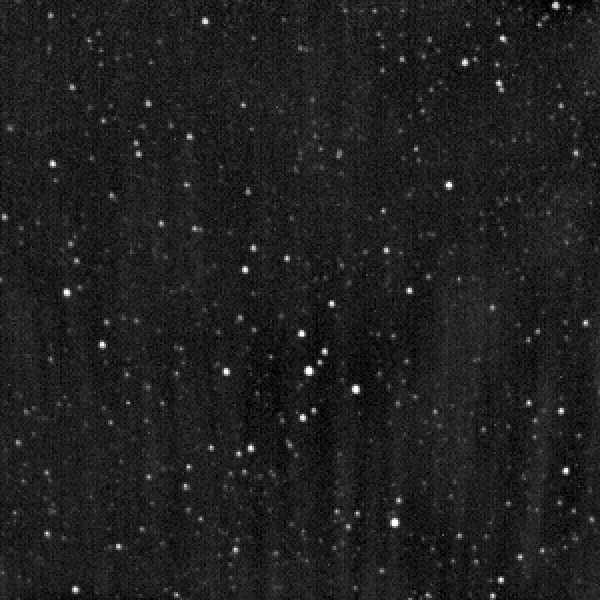
NASA’s Europa Clipper Spots Uranus En Route to Jupiter
In an intriguing development from space exploration, NASA’s Europa Clipper spacecraft recently captured an image of the distant planet Uranus while it was testing one of its stellar reference units. These star-tracking cameras are crucial for the spacecraft’s navigation and orientation, ensuring it remains on course during its long journey. The image, taken on November 5, 2025, showcases Uranus as a notable, larger dot on the left side of the frame, amidst a stunning starfield.
As the Europa Clipper continues its voyage, it finds itself approximately 2 billion miles (or 3.2 billion kilometers) from Uranus. This vast distance highlights the immense scope of space travel and the advanced technology involved in such missions. The Europa Clipper is on a mission to the Jupiter system, specifically to study Europa, one of its moons, which is enveloped in a thick layer of ice.
Mission Overview: A Journey to Europa
Launched in October 2024, the Europa Clipper is expected to arrive in the Jupiter system by 2030. During its mission, the spacecraft will perform around 50 flybys of Europa. The primary scientific objective of these flybys is to ascertain whether there are environments beneath Europa’s icy surface that could potentially support life. This makes the mission not only a study of another celestial body but also a quest to answer one of humanity’s most profound questions: Are we alone in the universe?
The mission is structured around three core scientific goals:
1. Investigating Europa’s Icy Shell
One of the main objectives is to determine the thickness of Europa’s icy shell. Understanding the dynamics between the ice surface and the ocean believed to exist beneath it will provide insights into how the surface interacts with potential liquid water below. This could reveal how nutrients and energy might be transferred from the surface to the ocean, creating conditions that could support life.
2. Compositional Analysis
Another critical aim is to analyze the composition of Europa’s surface. By studying the chemical makeup of the ice and any material expelled from the subsurface, scientists hope to gather clues about the moon’s potential for harboring life. This analysis will also enhance our understanding of the processes shaping Europa’s environment.
3. Geological Characterization
The mission also seeks to characterize Europa’s geology. Understanding the moon’s surface features and geological history can provide context for its current state and its potential for life. This involves mapping Europa’s terrain, identifying any active geological processes, and assessing the moon’s overall structure.
The Astrobiological Implications
Europa is considered one of the most promising places in our solar system to search for extraterrestrial life. Its subsurface ocean, which is potentially twice the volume of Earth’s oceans, might harbor the conditions necessary for life as we know it. By studying Europa, scientists hope to gain a better understanding of the astrobiological potential of other moons and planets, expanding our knowledge of where life might exist beyond Earth.
The mission’s findings could have significant implications for future explorations and the search for life beyond our planet. If Europa’s ocean is found to be habitable, it would suggest that similar environments could exist elsewhere, perhaps even within our own solar system.
Technical Insight: Stellar Reference Units
The recent capture of Uranus by the Europa Clipper’s stellar reference unit underscores the importance of these instruments for space navigation. Stellar reference units are sophisticated cameras that track the positions of stars, allowing the spacecraft to maintain its orientation in the vastness of space. This technology is crucial for long-duration missions like Europa Clipper, ensuring that the spacecraft remains on its correct path throughout its journey.
These units work by continuously comparing the observed positions of stars with onboard star maps, adjusting the spacecraft’s orientation as necessary. This capability is vital for the precise maneuvers needed during the flybys of Europa, where accurate data collection is crucial.
Public and Scientific Community Reactions
The scientific community and the general public have shown great enthusiasm for the Europa Clipper mission. The possibility of discovering life-supporting environments on Europa has captured the imagination of many, and each new development in the mission is eagerly anticipated.
Scientists are hopeful that the mission will yield groundbreaking results, providing data that could redefine our understanding of where life might exist. Public interest is also high, with many seeing the mission as a bold step in humanity’s exploration of the cosmos.
Conclusion: A Step Towards Unveiling the Mysteries of Europa
The Europa Clipper mission marks a significant milestone in space exploration, with its ambitious goal of uncovering the mysteries of one of Jupiter’s most intriguing moons. As it continues its journey, the spacecraft not only aims to answer questions about Europa but also to expand our understanding of the potential for life elsewhere in the universe. With each new discovery, we move closer to unraveling the secrets of our solar system and perhaps even finding that we are not alone. For more detailed insights into the mission, you can visit the original source.
For more Information, Refer to this article.