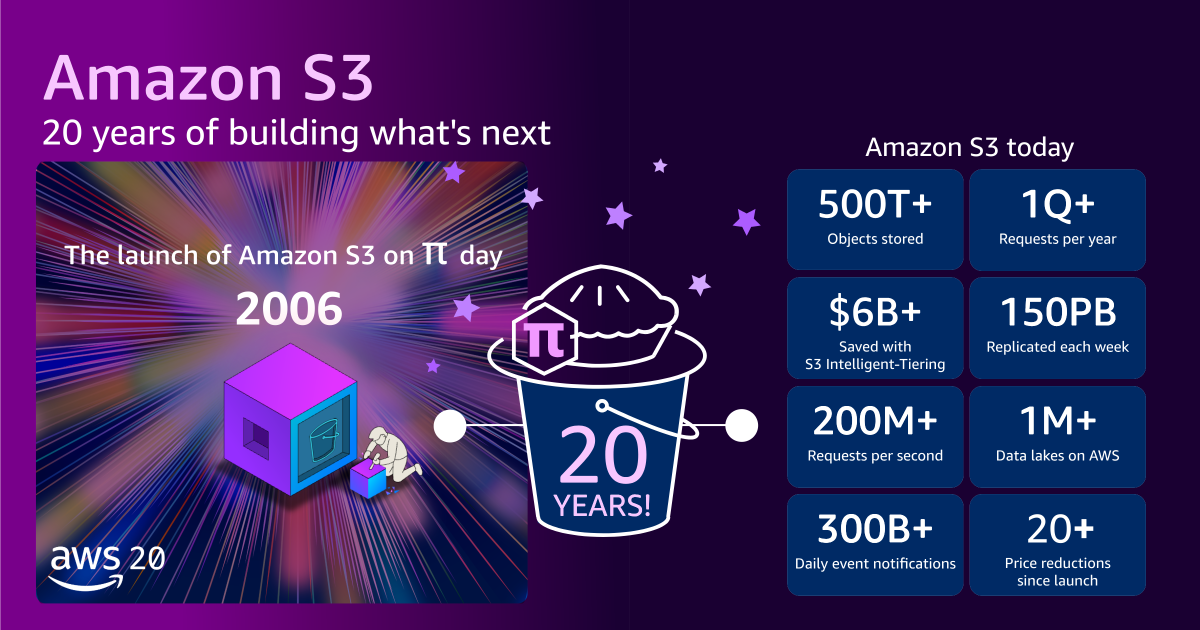
Amazon Simple Storage Service (Amazon S3), commonly known as S3, celebrated its 20th anniversary on March 14, 2006. This cloud storage service was launched with a simple announcement on the What’s New page of the Amazon Web Services (AWS) website. The announcement highlighted S3 as a storage solution designed to make web-scale computing easier for developers by providing a simple interface to store and retrieve data from anywhere on the web.
The early days of S3 focused on providing building blocks that handled the heavy lifting of data storage, allowing developers to concentrate on higher-level tasks. The service was built on five core principles: Security, Durability, Availability, Performance, and Elasticity. These principles ensured that data stored on S3 was secure, durable, always available, high-performing, and could scale automatically without manual intervention.
Over the past two decades, S3 has grown exponentially in terms of storage capacity, object count, and global reach. Initially offering one petabyte of storage capacity, S3 now stores over 500 trillion objects and serves more than 200 million requests per second globally. The maximum object size supported by S3 has increased from 5 GB to 50 TB, enabling customers to store and retrieve large amounts of data efficiently.
Despite the massive scale of S3, the pricing has significantly reduced over the years, with AWS now charging slightly over 2 cents per gigabyte. This price reduction, coupled with the introduction of storage tiers like Amazon S3 Intelligent-Tiering, has helped customers save billions of dollars in storage costs.
One of the key factors contributing to the success of S3 is its API, which has become a standard reference point in the storage industry. Multiple vendors offer S3-compatible storage tools and systems, allowing seamless integration with existing S3 workflows and reducing the barrier to entry for new users.
The engineering behind S3’s scalability involves continuous innovation and rigorous testing. Engineers use formal methods and automated reasoning to ensure data integrity and correctness at scale. Performance-critical code in the S3 request path has been rewritten in Rust, a programming language known for its memory safety and performance benefits.
Looking ahead, the vision for S3 extends beyond being a storage service to becoming the universal foundation for all data and AI workloads. Recent launches like S3 Tables, S3 Vectors, and S3 Metadata aim to optimize query efficiency, support semantic search, and centralize metadata for instant data discovery.
From its humble beginnings to becoming a cornerstone of cloud computing, Amazon S3 has remained true to its core principles of security, durability, availability, performance, and elasticity. As we celebrate 20 years of innovation on S3, we look forward to the next chapter of advancements and developments in cloud storage technology.
Here’s to the next 20 years of innovation on Amazon S3!
For more Information, Refer to this article.