
















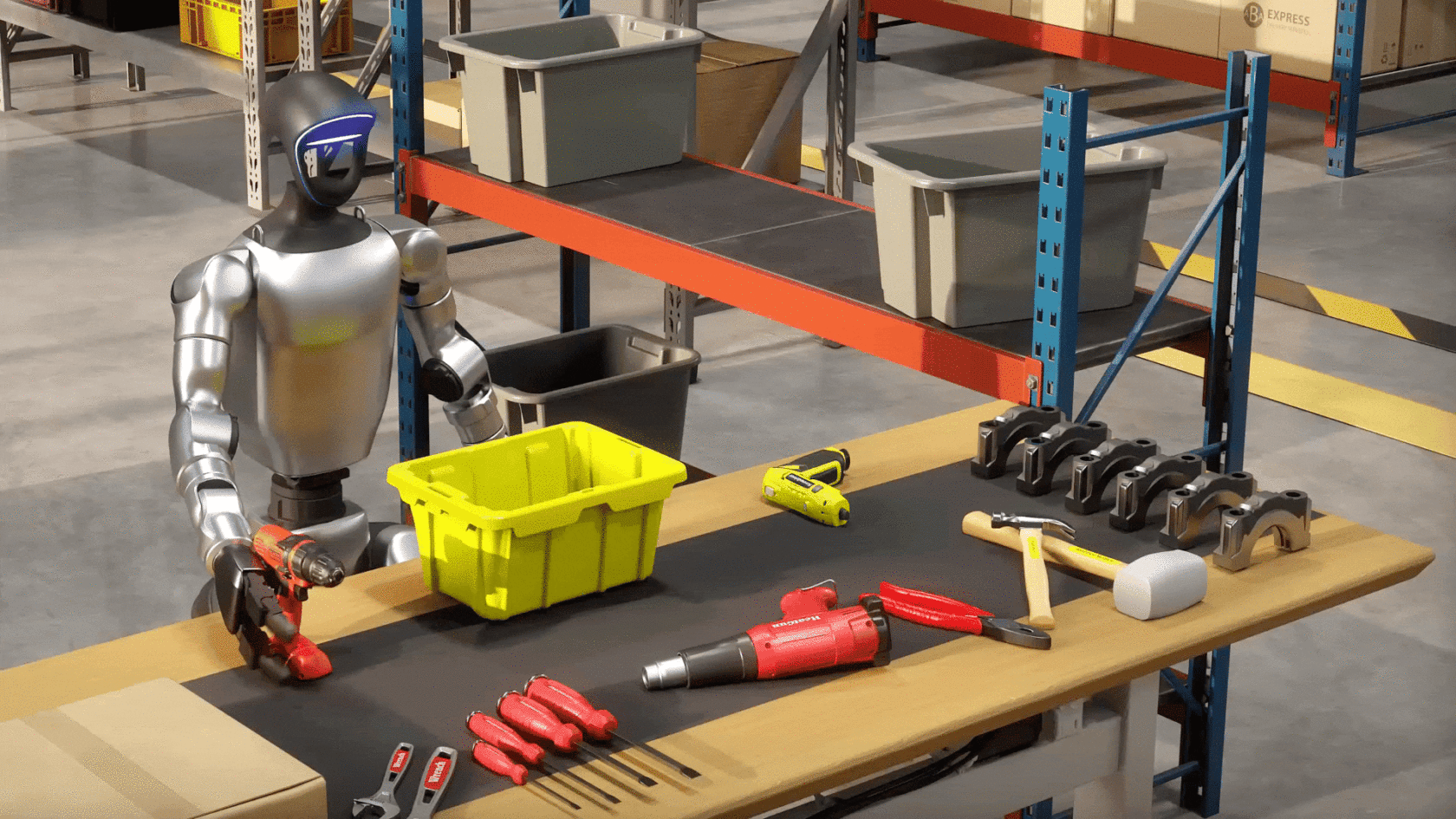
The future of robotics is evolving, with the emergence of the next generation of robots known as generalist-specialists. These robots are designed to be versatile, capable of learning a wide range of skills while also excelling in specialized tasks. They are like jacks of all trades that can also master specific jobs.
Creating these advanced robots requires a seamless integration of cloud-to-robot workflows that facilitate the collection and generation of data, training and evaluation of control policies, and safe deployment onto physical machines. These generalist-specialist systems rely on reasoning vision language action (VLA) models to perceive, understand, and act intelligently across various tasks.
To drive this transformation, the NVIDIA Isaac platform offers robotics developers a comprehensive set of tools, including models, data pipelines, simulation frameworks, and runtime libraries. This platform empowers developers to build and deploy robots at scale using NVIDIA’s three-computer solution. Additionally, NVIDIA provides an open VLA model called NVIDIA Isaac GR00T, which serves as a robust foundation for developers to bootstrap and post-train their own robotic intelligence.
These models, libraries, and frameworks can operate in the cloud or on edge AI infrastructure, and they can now be further enhanced with the integration of long-running agents like OpenClaw. With the introduction of the latest agent-friendly NVIDIA Isaac GR00T models, Isaac robot simulation, learning frameworks, and edge AI systems, NVIDIA is equipping developers with powerful tools for the generalist-specialist era of autonomy.
The workflows provided by NVIDIA are open and composable, allowing developers to mix and match components, bring their own tools and data, and accelerate their pipeline from prototype to real-world deployment. Agility Robotics, for example, leverages NVIDIA Isaac open frameworks to transition its robots from simulation to reality, showcasing the practical application of these advanced technologies.
A significant aspect of developing these next-generation robots involves the generation of data to train and enhance their capabilities. NVIDIA’s open libraries and frameworks streamline this process by combining real-world signals with simulation-generated data. By generating high-fidelity synthetic data, robotics developers can overcome the limitations of physical data collection and prepare their robots for deployment in unpredictable real-world environments.
Synthetic data plays a crucial role in AI training, with an expected increase in its utilization for edge scenarios from 20% currently to more than 90% by 2030. NVIDIA is at the forefront of driving this shift, providing libraries and open frameworks that enable the creation of realistic synthetic data based on the physical world. The NVIDIA Omniverse NuRec accelerated 3D Gaussian splatting libraries, now available for general use, facilitate the conversion of real-world sensor data into interactive simulations in NVIDIA Isaac Sim.
Moreover, NVIDIA’s collaboration with FieldAI underscores the potential for industrial applications, where the integration of world-class robot foundation models enables the seamless deployment of robotics and physical AI into various workflows. The combination of real data collection through teleoperation devices and the use of the NVIDIA Isaac Teleop tool enhances the training process for robots in simulation environments like NVIDIA Isaac Lab.
To accelerate data augmentation, evaluation, and orchestration for robotics, NVIDIA has introduced the NVIDIA Physical AI Data Factory Blueprint. This reference workflow, powered by NVIDIA Cosmos world foundation models and NVIDIA OSMO, offers a scalable data engine for robotics, enabling developers to create diverse synthetic scenarios efficiently.
In the realm of simulation, NVIDIA Isaac Sim emerges as a vital tool for developers to simulate both the environment and the robot itself. By offering a wide range of humanoid, autonomous mobile robot, and robot arm models, developers can rig these virtual models to real-world specifications and interact with them in simulated environments using tools like PTC Onshape.
The simulation process is further enhanced by the integration of physics engines like NVIDIA PhysX and Google DeepMind’s Mujoco in Isaac Sim and Isaac Lab. These engines enable developers to simulate how robots interact with various objects and terrains, ensuring realistic behavior and movement patterns.
Training robots to perform specific tasks involves post-training the reasoning VLAs with task-specific data. With frameworks like Isaac Lab 3.0, robots can engage in thousands of lightweight, physically based simulation environments simultaneously, enabling rapid learning and skill acquisition. This approach significantly accelerates the learning process, allowing robots to master a wide range of tasks in a fraction of the time it would take in the real world.
To ensure that simulation-based training translates effectively to real-world applications, developers can leverage tools like Newton, an open-source physics engine for robot learning. By using different physics solvers to compute how objects move and interact, developers can simulate complex scenarios where robots interact with soft objects or traverse challenging terrains.
The NVIDIA Isaac libraries and AI models offer essential building blocks for manipulation and mobility tasks, optimized for runtime deployment at the edge. These tools enable robots to perceive and grasp objects, as well as localize and navigate safely in dynamic environments.
As robots become more capable and advanced, researchers require flexible workflows to iterate on existing skills efficiently. NVIDIA’s SOMA-X research framework standardizes the representation of skeletons, motion, and identity across AI, simulation, and real robots. This standardization streamlines the process of integrating new body models, datasets, or hardware advancements, ensuring stability and compatibility across different platforms.
Safety is a paramount concern in the development and deployment of robotics. NVIDIA offers safety tooling like NVIDIA Halos, which provides a comprehensive safety system for the development and deployment of robots. Additionally, starter resources like the NVIDIA GR00T X-Embodiment dataset and educational materials from the NVIDIA Deep Learning Institute help robotics developers enhance their skills and knowledge.
In conclusion, the advancements in robotics technology driven by NVIDIA’s innovative platforms and tools are shaping the future of automation and autonomy. By providing developers with the necessary resources, frameworks, and solutions, NVIDIA is empowering them to create intelligent, versatile robots that can operate effectively in diverse real-world environments. As the robotics industry continues to evolve, NVIDIA remains at the forefront, driving innovation and enabling the next generation of robots to thrive.
For more Information, Refer to this article.