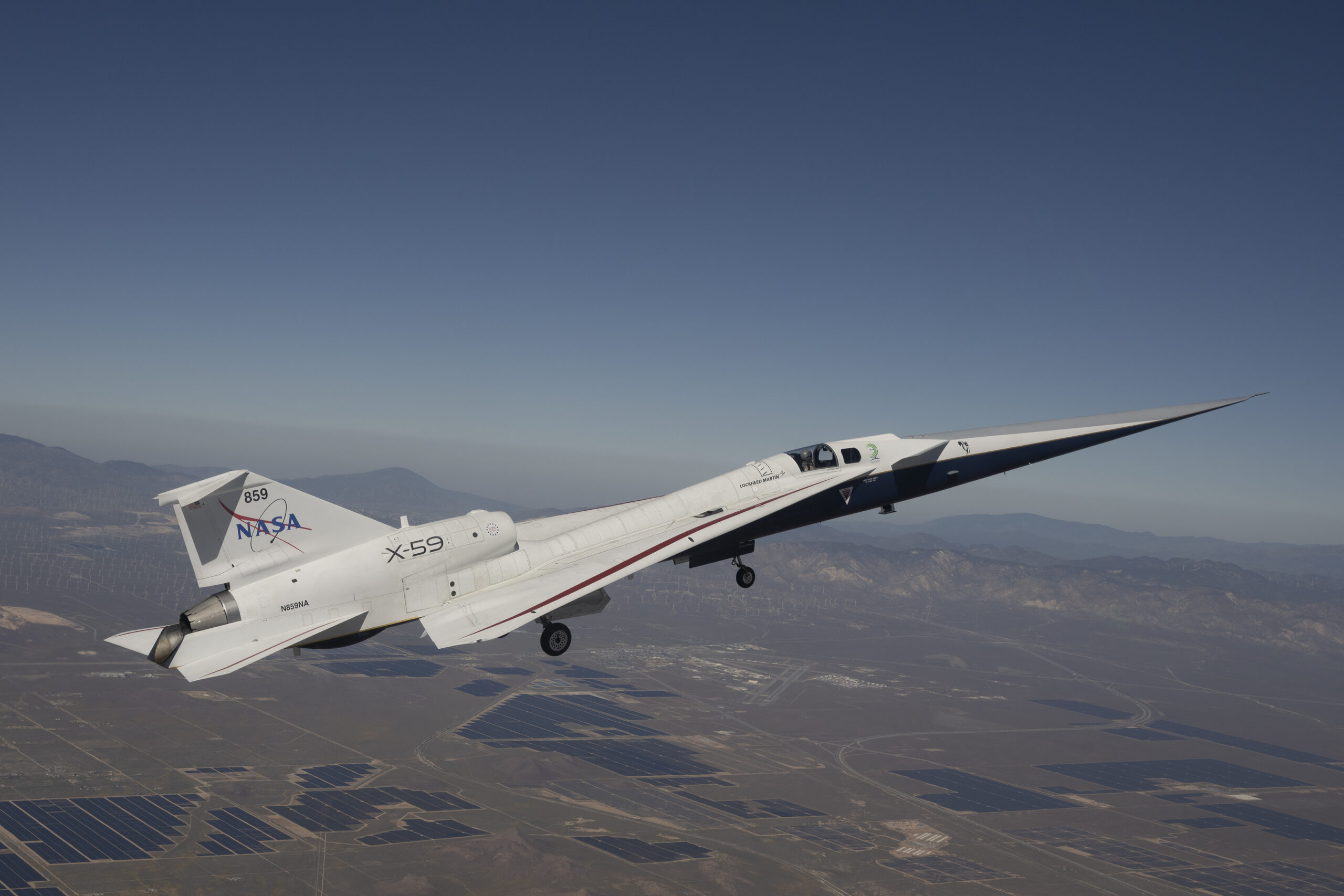
NASA’s cutting-edge X-59 aircraft recently completed its second test flight, marking the beginning of a series of extensive test flights scheduled for 2026. Despite a minor technical issue that led to an early landing, the team managed to gather valuable data that will be crucial for future tests.
Cathy Bahm, the project manager for NASA’s Low-Boom Flight Demonstrator at NASA’s Armstrong Flight Research Center, expressed optimism about the outcome of the flight. She mentioned, “Despite the early landing, this is a good day for the team. We collected more data, and the pilot landed safely. We’re looking forward to getting back to flight as soon as possible.”
The X-59 aircraft took off from Edwards Air Force Base, near NASA Armstrong, at 10:54 a.m. PDT. However, during the flight, pilot Jim “Clue” Less encountered a system warning in the aircraft’s cockpit, leading to a prompt return-to-base. Less reassured, “As we like to say, it was just like the simulator – and that’s what we like to hear. This is just the beginning of a long flight campaign.”
The main goal of the X-59 aircraft is to achieve supersonic flight, where it travels faster than the speed of sound, while producing minimal noise disturbance compared to traditional sonic booms. This advanced aircraft plays a pivotal role in NASA’s Quesst mission, which aims to make commercial supersonic travel over land a reality.
In the upcoming year, the X-59 will undergo rigorous testing to demonstrate its performance and airworthiness through a process called envelope expansion. This process involves gradually increasing the aircraft’s speed and altitude until it reaches supersonic velocities.
The development of the X-59 aircraft represents a significant step forward in the field of aviation technology. By conducting these test flights and gathering valuable data, NASA is paving the way for the future of supersonic travel. The success of the X-59 project could revolutionize the way we approach commercial aviation, making faster and more efficient travel a reality for passengers around the world.
As we look ahead to the upcoming test flights in 2026, the aerospace industry eagerly anticipates the advancements that will be made through the innovative technology of the X-59 aircraft. With each successful test flight, we come closer to achieving the goal of commercial supersonic flight over land, bringing us one step closer to a faster and more connected world.
In conclusion, the recent test flight of NASA’s X-59 aircraft marks a significant milestone in the development of supersonic travel technology. With each successful flight, the team gathers valuable data that will inform future tests and bring us one step closer to making commercial supersonic flight a reality. Keep an eye on the skies as we witness the exciting advancements in aviation technology unfold.
For more Information, Refer to this article.