NASA’s GUARDIAN Technology Detects Tsunamis in Real Time
A groundbreaking new data visualization created by NASA demonstrates how their experimental technology, known as GUARDIAN (GNSS Upper Atmospheric Real-time Disaster Information and Alert Network), can provide crucial extra time for communities facing the threat of a tsunami. This innovative software utilizes satellite navigation signals to detect subtle distortions that indicate the presence of moving hazards.
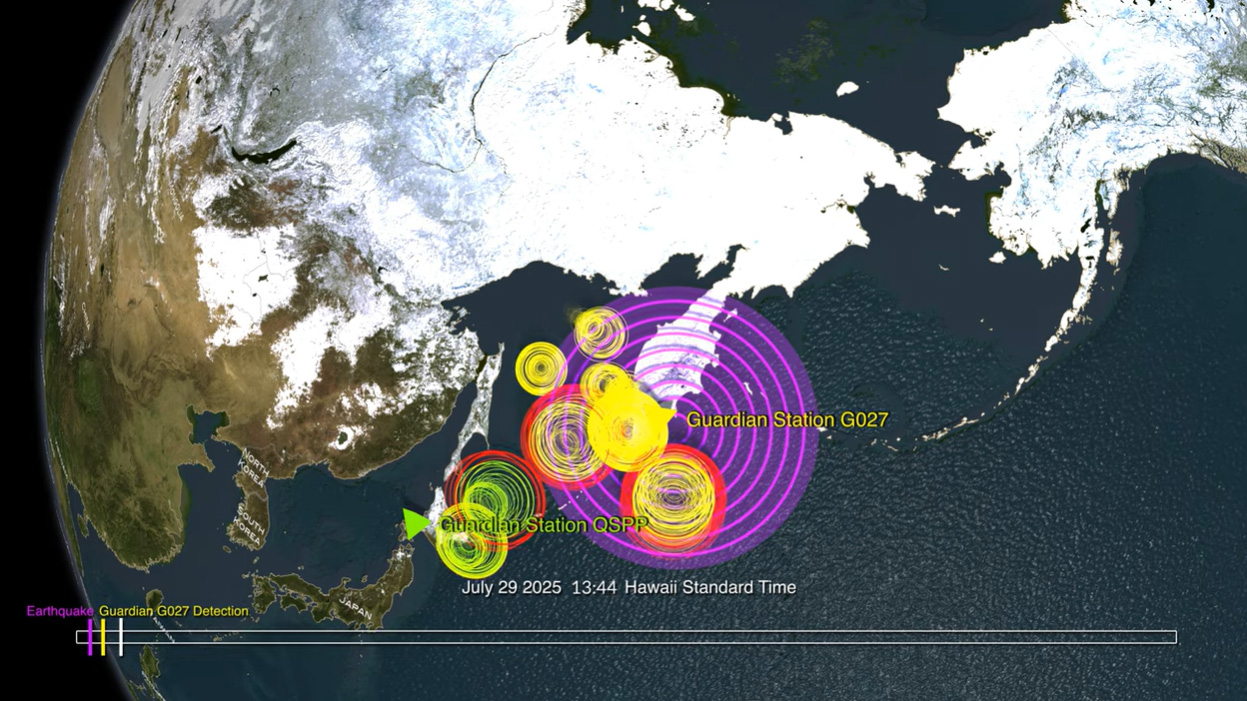
The animation featured in the visualization offers a detailed analysis of a real-life scenario involving the massive Kamchatka earthquake that struck off the coast of Russia on July 29, 2025. The earthquake, with a magnitude of 8.8, triggered a powerful tsunami that raced across the Pacific Ocean at speeds exceeding 500 mph (805 kph) towards Hawaii. The visualization highlights the earthquake in purple and showcases real-time readings from ground stations monitoring GPS and other satellite signals in red, orange, yellow, and green ringlets. Thanks to GUARDIAN’s advanced detection algorithms, these disturbances were identified as early as eight minutes after the earthquake occurred.
Over the following hours, GUARDIAN continued to track the progress of the tsunami across the Pacific Ocean in near real time. Impressively, the system detected an incoming wave approaching the coast of Kauai 32 minutes before it reached land and was officially recorded by tide gauges. This early detection capability demonstrates the potential of GUARDIAN to enhance existing tsunami warning systems and provide valuable lead time for at-risk communities.
Camille Martire, one of the developers of GUARDIAN at NASA’s Jet Propulsion Laboratory in Southern California, emphasized the system’s ability to complement existing early warning systems. Currently, the process of determining whether an earthquake has generated a tsunami presents significant challenges. Forecasters typically rely on seismic data and computer simulations to predict potential tsunamis, followed by confirmation from pressure sensors on the ocean floor. While these sensors are effective, they are costly and not widely distributed, leaving gaps in coverage that can lead to delays in issuing warnings.
Unlike traditional methods, GUARDIAN leverages existing data from GPS and other satellite constellations that make up the Global Navigation Satellite System, offering a cost-effective and complementary approach to tsunami detection. The system is accessible for free, although it is currently best suited for analysts with the expertise to interpret its findings.
The operation of GUARDIAN relies on data collected from over 350 GNSS ground stations located around the Pacific Ring of Fire, a region known for its seismic activity and tsunami risk. In addition to monitoring tsunamis, GUARDIAN can also detect earthquakes, volcanic eruptions, missile tests, spacecraft reentries, and meteoroid impacts. By utilizing signals from satellite navigation systems, GUARDIAN can identify disturbances caused by these events and provide critical information to help communities prepare and respond effectively.
The development of GUARDIAN is spearheaded by the GDGPS project at NASA’s Jet Propulsion Laboratory, with support from NASA’s Space Geodesy Project. This innovative technology has the potential to revolutionize early warning systems for natural disasters and provide communities with valuable time to take necessary precautions in the event of a crisis.
To learn more about the GUARDIAN technology and its capabilities, visit the official website at https://guardian.jpl.nasa.gov/.
In conclusion, NASA’s GUARDIAN technology represents a significant advancement in tsunami detection and early warning systems. By harnessing the power of satellite navigation signals and artificial intelligence, GUARDIAN offers a cost-effective and efficient solution for monitoring potential hazards and providing timely alerts to at-risk communities. With its ability to detect a wide range of natural disasters, GUARDIAN has the potential to save lives and mitigate the impact of catastrophic events.
For more Information, Refer to this article.