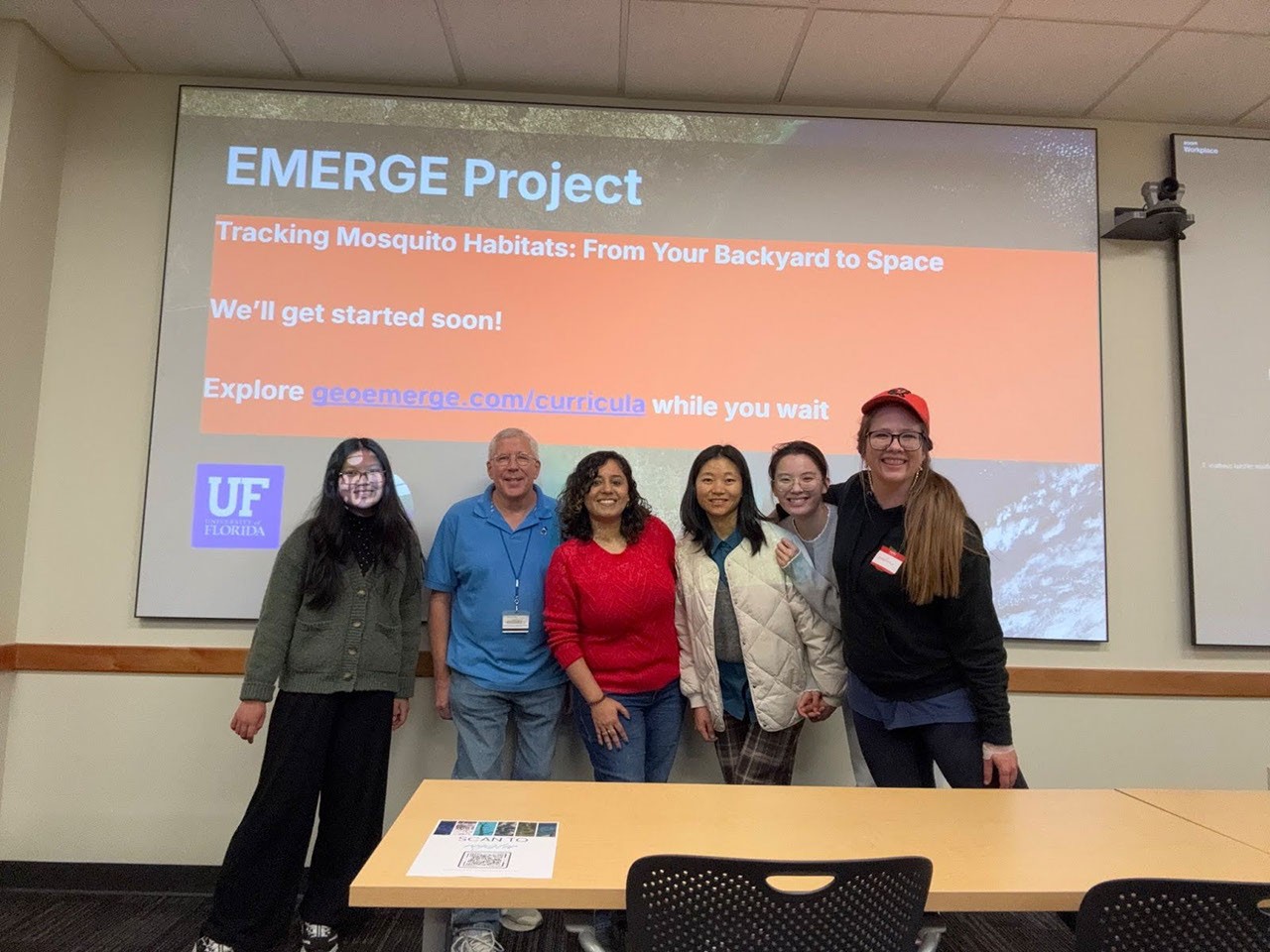
Students, researchers, and community members recently gathered at the University of Florida’s Marston Science Library for the Environmental Monitoring through Education, Research, and Geospatial Engagement (EMERGE) NASA Data Hackathon. This event aimed to empower individuals to engage in public health and environmental science using real-world data tools and citizen science. At the heart of the EMERGE initiative is NASA’s Global Learning & Observations to Benefit the Environment (GLOBE) Observer app, which allows smartphone users to collect data on mosquito habitats, land cover, clouds, and more.
Throughout the day, participants transformed environmental data into maps, dashboards, and infographics to support public health and environmental decision-making. The event was organized by the Geospatial Digital Informatics Lab, SciStarter, and Florida Community Innovation, with support from NASA and UF Libraries.
During the hackathon, attendees had the opportunity to work with volunteer-collected datasets and understand how local observations contribute to global research. Participants were provided with a digital textbook created by the GeoDI Lab to guide them on downloading, processing, visualizing, and analyzing GLOBE Observer data. Thirteen teams collaborated to analyze GLOBE data and propose improvements to data collection through the app.
The hackathon concluded with the recognition of winners in various categories, including App Improvement, Advanced Track, Intermediate Track, Beginner Track, and Field Track. Projects like “Mosquito Tracker” and “Epidemiological Vector Mapping System” were highlighted for their innovative approaches to utilizing GLOBE Observer data.
For those interested in civic tech and community-centered research, the Florida Community Innovation (FCI) invites participation in building tools, maps, and public resources. FCI partners with students and community members year-round to create accessible solutions and welcomes collaborators from diverse backgrounds. Individuals can join FCI by visiting their website and attending Wednesday meetings to get involved in projects.
To engage in NASA science from anywhere, individuals can download the GLOBE Observer app to contribute data on mosquito habitats and land cover. The EMERGE program, supported by NASA’s Citizen Science Seed Funding Program, aims to facilitate the use of citizen science techniques by scientists in their research.
Overall, the EMERGE NASA Data Hackathon at UF provided a platform for participants to leverage real-world data for environmental research and public health initiatives. By combining technology, community engagement, and citizen science, the event showcased the power of collaboration in addressing environmental challenges.
For more information on the EMERGE program and future events, visit the official website: https://geoemerge.com/nasa-at-uf.
For more Information, Refer to this article.