























NASA’s IXPE (Imaging X-ray Polarimetry Explorer) mission has recently captured a new observation of a supernova known as RCW 86, shedding light on the mysteries surrounding this celestial event. This new observation adds to the wealth of data gathered by various telescopes, including NASA’s Chandra X-ray Observatory.
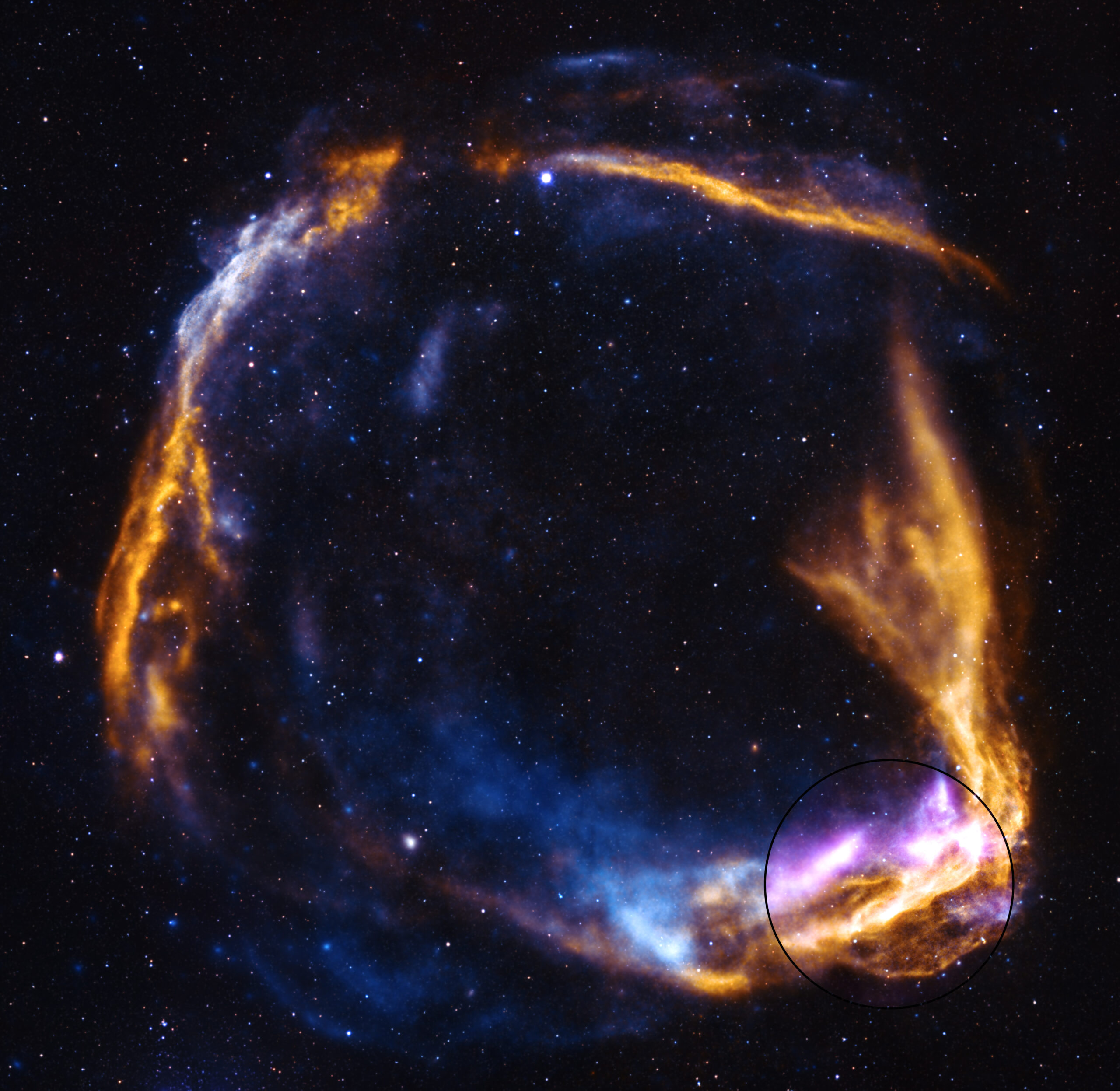
Astronomers utilizing the Chandra X-ray Observatory previously focused on RCW 86 and made a fascinating discovery. They found a large “cavity” region surrounding the system, which caused the supernova to expand at a faster rate than anticipated. This low-density cavity region may have played a role in shaping the unique appearance of RCW 86. The recent observation by IXPE focused on the outer rim of the supernova, where it is believed that the expansion came to a halt at the edge of the cavity. This phenomenon created a reflected shock effect, as indicated by the purple highlighting in the image.
The comprehensive image combines data from IXPE with observations from two other X-ray telescopes: NASA’s Chandra and the European Space Agency’s XMM-Newton telescope. The yellow portions of the image represent low-energy X-rays, while the blue areas indicate high-energy X-rays detected by Chandra and XMM-Newton. The starfield visible in the image is courtesy of the National Science Foundation’s National Optical-Infrared Astronomy Research Laboratory (NOIRLab).
The IXPE mission, a collaborative effort between NASA and the Italian Space Agency, with contributions from partners and science collaborators in 12 countries, continues to provide invaluable data that leads to groundbreaking discoveries about celestial objects throughout the universe. The mission is spearheaded by NASA’s Marshall Space Flight Center in Huntsville, Alabama. BAE Systems, Inc., based in Falls Church, Virginia, oversees spacecraft operations in conjunction with the University of Colorado’s Laboratory for Atmospheric and Space Physics in Boulder.
For more information on the ongoing mission of IXPE, visit the official NASA website at science.nasa.gov/mission/ixpe. This mission represents a significant step forward in our understanding of supernovae and the complex processes at play in the vast reaches of space. By studying events like RCW 86, scientists can gain insights into the life cycles of stars and the mechanisms that govern the evolution of celestial bodies.
The collaboration between different agencies and research institutions highlights the importance of international cooperation in advancing our knowledge of the cosmos. With each new observation and discovery, we come closer to unraveling the mysteries of the universe and expanding our understanding of the forces that shape the cosmos. The IXPE mission stands as a testament to the power of scientific collaboration and the quest for knowledge that drives humanity’s exploration of the cosmos.
For more Information, Refer to this article.