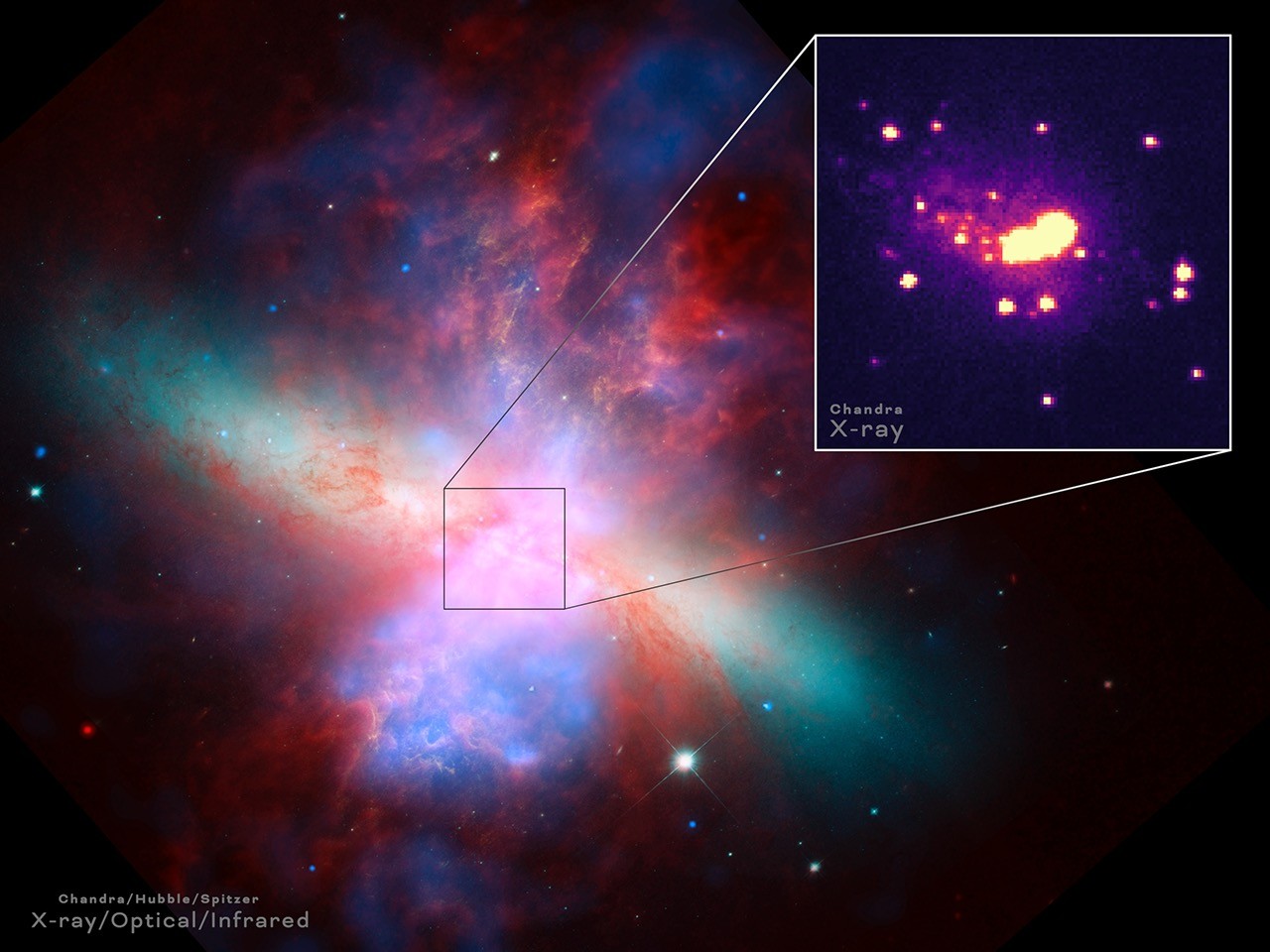
Astronomers have made a groundbreaking discovery by directly measuring the speed of superheated gas escaping from the heart of a galaxy known as M82. This galaxy, located 12 million light-years away, is experiencing an intense burst of star formation, causing the gas to move at speeds exceeding 2 million miles per hour.
The findings were made possible by the Resolve instrument aboard the XRISM spacecraft, which provided researchers with the necessary data to calculate the velocity of the gas. This measurement is crucial in understanding the mechanisms behind the formation of a massive wind that extends across the galaxy.
Previous models of starburst galaxies like M82 suggested that shock waves from star formation and supernovae heat up the gas near the center, initiating a powerful wind. However, until now, researchers lacked the ability to measure the velocities required to test this hypothesis. With the XRISM data, scientists were able to confirm that the gas is moving even faster than some models predicted, providing enough energy to drive the wind to the edge of the galaxy.
The study, led by astrophysicist Erin Boettcher and published in Nature, sheds light on the dynamics of starburst galaxies and the role of galactic winds in shaping their evolution. M82, also known as the Cigar galaxy, is forming stars at a rate ten times faster than the Milky Way, making it a prime target for studying such phenomena.
The extended wind of M82, which stretches out to 40,000 light-years, has been a subject of interest for scientists using various telescopes, including Chandra, Webb, Hubble, and Spitzer. By analyzing the X-ray signal from superheated iron in the galactic center, researchers were able to determine the temperature and speed of the hot wind.
The high resolution and sensitivity of the Resolve instrument allowed for precise measurements of the wind speed by examining the spectral lines of iron. These lines revealed the velocity of the wind, which was found to be slightly faster than expected. This, combined with the high temperature of the gas, indicated that the wind is capable of driving the larger, cooler wind observed in M82.
One of the intriguing questions raised by the study is the fate of the gas expelled from the galaxy. Researchers calculated that M82 expels enough gas each year to form seven stars the size of our Sun, yet there seems to be more gas moving outward than expected. This discrepancy poses a challenge for current models of galactic winds and highlights the need for further research.
The XRISM satellite’s observations of M82 are expected to provide valuable insights into the workings of starburst galaxies and help refine existing models. By collaborating on international projects like XRISM, NASA aims to push the boundaries of scientific discovery and deepen our understanding of the universe.
The study represents a significant step forward in our knowledge of galactic winds and their impact on the evolution of galaxies. By unlocking the secrets of M82’s hot wind, researchers are paving the way for a better understanding of the complex processes shaping our cosmic environment.
For more Information, Refer to this article.