






















NVIDIA recently showcased a significant advancement in physical AI during the GTC event. This development marks a shift from single-use cases to enterprise-level deployments across various industries. The focus is on cutting-edge models like NVIDIA Cosmos 3, NVIDIA Isaac GR00T N1.7, and NVIDIA Alpamayo 1.5.
In addition, NVIDIA introduced the NVIDIA Physical AI Data Factory Blueprint, which aims to enhance world modeling, humanoid skills, and autonomous driving. The blueprint also includes the NVIDIA Omniverse DSX Blueprint for AI factory digital twin simulation.
OpenClaw, an open-source agentic framework, extends the AI stack to operations, enabling autonomous execution of tasks on dedicated machines. This framework provides the tools necessary for creating secure AI assistants.
OpenUSD plays a crucial role in the scalability of physical AI by providing a common language for describing scenes. This allows teams to integrate CAD data, simulation assets, and real-world telemetry into a shared, accurate view of the world.
To simplify the design and deployment of AI factories, NVIDIA introduced the Omniverse DSX Blueprint. This reference architecture enables operators to optimize performance and efficiency through simulation before deploying real-world systems.
NVIDIA also unveiled the Physical AI Data Factory Blueprint, an open reference architecture that transforms compute into high-quality training data. This blueprint unifies data curation, augmentation, and evaluation into a single pipeline, enabling developers to generate diverse datasets from limited inputs.
Leading developers in the physical AI space, such as FieldAI, Hexagon Robotics, Linker Vision, Milestone Systems, Skild AI, and Teradyne Robotics, are already leveraging the blueprint to accelerate their projects.
Cloud platforms like Microsoft Azure and Nebius are the first to offer the blueprint, turning compute into data production engines for AI systems and robots.
The seamless conversion of CAD files to OpenUSD is essential for the physical AI pipeline. Companies like FANUC and Fauna Robotics are using tools like the NVIDIA Omniverse Kit and NVIDIA Isaac Sim to optimize 3D data for rendering and simulation.
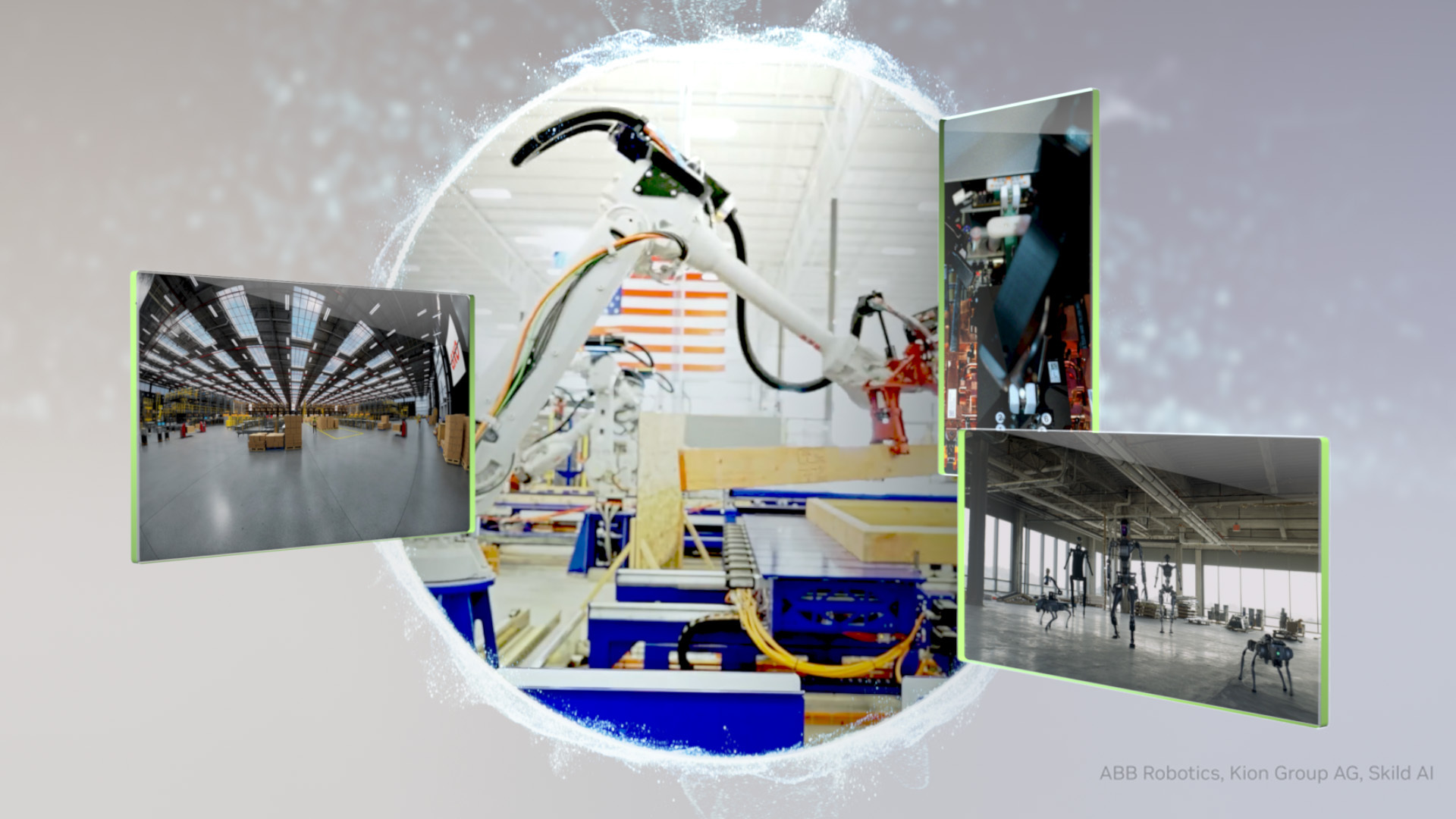
The NVIDIA Mega Omniverse Blueprint allows enterprises to design, test, and optimize robot fleets and AI agents in digital twins before deployment. KION is utilizing this blueprint to train autonomous forklifts for GXO, a leading logistics provider.
NVIDIA is collaborating with global robotics leaders like ABB Robotics, FANUC, KUKA, and Yaskawa to enhance production-level physical AI. These companies are using NVIDIA Omniverse libraries and Jetson modules to validate complex robot applications in digital twins.
Leading developers like FieldAI and Skild AI are building robot brains using NVIDIA Cosmos world models and Isaac simulation frameworks for data generation and policy validation.
Overall, NVIDIA’s advancements in physical AI are transforming the manufacturing and logistics industries through industrial digital twins. These developments are bridging the gap between simulation and real-world deployment, enabling faster and more efficient robotic systems.
For more information on NVIDIA’s announcements from GTC, visit their online press kit and watch the keynote replay. Catch up on the Physical AI Days sessions and developer livestream replay to stay updated on the latest developments in physical AI.
For more Information, Refer to this article.