

















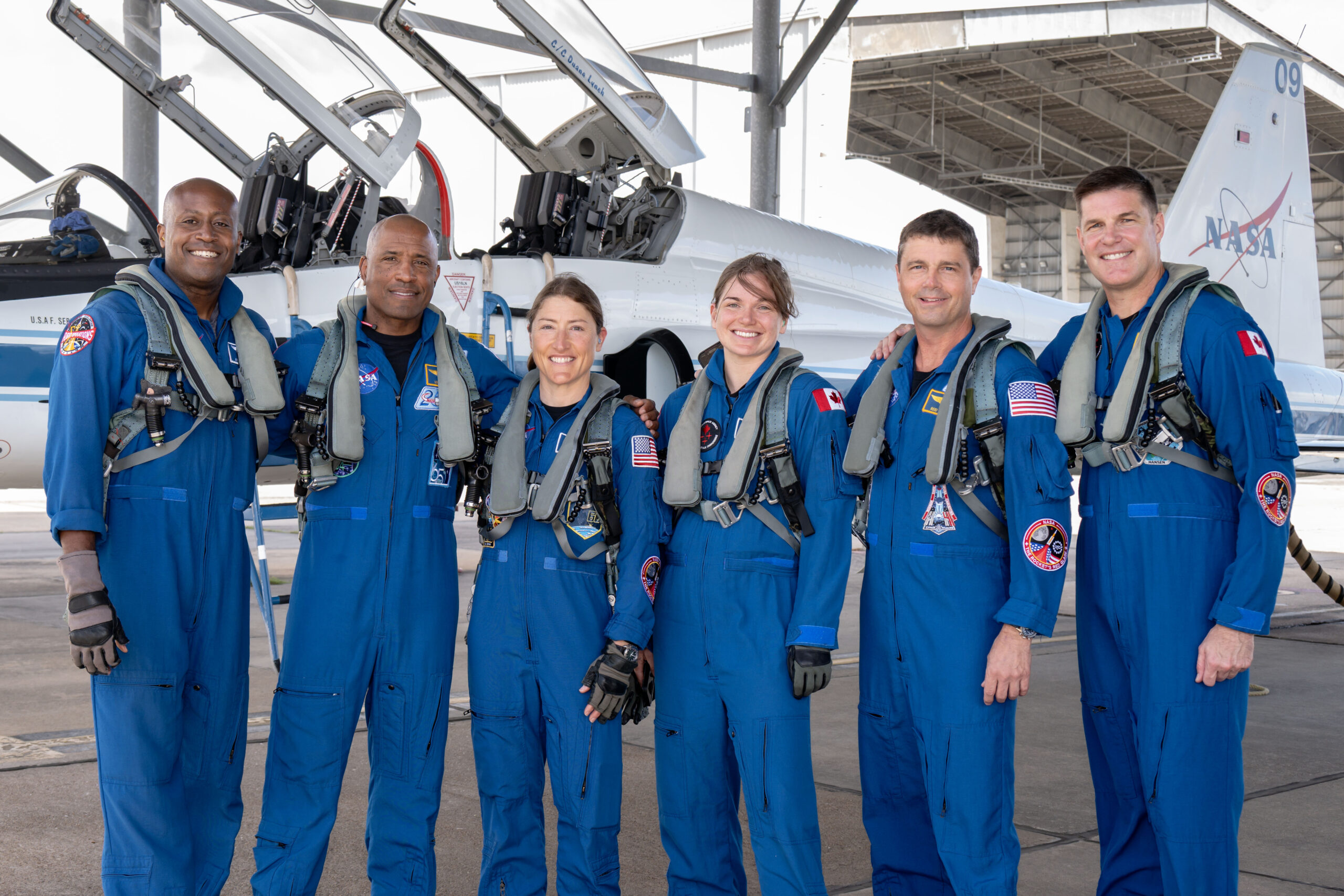
NASA astronauts Andre Douglas, Victor Glover, and Christina Koch, along with Canadian Space Agency (CSA) astronauts Jenni Gibbons, NASA astronaut Reid Wiseman, and CSA astronaut Jeremy Hansen, gathered for a photo before the Artemis II crew headed to a media event on March 27, 2026. Douglas and Gibbons are designated as the backup crew members for the mission, ready to step in if necessary.
Artemis II marks a significant milestone as NASA’s inaugural crewed mission within the Artemis program. Scheduled to launch from the Kennedy Space Center in Florida, the mission will take Wiseman, Glover, Koch, and Hansen on a thrilling 10-day voyage around the Moon. The primary objectives of the mission include testing the life support systems of the Orion spacecraft with crew members for the first time and laying the foundation for future crewed Artemis missions.
The Artemis program is NASA’s ambitious initiative to return humans to the Moon, with the ultimate goal of landing astronauts on Mars. By conducting missions like Artemis II, NASA aims to advance human exploration of space and develop technologies crucial for deep space travel.
The crew members of Artemis II are seasoned astronauts with extensive experience in space exploration. Each member brings a unique set of skills and expertise to the mission, ensuring its success and safety. Wiseman, Glover, Koch, and Hansen have undergone rigorous training to prepare for the challenges of a lunar mission, including simulated spacewalks, emergency procedures, and spacecraft operations.
One of the key highlights of Artemis II is the testing of the Orion spacecraft’s life support systems with crew members on board. This crucial step will provide valuable data on the spacecraft’s performance in a real-life mission scenario, paving the way for future crewed missions to the Moon and beyond.
In addition to testing the Orion spacecraft, Artemis II will also focus on laying the groundwork for future Artemis missions. By gathering data on crew behavior, spacecraft performance, and mission logistics, NASA will be better equipped to plan and execute future lunar missions with precision and efficiency.
The Artemis program represents a new era of human space exploration, with a focus on sustainable lunar exploration and paving the way for crewed missions to Mars. By leveraging the expertise of international partners like the Canadian Space Agency, NASA is able to pool resources and knowledge to achieve ambitious goals in space exploration.
As the Artemis II crew prepares for their historic mission, the world watches with anticipation and excitement. The success of Artemis II will not only mark a significant milestone in human space exploration but also pave the way for future missions to the Moon and beyond.
With the Artemis program, NASA is pushing the boundaries of human exploration and expanding our understanding of the cosmos. By venturing back to the Moon and setting our sights on Mars, humanity is taking a giant leap towards becoming an interplanetary species.
As the countdown to the Artemis II mission begins, the astronauts and ground crew are working tirelessly to ensure a successful and safe journey. With their dedication, expertise, and teamwork, the Artemis II crew is ready to make history and inspire future generations to reach for the stars.
The Artemis II mission is not just a journey to the Moon; it is a testament to human ingenuity, determination, and collaboration. As we look towards the stars, we are reminded of the boundless possibilities that await us in the vast expanse of space.
For more Information, Refer to this article.