

















NASA’s Artemis II Mission: Astronauts Embark on Historic Lunar Flyby
In a remarkable display of American innovation, astronauts aboard NASA’s Artemis II mission are currently in flight, gearing up for the first crewed lunar flyby in over 50 years.
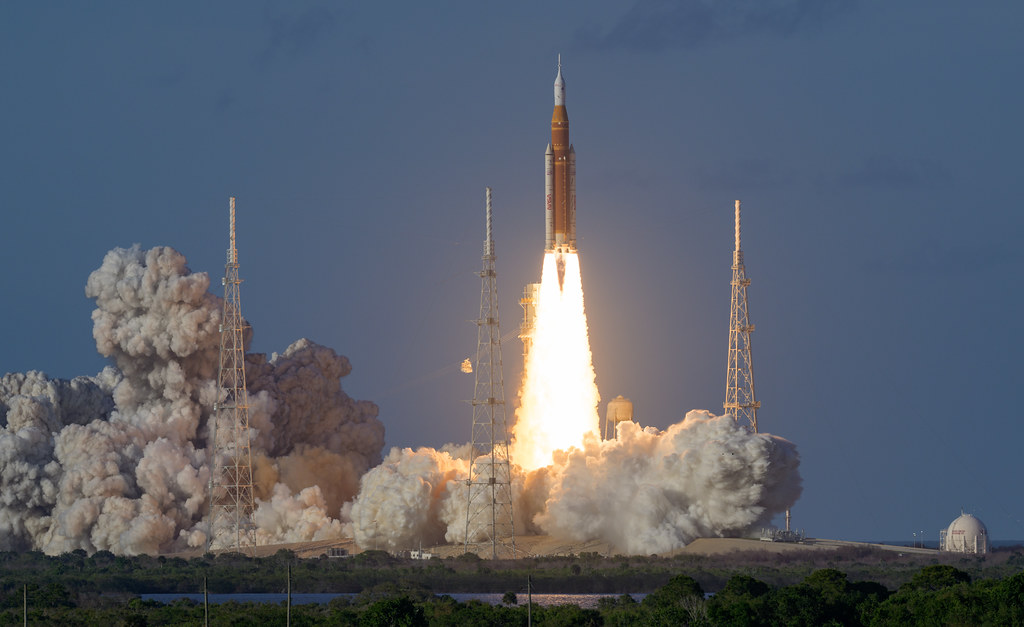
The journey began as NASA’s powerful Space Launch System (SLS) rocket roared off from Launch Pad 39B at the Kennedy Space Center in Florida. The rocket carried four astronauts on board the Orion spacecraft, propelling them on a planned test flight around the Moon and back to Earth.
This groundbreaking mission, named Artemis II, symbolizes a significant moment for the nation and all enthusiasts of space exploration. Building on the vision set by former President Donald J. Trump, Artemis II marks humanity’s return to the Moon after more than five decades, setting the stage for a new era of lunar exploration beyond the Apollo missions. NASA Administrator Jared Isaacman expressed his enthusiasm for the mission and highlighted the profound impact it will have on future space endeavors.
The successful launch initiates an approximately 10-day mission for NASA astronauts Reid Wiseman, Victor Glover, Christina Koch, and Canadian Space Agency astronaut Jeremy Hansen. As the inaugural crewed mission of NASA’s Artemis program, the flight aims to demonstrate life support systems with crew onboard and establish a robust lunar presence in preparation for upcoming missions to Mars.
Upon entering space, the Orion spacecraft unfurled its solar array wings to harness energy from the Sun. Meanwhile, the crew and ground engineers commenced the transition from launch to flight operations, meticulously checking vital systems to ensure a smooth journey.
NASA Associate Administrator Amit Kshatriya emphasized that Artemis II is a test flight, and the crew’s mission to put Orion through its paces has just begun. The team behind the spacecraft’s construction and preparation has provided the crew with a reliable vehicle to showcase its capabilities, paving the way for future missions to the Moon’s surface.
Approximately 49 minutes into the flight, the SLS rocket’s upper stage ignited to place Orion in an elliptical orbit around Earth. A subsequent burn by the stage will propel the spacecraft, named “Integrity” by the crew, into a high Earth orbit extending around 46,000 miles beyond our planet. Following the burn, Orion will detach from the stage, soaring freely on its trajectory.
In the hours that follow, the rocket’s upper stage will deploy four CubeSats – small satellites from various space agencies – for scientific investigations and technology demonstrations. The spacecraft will linger in high Earth orbit for a day, during which the crew will conduct a manual pilot demonstration to evaluate Orion’s maneuvering capabilities. Mission Control Center teams at NASA’s Johnson Space Center will continue monitoring and assessing spacecraft systems alongside the astronauts.
If all systems remain operational, mission controllers will instruct Orion’s European-built service module to execute a translunar injection burn on April 2. This maneuver, lasting approximately six minutes, will propel the spacecraft on a trajectory that will take the crew around the Moon and exploit lunar gravity to slingshot them back towards Earth.
During a planned lunar flyby on April 6, the astronauts will capture images and make observations of the Moon’s surface, becoming the first individuals to witness certain areas of the far side up close. Despite the partial illumination of the lunar far side during the flyby, the lighting conditions are expected to create shadows that enhance surface features, providing valuable insights for future lunar missions.
Upon completing the lunar flyby successfully, the astronauts will set course for Earth, ultimately splashing down in the Pacific Ocean.
NASA’s Artemis program represents a new era of innovation and exploration, with plans to send astronauts on increasingly challenging missions to uncover the mysteries of the Moon, reap economic benefits, and pave the way for future crewed missions to Mars.
For the latest updates on the Artemis II mission, including images from the test flight, visit the official NASA website at: https://www.nasa.gov/mission/artemis-ii/.
In conclusion, the Artemis II mission marks a significant milestone in space exploration, showcasing the United States’ commitment to pushing the boundaries of human achievement beyond Earth’s orbit.
For more Information, Refer to this article.