

















In March 2026, scientists observed a record low maximum extent of sea ice in the Arctic. This phenomenon, which occurs annually, saw the sea ice reach just 14.29 million square kilometers, matching the lowest maximum recorded since satellite monitoring began in 1979. One of the key regions contributing to this low maximum was the Barents Sea.
The Barents Sea, located at the edge of the Arctic Ocean, plays a crucial role in the ecosystem of the region. Bordered by Svalbard to the northwest and Russian islands to the northeast and east, this area is vital for fisheries, shipping routes, and scientific research. Remote sensing technology is used to monitor sea ice across various subregions in the Arctic, including the Barents Sea.
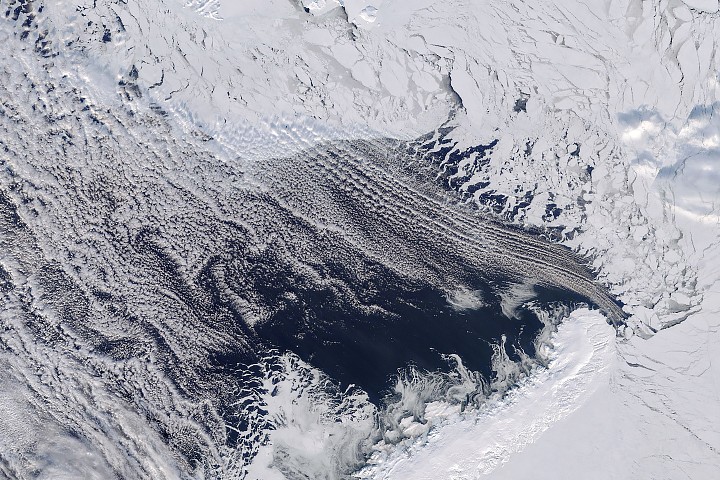
On March 17, 2026, NASA’s Terra satellite captured an image of the northern Barents Sea, showcasing broken sea ice drifting near areas of open water. Despite the cloudy conditions, the satellite was able to capture the thin sea ice cover in the region. Data from NASA’s ICESat-2 satellite indicated that the sea ice in the Barents Sea was not only at a low extent but also very thin.
According to Nathan Kurtz, the chief of the Cryospheric Sciences Laboratory at NASA’s Goddard Space Flight Center, previous years have also shown thin ice around the time of the maximum extent. However, in 2026, the ice was completely melted away in more areas of the Barents Sea, indicating a concerning trend.
The Sea of Okhotsk, located on the opposite side of the Arctic, also played a role in the low total sea ice extent observed in March 2026. Unlike the Barents Sea, the Sea of Okhotsk experiences thin, seasonal ice that varies in thickness from year to year. Local weather conditions, such as winds, play a significant role in shaping the ice cover in this region.
Studies have shown that the main driver of ice loss in the Barents Sea is large-scale atmospheric circulation. Winds bring warm, humid air from the North Atlantic into the region, accelerating the melt of sea ice. These winds can be influenced by weather patterns originating thousands of miles away, such as disturbances near Indonesia.
In contrast, the Sea of Okhotsk experiences ice loss mainly due to local weather conditions and wind patterns. The ice cover in this region can vary in thickness based on how the winds interact with the ice, either pushing it together to create thicker areas or spreading it out to make it thinner.
Overall, the record low maximum extent of sea ice in the Arctic in March 2026 highlights the impact of both local and distant factors on the polar ice cap. As climate change continues to affect the Arctic region, monitoring and understanding these trends are crucial for predicting future changes in sea ice extent and its implications for the environment.
For further information and research on Arctic sea ice extent and variability, references to relevant studies and data sources are provided for interested readers to explore in more detail.
For more Information, Refer to this article.