Astronomers Uncover Formation Secrets of 29 Cygni b with James Webb Space Telescope
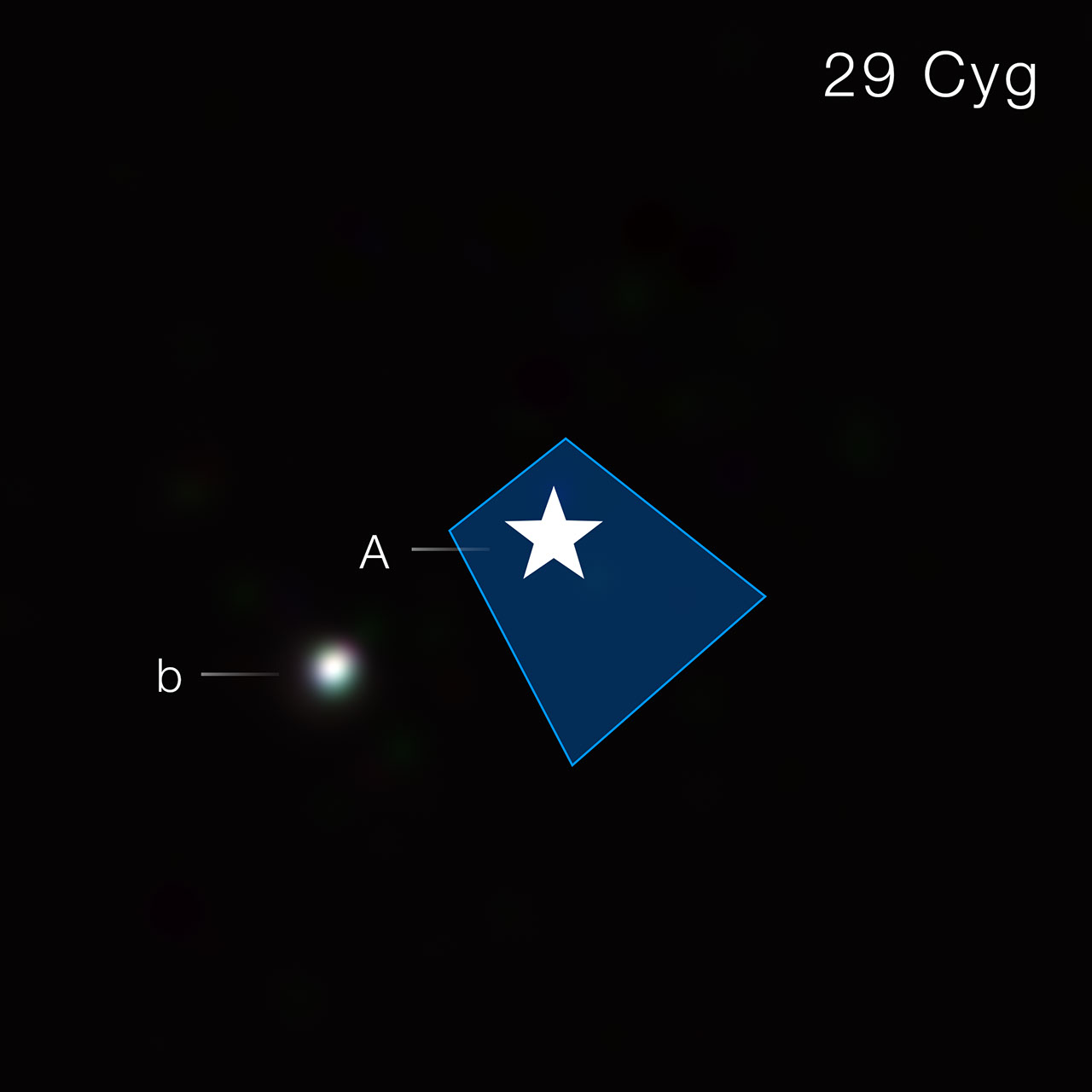
Astronomers have made significant strides in understanding the formation of massive exoplanets, particularly through their recent study of 29 Cygni b, a gas giant approximately 15 times the mass of Jupiter. Utilizing NASA’s James Webb Space Telescope (JWST), researchers provided compelling evidence that this planet formed through a bottom-up accretion process rather than through fragmentation, as detailed in a paper published in The Astrophysical Journal Letters.
Understanding Planet Formation Mechanisms
The prevailing theory of planet formation suggests that planets emerge from vast disks of gas and dust surrounding young stars. This process, known as accretion, begins with tiny particles coalescing into larger pebbles, which then collide and merge to form protoplanets. Over time, these protoplanets can gather enough mass to become gas giants like Jupiter. However, due to the lengthy timeline required for gas giants to form and the eventual dissipation of the material in these disks, planetary systems often feature far more small planets than large ones.
In contrast, stars originate from massive clouds of gas that fragment under their own gravitational forces. This fragmentation process raises questions about how exceptionally massive planets can exist far from their host stars in regions where accretion should be improbable. The discovery of 29 Cygni b offers new insights into this conundrum.
Key Findings from the Study
29 Cygni b orbits its star at an average distance of about 1.5 billion miles (approximately 2.4 billion kilometers), similar to Uranus’s orbit within our solar system. Researchers targeted this planet because it occupies an ambiguous position between two formation theories: it is too massive for traditional accretion models while also being too light for those relying on disk fragmentation.
Lead author William Balmer from Johns Hopkins University explained, “In computer models, it’s very easy for fragmentation in a disk to run away to much higher masses than 29 Cygni b. This is the lowest mass you could plausibly get. But at the same time, it’s about the highest mass you could get from accretion.”
The research team employed JWST’s Near-Infrared Camera (NIRCam) in coronagraphic mode to directly image 29 Cygni b. This study was part of a broader observing program targeting four young exoplanets weighing between 1 and 15 times Jupiter’s mass, all located within approximately 9 billion miles (15 billion kilometers) from their respective stars.
Chemical Composition and Evidence of Accretion
The planets observed were all relatively young and hot, with temperatures ranging from about 1,000 to 1,900 degrees Fahrenheit (530 to 1,000 degrees Celsius). This thermal state allowed researchers to analyze their atmospheric chemistry effectively. By using specific filters on JWST, the team searched for signs of light absorption by carbon dioxide (CO2) and carbon monoxide (CO), which indicated the presence of heavier chemical elements—collectively referred to as metals in astronomical terms.
The findings revealed that 29 Cygni b is significantly enriched in metals compared to its host star—similar in composition to our Sun—suggesting it has accumulated substantial amounts of metal-rich solids from its protoplanetary disk. The amount of heavy elements present on this planet is equivalent to around 150 Earths.
Orbital Alignment and Implications
The research team also utilized the CHARA array (Center for High Angular Resolution Astronomy), a ground-based optical telescope system, to assess whether the orbit of 29 Cygni b aligns with the spin axis of its host star. They confirmed this alignment—a characteristic expected if the planet formed within a protoplanetary disk.
Ash Messier, co-author and graduate student at Johns Hopkins University, stated, “We were able to update the planet’s orbit and also observed the host star to determine its orientation with respect to that orbit.” The alignment indicates that 29 Cygni b likely formed through rapid accretion rather than gas fragmentation.
Future Research Directions
The research team plans to gather additional data on three other targets within their program. They aim to investigate compositional differences among lower-mass and higher-mass planets which could provide further insights into their respective formation mechanisms.
The James Webb Space Telescope continues to be a pivotal tool in unraveling cosmic mysteries—from exploring our solar system to examining distant worlds around other stars and probing fundamental questions about the universe’s origins.
What This Means
This study enhances understanding of how massive exoplanets like 29 Cygni b form and challenges existing theories regarding planetary formation mechanisms. As astronomers continue their investigations using advanced technologies like JWST, they are poised to uncover more about the diverse processes that shape planetary systems across the universe.
For more information, read the original report here.