
















Choosing the wrong model can cost you your milestone. Here is how to tell which one your project actually needs.
Imagine this: you hire an external art studio. They deliver everything on time. The assets are clean, technically correct, and match your original spec perfectly. But your milestone still fails.
Why? Because your game changed three months ago — and the studio you hired was never part of that change. They did exactly what you asked. They just did not know what you needed anymore.
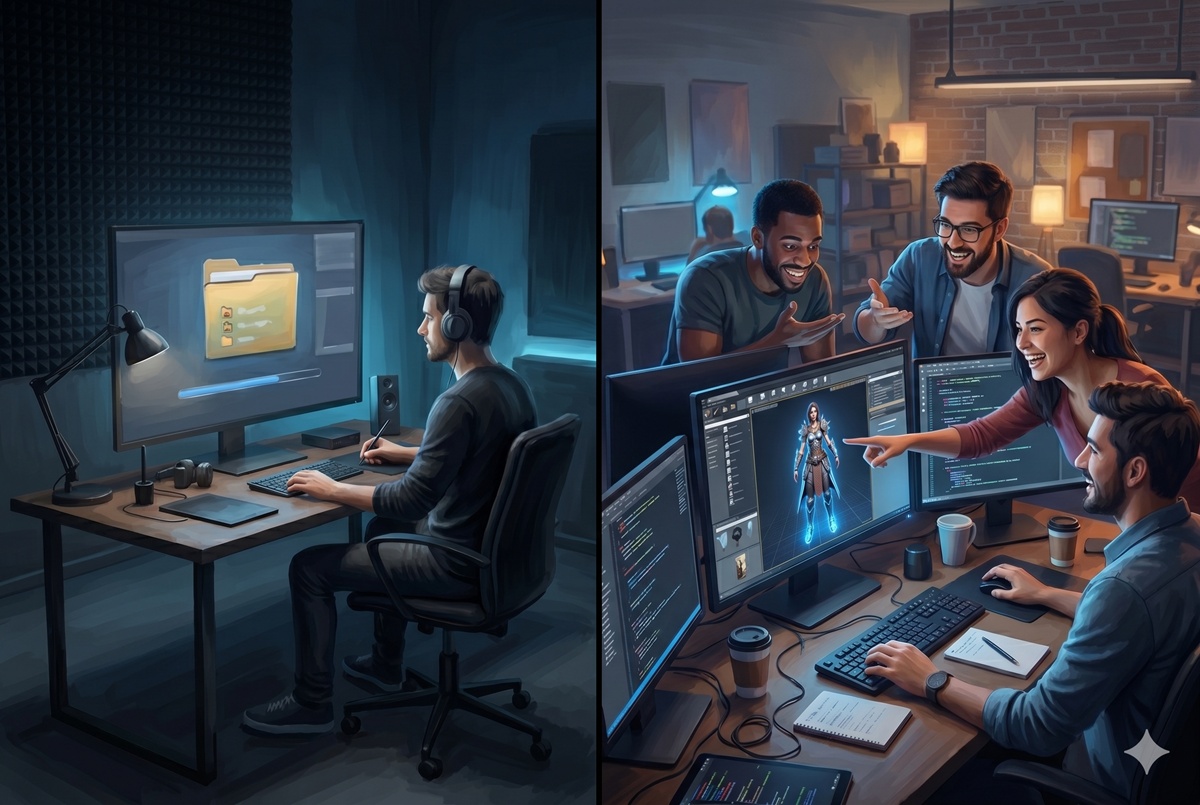
This is the key difference between traditional game art outsourcing and end-to-end art co-development. Many studios mix up these two models, budget for one, and find out mid-production they hired the other. Understanding the difference can save you a lot of time, money, and stress.
What Game Art Outsourcing Companies Actually Provide
Traditional game art outsourcing is a straightforward process. You send an external studio a document with your asset list, art style guide, technical requirements, and reference images. They work through the list and deliver the finished assets. You review, give feedback, and they revise. This cycle repeats until the work is done.
When this model works, it works really well. If your art direction is already decided, your pipeline is stable, and your asset list is unlikely to change, then outsourcing is fast, affordable, and easy to manage. You know exactly what you are paying for before you start.
The problem is that most games in active development are not in that stable state. Art direction changes. A playtesting session might shift the visual tone. A level gets redesigned and now needs assets that were never in the original plan. What you sent to the studio in January may look nothing like what you actually need by March.
Traditional outsourcing has no real way to handle this kind of change. The external team works from the instructions they were given. When your needs change, you have to write a new brief, and someone on your team has to catch the outside studio up on months of context they were never part of in the first place.
What End-to-End Art Co-Development Really Means
End-to-end art co-development is not just a fancier version of outsourcing. It is a completely different way of working. Instead of executing a fixed list of tasks, an external studio takes shared ownership of the entire production pipeline — from concept art all the way through to engine integration.
Ninel Anderson, CEO of Devoted Studios, explained the difference clearly in a Naavik Gaming Podcast interview:
“Outsourcing is when deliverables are very clearly defined, scoped, planned, and need to be executed — ‘here’s the map, bring us back the result.’ Co-development is: ‘here’s our vision, here’s what broadly needs to be delivered — but we don’t really know all the details, and we need to figure it out together.’ A lot of ownership over the result. A lot of creativity.”
In practical terms, end-to-end co-development means one studio handles everything from concept sketches to 3D modeling, technical art, and final engine integration — all as one connected pipeline instead of a series of hand-offs between different teams.
This is what removes a whole category of production risk that standard outsourcing simply cannot address.
Here is a simple example of how it matters in practice: when the same team owns both concept art and 3D production, there is no waiting for one team to finish before the other starts. Anderson shared a real example of this — when Devoted Studios was dependent on outside concept work, their 3D team would sit idle whenever concept rounds ran long. After switching to full in-house end-to-end ownership, the 3D team could start working on basic shapes and forms while the concept team was still finalizing colors and textures. By the time the final look was approved, production was already 30 to 40 percent complete.
As Anderson put it: “So on the overall timeline, we’re not delayed — even though the first things might need a little more time on creativity.”
That is not a small workflow tweak. That is a structural change in how risk is spread across the entire production schedule.
Where the Line Actually Falls in Practice
The difference between these two models is not about quality. Many game art outsourcing companies produce excellent work. The real difference is about what happens when something changes upstream — and who has to deal with the cost of that change.
In a standard outsourcing relationship, any upstream change comes back to the client. New brief. New specs. New scope. The external team restarts from the updated instructions, with no real understanding of why the change happened.
In a co-development relationship, the partner is close enough to the production process to catch changes early — and in some cases, to flag issues before the client even notices them.
Anderson described what this looks like in real projects:
“Vision is foundational. The most important part on the co-development partner side is asking questions: ‘I do want to know the vision. Can you walk me through so we can support with the best decisions?'”
A partner who understands why a level exists — not just what assets it needs — will notice when a new design direction makes the current asset list outdated. A vendor working against a fixed spec will only notice when the final delivery does not match the reference pack. By that point, it may be too late to recover the timeline.
A Telling Sign: The Work They Chose to Stop Taking
One of the most honest signals about how a studio works is what they have decided not to do.
Devoted Studios no longer accepts standalone animation or visual effects (VFX) projects. The reason is instructive: both disciplines are highly subjective. Success is not about meeting a technical spec — it is about conveying a feeling. Without shared production context and a unified creative vision, there is no clear way to define when the work is actually done. Revision cycles drag on. Fixed-budget projects turn into losses.
Those same animation and VFX projects, handled as part of an end-to-end co-development engagement — where the team owns concept, environment art, and effects as a single connected whole — work well every time.
This reflects the same core principle: isolated deliverables can be measured against a spec. Integrated production can only be measured against the game itself.
How to Choose the Right Model for Your Project
Choosing between game art outsourcing and end-to-end co-development is not primarily about budget. It is about where your project actually stands right now.
Ask yourself these questions:
- Is your art direction fully locked and approved?
- Is your style guide stable — or still evolving?
- Is your asset list unlikely to change in the coming months?
- Do you have a stable pipeline and clear technical specs ready to hand over?
If you answered yes to all of the above, then traditional game art outsourcing is the right choice. It is efficient, scalable, and cost-effective for that situation. The right outsourcing studio will deliver exactly what you need, on time, without unnecessary overhead.
If you answered no to any of them — if you are in active development, your direction is still evolving, levels are being redesigned, and the game you plan to ship in a year looks different from what you can describe today — then you need something more than a vendor executing tasks. You need a partner with enough ownership and visibility to move alongside you as things change. That is what end-to-end co-development provides.
The most useful question to ask any external art studio before you sign a contract is not “can you match this style guide?” It is: what do you do when the style guide changes?
As Anderson puts it: “If you’re looking to augment your pipeline with a partner, I’d highly suggest looking to one that could do end-to-end production.”
The game art outsourcing companies worth working with — like Devoted Studios — can answer that question with a specific process, not just a sales pitch.
Devoted Studios handles end-to-end game art production — from concept through 3D modeling, technical art, and engine integration — for studios in active development. 250+ team members, across 15 countries, with 250+ shipped projects. Learn more at devotedstudios.com/art-services/