






















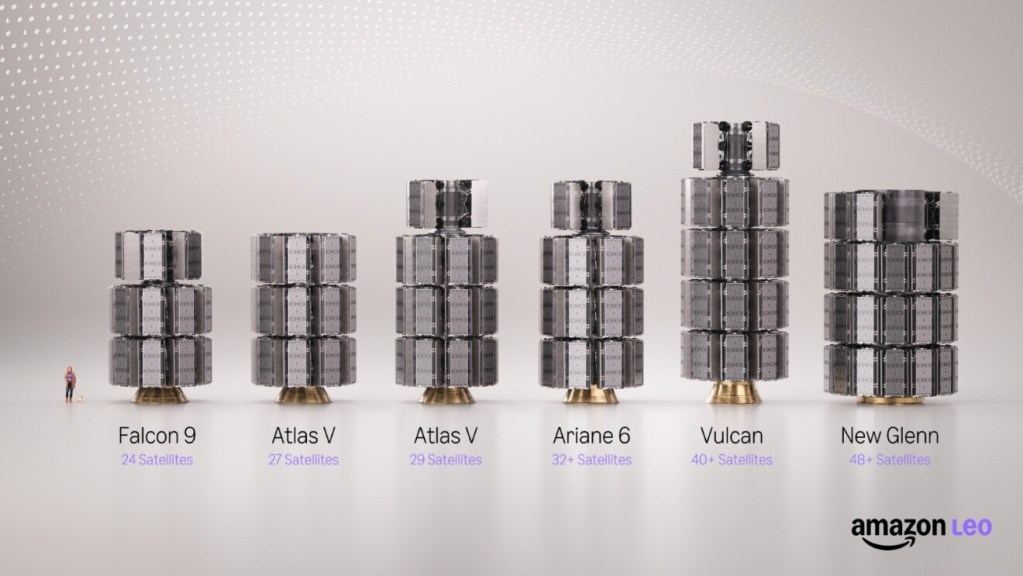
Amazon has announced plans to increase the number of annual launches for its low Earth orbit broadband constellation to over 20 missions. This decision is heavily dependent on the success of rockets that have not yet been tested on a large scale.
The pressure is mounting for Amazon to meet deadlines and ensure the timely deployment of its Leo (Low Earth Orbit) broadband constellation. In order to achieve this goal, the company is ramping up its launch cadence, aiming to double the annual number of missions to more than 20.
Launching satellites into low Earth orbit is a complex and challenging process that requires careful planning and coordination. Amazon’s decision to increase its launch rate reflects the company’s commitment to expanding its presence in the rapidly growing space industry.
One of the key factors driving this decision is the need to stay competitive in the market. With other companies also vying for a share of the space-based broadband market, Amazon is under pressure to move quickly and efficiently in order to maintain its position as a leading provider of satellite services.
However, the success of Amazon’s plan hinges largely on the performance of the rockets that will be used to launch its satellites into orbit. These rockets have not yet been proven at scale, which introduces an element of risk into the equation.
Despite the challenges and uncertainties, Amazon remains optimistic about the future of its Leo broadband constellation. By increasing its launch cadence and pushing ahead with its expansion plans, the company is demonstrating its commitment to innovation and growth in the space sector.
In conclusion, Amazon’s decision to accelerate the deployment of its Leo broadband constellation is a bold move that reflects the company’s ambition and determination to succeed in the competitive space industry. By doubling the annual launch rate to more than 20 missions, Amazon is positioning itself for future growth and expansion in the satellite services market.
For more information on Amazon’s plans for its Leo broadband constellation, you can visit the original article on SpaceNews website [here].
For more Information, Refer to this article.