












![[Photo] Inside Samsung OLED FC: Elite Gamers Compete Live on Advanced OLED Displays at Samsung KX](https://www.hawkdive.com/media/samsung-tvs-and-displays-s90f-tvs-odyssey-oled-g6-samsung-oled-fc_thumb932f-218x150.jpg "Elite gamers battle on advanced OLED displays at Samsung KX.")








Europe’s First Exascale Supercomputer JUPITER: Unleashing New Horizons in Scientific Research
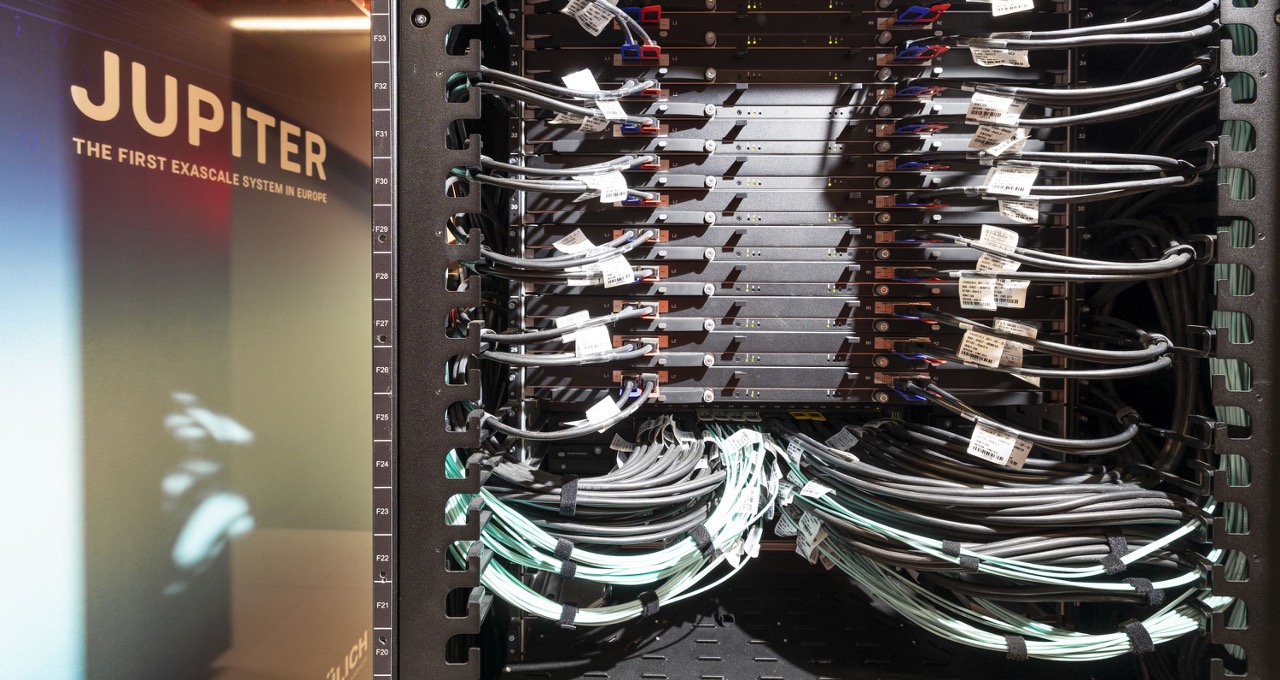
In a significant milestone for Europe, the Jülich Supercomputing Centre in Germany has celebrated the inauguration of JUPITER, the continent’s first exascale supercomputer. This cutting-edge machine promises to revolutionize scientific research across various domains, including climate science, neuroscience, and quantum simulations. At the heart of this advancement is the NVIDIA Grace Hopper platform, which empowers JUPITER to perform at unprecedented speeds, heralding a new era in computing capabilities.
A Leap Forward in Computing Power
JUPITER, an acronym for "Joint Undertaking Pioneer for Innovative and Transformative Exascale Research," stands as a testament to over a decade of dedicated research and development. It can execute an astounding one quintillion FP64 operations per second, and its AI performance is projected to reach up to 90 exaflops. This achievement effectively doubles the speed of high-performance computing and AI workloads compared to its closest counterparts in Europe.
The technological marvel of JUPITER is built on Eviden’s BullSequana XH3000 liquid-cooled architecture, representing a fusion of high-performance computing and artificial intelligence. The integration of NVIDIA Grace Hopper Superchips and Quantum-2 InfiniBand enables JUPITER to serve as a versatile platform for scientific discovery and innovation. This capability is not just about speed; it is about unlocking new possibilities for scientific and industrial advancements in Europe.
A Historic Unveiling
The inauguration ceremony of JUPITER was a landmark event attended by prominent figures, including Germany’s Chancellor, Friedrich Merz, and leaders from various scientific and technological fields. The ceremony underscored the significance of JUPITER as a historic European pioneering project, marking a new chapter in Europe’s technological evolution.
Chancellor Merz highlighted the transformative potential of JUPITER, emphasizing its role in driving national and industrial innovation. As the first supercomputer of its kind in Europe and the first outside the United States to reach such capabilities, JUPITER is poised to set new standards in scientific research and technological development.
Why JUPITER Matters
JUPITER’s capabilities extend beyond mere computational speed; it opens doors to breakthroughs in various scientific disciplines. European startups, enterprises, and researchers now have access to an unprecedented level of computing power, enabling rapid and efficient advancements in areas such as:
- Climate Science: JUPITER facilitates high-resolution climate modeling, enhancing the accuracy of weather predictions and simulations of extreme weather events.
- Generative AI: It supports the development of large language models (LLMs) tailored for European languages, which can enhance productivity across industries by generating humanlike responses.
- Neuroscience: JUPITER aids in drug discovery and brain mapping, offering insights into neurodegenerative diseases like Alzheimer’s.
- Quantum Simulation: The supercomputer brings quantum computing closer to reality by surpassing current limits in qubit handling, a crucial aspect of quantum simulations.
Pioneering Research Initiatives
JUPITER’s power is already being harnessed for flagship research projects across Europe. The Max Planck Institute for Meteorology utilizes JUPITER’s capabilities for climate simulations, predicting extreme weather events with remarkable spatial resolution. Similarly, the Jülich Supercomputing Centre and its partners are leveraging JUPITER for the TrustLLM project, which focuses on training the next generation of LLMs for diverse European languages.
In neuroscience, the Arbor simulator is being used to model neuron behavior at a subcellular level, paving the way for breakthroughs in understanding and treating neurodegenerative diseases. Moreover, JUPITER is set to break records in quantum computing, with the potential to handle over 50 qubits, a significant milestone in the field.
Empowering European Researchers
JUPITER’s impact extends beyond Germany, empowering researchers across Europe to tackle some of the most challenging scientific problems. Its optimal energy efficiency ensures sustainable progress in AI leadership and scientific discovery.
Key research initiatives include:
- Molecular Dynamics Simulation: The Max Planck Institute of Biophysics is using JUPITER to achieve atom-level insights into the nuclear pore complex, advancing models for nuclear transport and combating retroviruses.
- Multilingual LLMs: The University of Edinburgh is generating synthetic data to train LLMs capable of reasoning across long documents in any language.
- Particle Physics: The University of Wuppertal is enhancing the resolution of microphysical computations, potentially leading to the discovery of new particles and interactions.
- Foundation Models for Video: Ludwig Maximilian University of Munich is developing advanced video models for applications ranging from medical imaging to autonomous driving.
- Multimodal AI Models: The University of Lisbon is scaling multimodal, multilingual language models to support all European languages and address existing model limitations.
Conclusion
JUPITER signifies a monumental leap in Europe’s scientific and technological capabilities. By providing unprecedented computing power and fostering collaborative research initiatives, it positions Europe at the forefront of global scientific innovation. As the continent’s first exascale supercomputer, JUPITER not only enhances computational efficiency but also drives progress in understanding complex systems, ultimately leading to transformative advancements across various scientific fields.
For further insights into how NVIDIA technologies are enabling supercomputing breakthroughs, you can explore more at the NVIDIA Blog.
Images and video courtesy of Forschungszentrum Jülich / Sascha Kreklau.
For more Information, Refer to this article.