





















NASA’s Hubble Space Telescope Captures a Stunning View of Interstellar Comet 3I/ATLAS
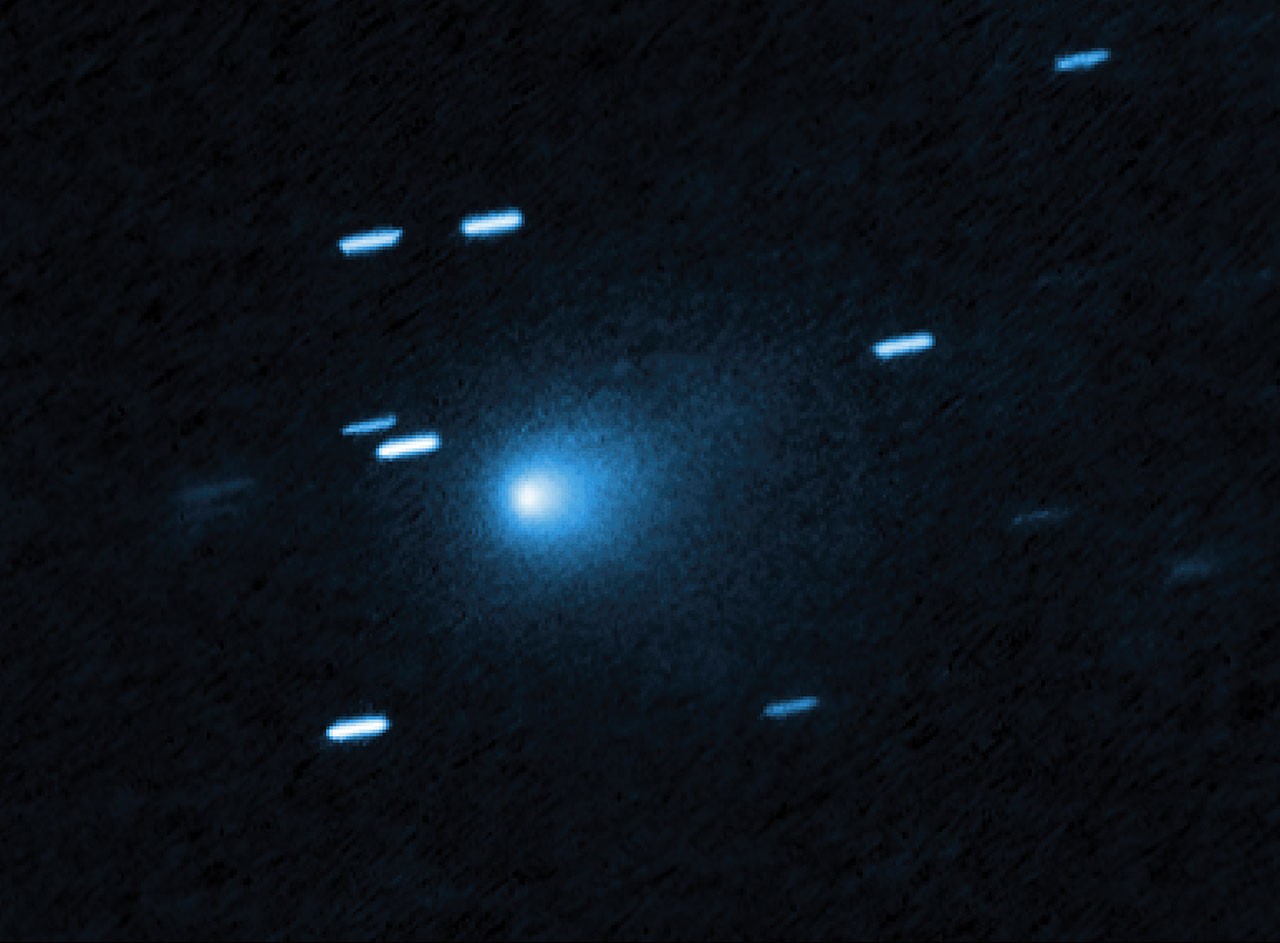
In a remarkable achievement, a team of astronomers has captured the sharpest-ever image of the interstellar comet 3I/ATLAS using NASA’s Hubble Space Telescope. This achievement is part of NASA’s broader mission to explore space and understand near-Earth objects better. While this comet poses no threat to Earth, it provides scientists with a unique opportunity to study an object that originated outside our solar system.
The Hubble Space Telescope’s Role in Observing 3I/ATLAS
Hubble’s observations are crucial for providing a more accurate estimate of the comet’s size and characteristics. The telescope’s data suggest that the comet’s solid icy nucleus could be as large as 3.5 miles (5.6 kilometers) in diameter, although it might be as small as 1,000 feet (320 meters). Despite Hubble’s incredible capabilities, the nucleus remains hidden, even from its view. The telescope’s efforts are complemented by other NASA missions, including the James Webb Space Telescope, TESS (Transiting Exoplanet Survey Satellite), and the Neil Gehrels Swift Observatory, along with collaborations with facilities like the W.M. Keck Observatory. These combined efforts aim to shed light on the comet’s chemical composition and other properties.
Observations from Hubble
Hubble’s powerful optics have captured the comet’s teardrop-shaped cocoon of dust emanating from its nucleus. The observations also highlighted a dust plume released as the comet’s surface is warmed by the Sun, and hints of a dust tail trailing away from it. This behavior resembles that of other comets within our solar system when they are approximately 300 million miles away from the Sun.
The most intriguing aspect of 3I/ATLAS is its origin. Unlike typical comets that hail from within our solar system, this interstellar visitor originated from an entirely different solar system somewhere in the Milky Way galaxy. This provides an invaluable opportunity for scientists to study an object that has traveled through interstellar space for billions of years.
The Journey of 3I/ATLAS
Traveling at a staggering speed of 130,000 miles (209,000 kilometers) per hour, 3I/ATLAS holds the record for the highest velocity ever recorded for a solar system visitor. This incredible speed suggests that the comet has been subjected to gravitational interactions with various stars and nebulae throughout its journey across the galaxy, acting like a cosmic slingshot that accelerated its speed over time.
David Jewitt, a leading member of the science team from the University of California, Los Angeles, likened the comet’s brief appearance to "glimpsing a rifle bullet for a thousandth of a second," emphasizing the challenge in tracing back its exact origin.
Broader Implications of the Discovery
The discovery of 3I/ATLAS marks an exciting development in the field of astronomy. As Jewitt pointed out, "This latest interstellar tourist is one of a previously undetected population of objects bursting onto the scene that will gradually emerge." This is made possible by powerful sky survey technologies that were not available before, allowing astronomers to detect and study more interstellar objects as they enter our solar system.
The comet was first discovered by the NASA-funded Asteroid Terrestrial-impact Last Alert System (ATLAS) on July 1, 2025. ATLAS is an early warning system designed to detect potential asteroid impacts and is managed by the University of Hawai’i.
Future Observations and Collaborations
As 3I/ATLAS continues its journey through the solar system, other NASA missions will provide additional insights into this fascinating celestial object. Scientists expect it to remain visible to ground-based telescopes until September, after which it will temporarily disappear behind the Sun. It is anticipated to reappear by early December, offering astronomers further opportunities for study.
The Hubble Space Telescope, a product of international collaboration between NASA and the European Space Agency (ESA), has been operational for over three decades. It continues to revolutionize our understanding of the universe with its groundbreaking discoveries. Managed by NASA’s Goddard Space Flight Center in Maryland, with mission support from Lockheed Martin Space in Denver, and scientific operations conducted by the Space Telescope Science Institute in Baltimore, Hubble remains a vital tool for space exploration.
For those interested in delving deeper into Hubble’s contributions to space science, further information can be found on NASA’s official Hubble website.
In conclusion, the observation of 3I/ATLAS by the Hubble Space Telescope marks a significant milestone in our quest to understand the universe beyond our solar system. This discovery not only reinforces the capabilities of modern astronomical tools but also opens the door to a new era of interstellar exploration, offering a glimpse into the myriad wonders that await us in the cosmos.
For more Information, Refer to this article.