














![[Video] Samsung Color E-Paper: A Smarter Alternative to Traditional Posters](https://www.hawkdive.com/media/samsung-tvs-and-displays-samsung-color-e-paper-samsung-vxt-digital-signage_thumb932-218x150.jpg "Samsung introduces Color E-Paper as innovative poster alternative.")







Achieving Fusion Ignition: A Breakthrough at Lawrence Livermore National Laboratory
For more than sixty years, the Lawrence Livermore National Laboratory (LLNL) has been at the forefront of research aimed at achieving fusion ignition. This involves generating more fusion energy than the amount of laser energy supplied to the target. At the heart of LLNL’s efforts is the world-renowned National Ignition Facility (NIF), which utilizes a technique known as inertial confinement fusion. This method involves focusing laser beams on a small fuel pellet to initiate a fusion reaction. In contrast, magnetic confinement fusion, another method being explored globally, uses strong magnets to contain a plasma—a hot, ionized gas of charged particles—within a reactor.
The Promise of Polar Direct Drive
A significant advancement in the pursuit of fusion energy at LLNL was the development of the polar direct drive (PDD) approach. According to a lead researcher, over a year and a half after achieving initial experimental success, PDD demonstrated itself as a highly efficient method for converting laser energy input into fusion energy output. This approach not only improves energy conversion efficiency but also offers superior diagnostic capabilities for conducting high-temperature plasma physics experiments.
Collaboration and Innovation in Fusion Research
The design of the large diameter PDD capsule was a collaborative effort, spearheaded by Heather Whitley, the Associate Program Director for High Energy Density Science at LLNL. Alongside her, Steve Craxton and Emma Garcia from the University of Rochester played pivotal roles in its development. Whitley emphasized that the PDD configuration provides excellent diagnostic access, which is crucial for advancing high-temperature plasma physics research.
In December 2022, LLNL’s NIF achieved a landmark scientific breakthrough by conducting the first controlled fusion experiment to produce net energy gain using the indirect drive method. This achievement marked a significant milestone in fusion research and garnered international attention, highlighting the potential of fusion energy as a sustainable and clean energy source.
A Team of Pioneers
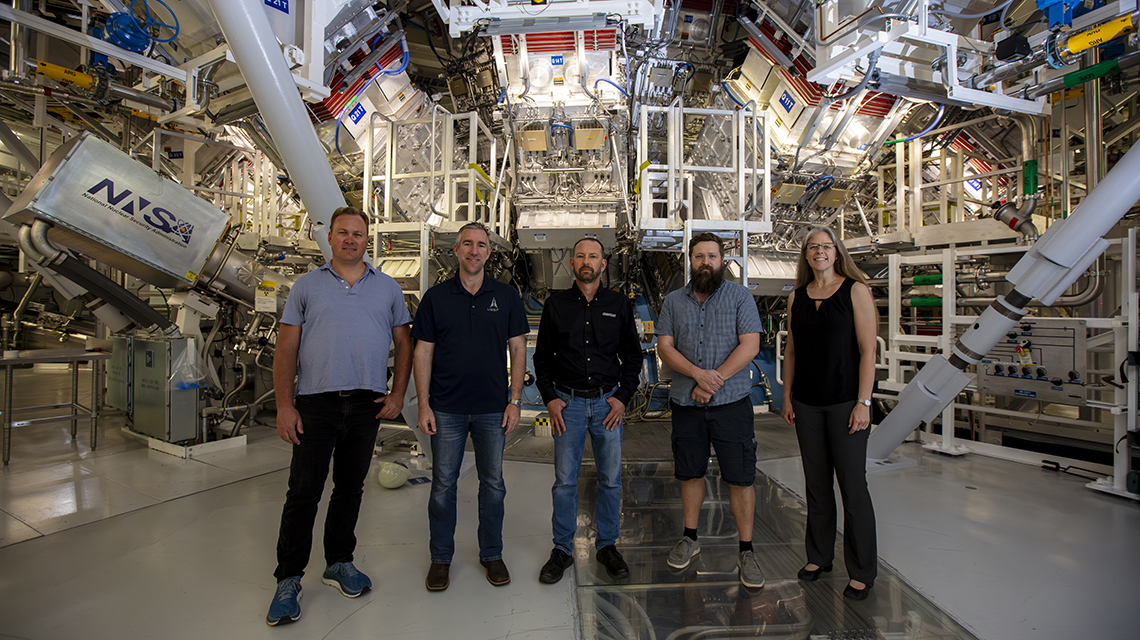
The research leading to these groundbreaking achievements was a collaborative effort involving several experts. Key contributors include Elijah Kemp, Zach Walters, Heather Whitley, and Brent Blue from LLNL, as well as Steve Craxton, Patrick McKenty, Emma Garcia, and Yujia Yang from the University of Rochester’s Laboratory for Laser Energetics. Their combined expertise and dedication have been instrumental in advancing the frontier of fusion energy research.
Recognizing Excellence in Fusion Energy Research
The accomplishments of these researchers have not gone unnoticed. The prize ceremonies for the 2024 and 2025 awards will be held in October at the International Atomic Energy Agency (IAEA) Fusion Energy Conference in Chengdu, China. This event will serve as a platform to recognize and celebrate the remarkable achievements in the field of fusion energy research.
Further Information and Resources
For those interested in learning more about nuclear fusion and the latest developments in this exciting field, the Nuclear Fusion journal is an excellent resource. It provides valuable insights into current research, and offers guidance on how to prepare and submit articles for publication. More information can be found on the IAEA’s official website.
The Future of Fusion Energy
Fusion energy holds the promise of being a virtually limitless and environmentally friendly energy source. Unlike fossil fuels, fusion reactions produce no greenhouse gases and use abundant resources, such as hydrogen isotopes, as fuel. The successful harnessing of fusion energy could revolutionize the energy industry, providing a sustainable solution to the world’s growing energy needs.
The recent breakthroughs at LLNL are a testament to the potential of fusion energy and the dedication of researchers worldwide to making this dream a reality. As research progresses, the hope is that fusion energy will one day become a practical and widely adopted energy source, contributing to a cleaner and more sustainable future for all.
In summary, the advancements in fusion research at LLNL, particularly with the development of polar direct drive, signify a major leap forward in our quest for sustainable energy solutions. The collaborative efforts and innovative approaches demonstrated by the researchers involved are paving the way for a future where fusion energy could play a crucial role in meeting global energy demands.
For more Information, Refer to this article.