



















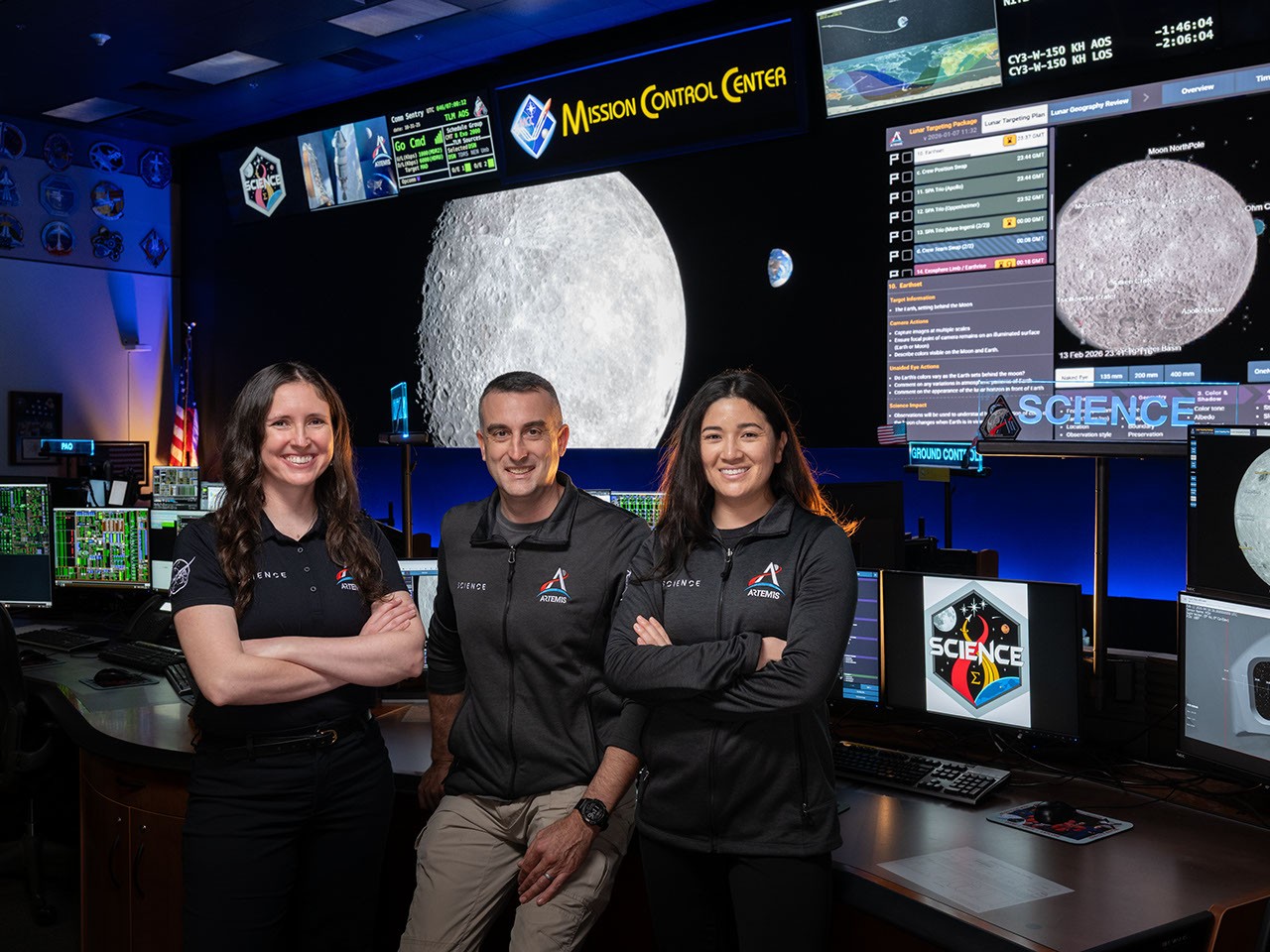
In the world of NASA, business attire and multiple computer monitors have taken a back seat to hiking gear and rock hammers for three individuals who have been certified as NASA’s first Artemis II science officers. Kelsey Young from NASA’s Goddard Space Flight Center, Trevor Graff, and Angela Garcia from NASA’s Johnson Space Center have transitioned from their usual settings to become integral parts of NASA’s Mission Control for the Artemis missions.
The concept of integrating science operations into human spaceflight is not new, dating back to the Apollo era. However, the Artemis missions are taking this integration to a whole new level by introducing dedicated science officers in NASA’s Mission Control. These science officers, like Kelsey Young, play a crucial role in ensuring that lunar science and geology objectives are seamlessly integrated into mission execution.
Mission Control is a hub of activity, with various consoles dedicated to different aspects of the mission. While some consoles monitor communication, life support, and propulsion, others are now focused on science operations. Young, Garcia, and Graff underwent months of rigorous training and simulations to become certified flight controllers for Artemis missions, all while honing their geology and lunar observation skills.
The Artemis II mission will see astronauts conducting a lunar flyby, during which they will capture photographs and record audio observations of the Moon. These observations are critical for advancing our understanding of lunar geology and geography. The astronauts have undergone extensive training to prepare for this mission, including studying lunar landscapes in Iceland and building their lunar science toolboxes.
The integration of science into human spaceflight is a complex process that involves real-time data analysis and strategic guidance from experts in the Science Evaluation Room and Science Mission Operations Room at NASA Johnson. These experts work closely with the science officer in Mission Control to ensure that the mission objectives are met.
Artemis II is not just a test flight; it is a stepping stone towards future Artemis missions that will involve even more sophisticated science operations. Lessons learned from Artemis II will shape the way for future lunar science missions, paving the way for new discoveries and insights about our nearest neighbor in space.
The astronauts’ observations of the Moon will provide a unique perspective that complements the decades of scientific research conducted on the lunar surface. By combining astronaut observations with scientific knowledge, researchers hope to uncover new discoveries and gain a deeper understanding of the Moon’s features.
As the Artemis missions progress, the integration of science into human spaceflight will continue to evolve, building on the rich history of previous missions like Apollo. The contributions of the science officers and astronauts to lunar science will be invaluable in expanding our knowledge of the Moon and its significance to humanity.
The Artemis missions serve as a source of inspiration for people around the world, reminding us of the endless possibilities of space exploration and the mysteries that await us beyond our planet. Through their work, individuals like Kelsey Young, Trevor Graff, and Angela Garcia are pushing the boundaries of human knowledge and opening new doors to the wonders of the cosmos.
In conclusion, the Artemis II mission represents a significant milestone in NASA’s quest to explore the Moon and beyond. With dedicated science officers like Young, Graff, and Garcia at the helm, the future of lunar science looks brighter than ever.
For more Information, Refer to this article.