





















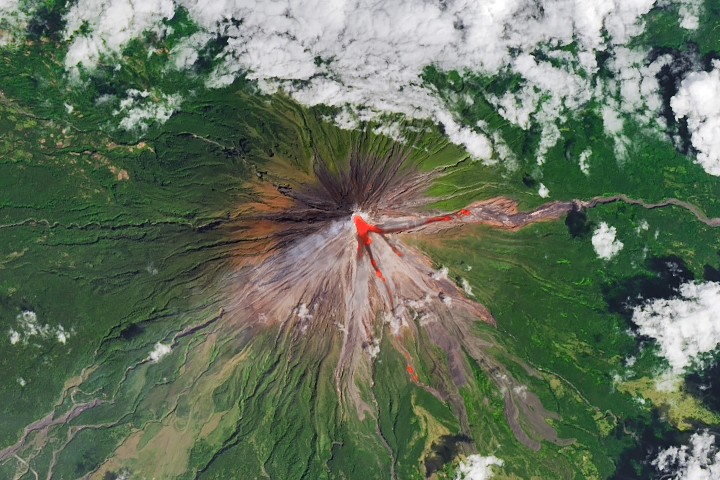
Mayon Volcano in the Philippines is currently experiencing heightened volcanic activity, with lava flows, pyroclastic flows, and increased sulfur dioxide emissions. The Philippine Institute of Volcanology and Seismology (PHIVOLCS) has raised the alert level to three, indicating a high risk of eruption. This stratovolcano, known for its frequent eruptions, poses a threat to communities within a 6-kilometer radius of the crater.
Historical records show that Mayon Volcano has erupted 65 times in the past 5,000 years, with the latest episode beginning in January 2026. Rockfalls near the summit and inflation of the mountain’s upper slopes were the first signs of increased activity reported by PHIVOLCS. By January 6, lava began flowing from the crater, accompanied by pyroclastic flows moving down one side of the mountain.
The ongoing eruption has led to evacuations of hundreds of families from nearby communities, such as Tabaco City, Malilpot, and Camalig. Past eruptions of Mayon Volcano have been devastating, resulting in thousands of deaths over the years. The current emission of sulfur dioxide, with levels peaking at over 7,000 metric tons per day, is the highest recorded in 15 years.
NASA satellites have been monitoring the volcano’s activity, capturing images of sulfur dioxide plumes drifting southwest on multiple occasions. The combination of lava flows, pyroclastic flows, and increased sulfur dioxide emissions indicates a volatile situation at Mayon Volcano. Researchers and scientists continue to study the volcano to better understand its behavior and potential hazards.
For more information on the ongoing volcanic activity at Mayon Volcano, you can refer to the sources listed below:
– Chan, H. & Konstantinou, K. (2020) “Multiscale and multitemporal surface temperature monitoring by satellite thermal infrared imagery at Mayon Volcano, Philippines.” Journal of Volcanology and Geothermal Research, 401, 106976.
– Global Volcanism Program (2026) Mayon. Accessed March 12, 2026.
– GMA News Online (2026, January 6) “Six Albay towns evacuate residents amid Mayon Volcano Alert Level 3 status.” Accessed March 12, 2026.
– NASA Earthdata (2023, January 25) “Monitoring Volcanic Sulfur Dioxide Emissions.” Accessed March 12, 2026.
– NASA Earth Observatory (2009, December 15) “Mayon Volcano Threatens Major Eruption.” Accessed March 12, 2026.
– PHIVOLCS (2026, March 12) “Latest volcano bulletins, advisories, updates & other issuances, or archived issuances.” Accessed March 12, 2026.
– PHIVOLCS (2026, February 10) “Mayon Volcano Eruption Update.” Accessed March 12, 2026.
– Ruth, D.C.S. & Costa, F. (2021) “A petrological and conceptual model of Mayon volcano (Philippines) as an example of an open-vent volcano.” Bulletin of Volcanology, 83(62).
Stay tuned for further updates on the situation at Mayon Volcano as scientists and researchers continue to monitor and assess the volcanic activity.
For more Information, Refer to this article.