






















In the realm of engineering and computational analysis, utilizing reduced-order dynamic math models (DMMs) has long been a popular method for achieving computational efficiency in linear system-level dynamic analyses. However, when it comes to nonlinear system dynamics, the use of reduced-order DMMs has also shown promise, particularly in the realm of contact dynamics. A prime example of this can be seen in the Henkel-Mar pad separation analysis methodology.
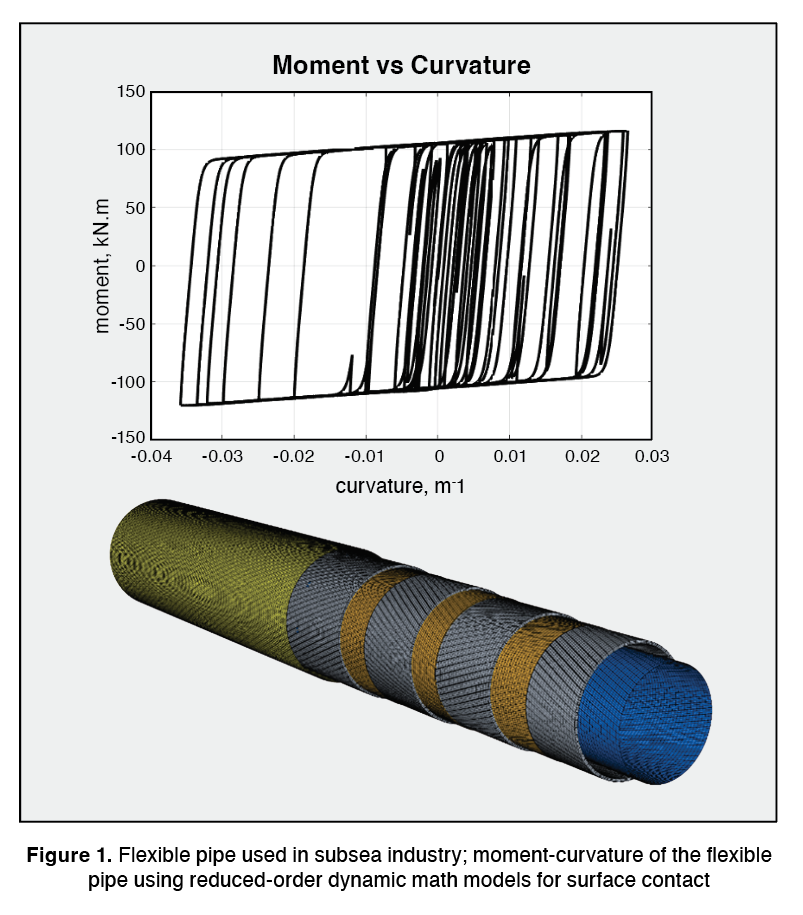
One area where reduced-order DMMs have shown significant potential is in contact dynamics involving repetitive geometry patterns. Take, for example, the design of a “flexible” pipe used in the subsea industry, which features four layers of helically wound steel wires. These layers provide the pipe with stick/slip behavior during bending, ultimately leading to a longer fatigue life in harsh ocean environments. By leveraging the repetitive contact topology of the helically wound armor layers, engineers can construct and track contact surfaces, enabling the operation of friction logic and resulting in friction hysteretic moment-curvature plots.
In a recent study, a pipe subjected to multiple bending cycles was analyzed in essentially real-time computation using reduced-order DMMs. The same analysis conducted with full finite element model (FEM) resolution would have required 48 hours of computation on 36 central processing units (CPUs) running in parallel due to the high order of the FEM.
But what about utilizing DMMs for computationally efficient nonlinear dynamics involving large displacements and rotations? To address this question, the residual flexibility mixed boundary transformation (RFMB) plays a crucial role. The RFMB coordinate transformation, which includes constraint modes, residual flexibility, and a truncated set of normal modes, retains full flexibility at the DMM physical degrees of freedom (DOFs) while significantly reducing the number of kept modes compared to interior FEM DOFs.
To enable DMM large displacements and rotations, four coordinates are added to the RFMB to track large rotations, transforming it into a nonlinear dynamic substructure (NDS). This NDS approach allows for highly nonlinear dynamic simulations, as demonstrated in the analysis of an undeformed cantilever beam model. By applying this method, the cantilever beam can be rolled up and bent into various shapes in a highly nonlinear dynamic simulation conducted in seconds on a standard laptop.
One practical application of this large displacement/rotation NDS capability is the inclusion of umbilical models in the coupled loads analysis (CLA) framework. By integrating umbilicals into the CLA, engineers can more accurately capture system flexibilities, dynamic responses, and clearances between components. This capability was demonstrated in the analysis of the Interim Cryogenic Propulsion Stage (ICPS) umbilical integrated into the Space Launch System (SLS) CLA.
Overall, the power of reduced-order models extends beyond linear dynamics, offering a versatile approach to incorporating large displacements and rotations into system-level dynamic analyses. By leveraging reduced-order DMMs, engineers can seamlessly integrate complex components like umbilicals into dynamic analyses, providing a more comprehensive understanding of system behavior and interactions.
In conclusion, the advancements in utilizing reduced-order DMMs for nonlinear dynamic simulations offer a promising avenue for enhancing computational efficiency and accuracy in engineering analyses. By incorporating these methods into their workflow, engineers can tackle complex dynamic problems with greater ease and precision, ultimately leading to more robust and optimized designs.
For more Information, Refer to this article.