




















Asteroid Bennu: A Window into the Early Solar System and the Origins of Life
Asteroid Bennu, a celestial body of significant interest to scientists, continues to unveil secrets about the origins of our solar system and the building blocks of life. This ongoing exploration is made possible by NASA’s OSIRIS-REx mission, which brought pristine samples of Bennu to Earth. Recent findings published in the esteemed journals Nature Geosciences and Nature Astronomy have revealed groundbreaking discoveries, including the presence of sugars vital for biological processes, an enigmatic gum-like substance, and an unexpected concentration of supernova dust in the samples.
Sugars Essential for Life
A team of researchers led by Yoshihiro Furukawa from Tohoku University in Japan has made a remarkable discovery in the samples from Bennu. They found sugars essential for life as we know it, including five-carbon sugar ribose and, for the first time in extraterrestrial samples, six-carbon glucose. These findings were detailed in the journal Nature Geoscience. While these sugars are not direct evidence of life, their presence, along with previously identified amino acids, nucleobases, and carboxylic acids, suggests that the fundamental components of biological molecules were widespread across the solar system.
On Earth, deoxyribose and ribose are crucial sugars that form the backbone of DNA and RNA, respectively. DNA serves as the primary genetic material in cells, while RNA plays multiple roles in biological processes. Ribose is a key component of RNA’s sugar-phosphate backbone, connecting information-carrying nucleobases. The discovery that all five nucleobases, along with phosphates, were found in Bennu samples implies that the asteroid contains all the necessary components to form RNA molecules.
The presence of ribose without deoxyribose in the Bennu samples is particularly intriguing. It suggests that ribose may have been more prevalent in the early solar system’s environments, supporting the “RNA world” hypothesis. This hypothesis posits that early life forms may have relied on RNA as the primary molecule for storing genetic information and driving essential chemical reactions.
Furukawa explains, “Present-day life is organized by three types of functional biopolymers: DNA, RNA, and proteins. Early life, however, may have been simpler, with RNA being the leading candidate for the first functional biopolymer due to its ability to store genetic information and catalyze biological reactions.” The discovery of glucose in the Bennu samples also provides evidence that an important energy source for life was present in the early solar system.
The Mysterious Ancient ‘Gum’
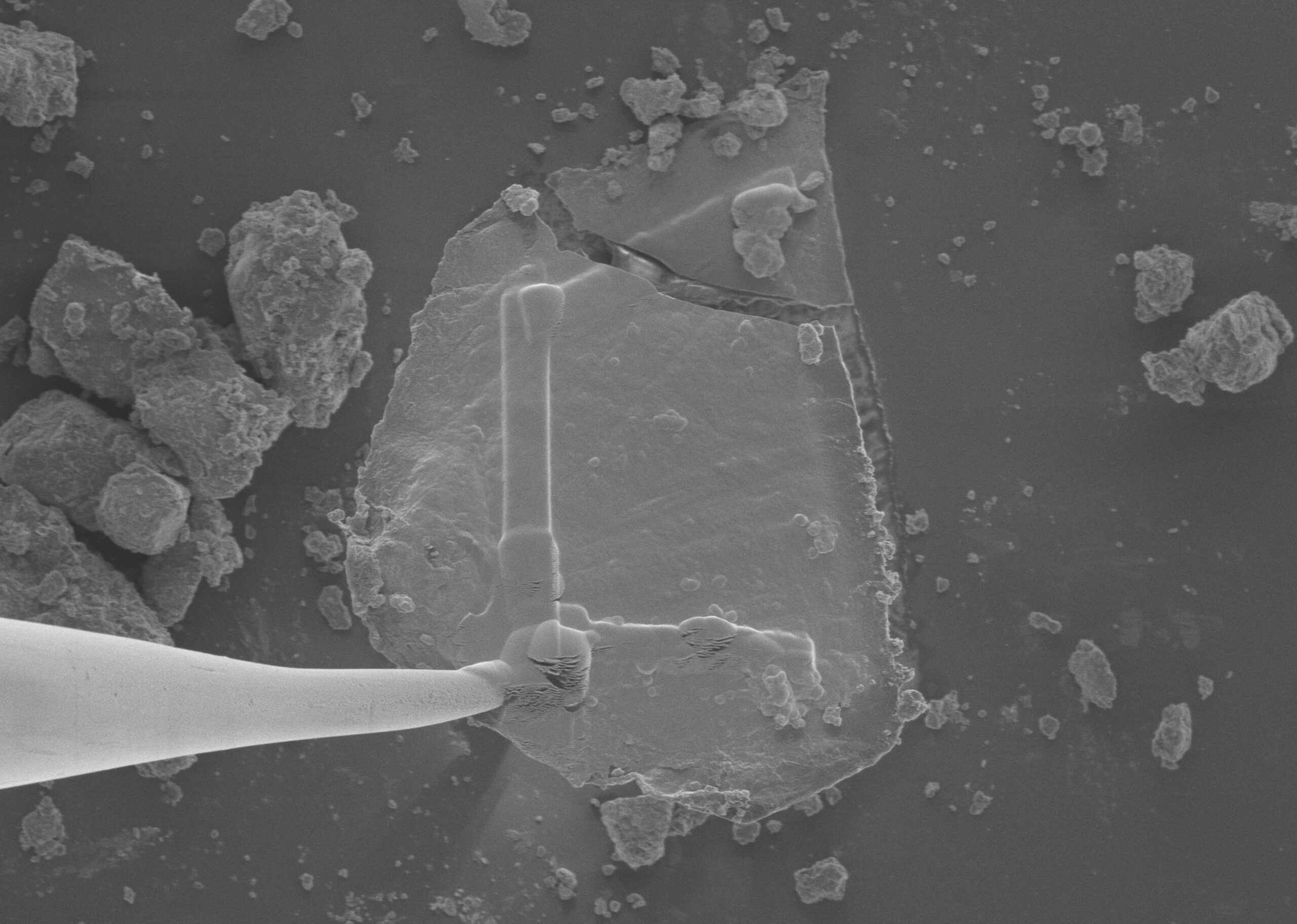
Another fascinating discovery, detailed in a paper led by Scott Sandford from NASA’s Ames Research Center and Zack Gainsforth from the University of California, Berkeley, describes a gum-like material in the Bennu samples. This material, never before observed in space rocks, could have played a role in setting the stage for life on Earth. The substance likely formed in the early solar system as Bennu’s parent asteroid warmed.
This ancient “space gum” consists of polymer-like materials rich in nitrogen and oxygen. Such complex molecules could have provided some of the chemical precursors necessary for the emergence of life on Earth. Finding them in the pristine samples from Bennu is crucial for understanding how life began and whether similar processes could occur elsewhere in the universe.
Bennu’s parent asteroid formed from materials in the solar nebula, a rotating cloud of gas and dust that gave rise to the solar system. As the asteroid warmed due to natural radiation, a compound called carbamate formed through a process involving ammonia and carbon dioxide. Carbamate is water-soluble, but it survived long enough to polymerize, reacting with itself and other molecules to form larger chains resistant to water. This suggests that it formed before the asteroid’s environment became watery.
“We’re looking at one of the earliest alterations of materials in this rock,” said Sandford. “On this primitive asteroid, we’re witnessing events near the beginning of the solar system.” Using an infrared microscope, Sandford’s team selected unusual, carbon-rich grains abundant in nitrogen and oxygen. They then employed advanced techniques at the Lawrence Berkeley National Laboratory to analyze the composition of these grains.
The team discovered that the material was flexible, similar to used gum or soft plastic. It was translucent and became brittle when exposed to radiation. “The chemical makeup reveals similarities to polyurethane on Earth, making it akin to a ‘space plastic,’” explained Sandford. However, this ancient material is more complex than simple polyurethane, with random connections and varying elemental compositions.
By investigating the origins of this strange substance, scientists can gain insights into the young solar system, revealing the precursors and ingredients of life it contained and how these materials may have been distributed.
Abundant Supernova Dust
In another study led by Ann Nguyen of NASA’s Johnson Space Center, researchers analyzed presolar grains—dust from stars older than our solar system—in two different rock types from Bennu samples. This study, published in Nature Astronomy, aimed to learn more about Bennu’s parent body formation and its geological alterations. It was found that the samples contained six times more supernova dust than any other studied astromaterial, indicating that Bennu’s parent body formed in a region enriched with the dust of dying stars.
The research also revealed that while Bennu’s parent asteroid underwent significant alteration by fluids, there are still pockets of less-altered materials within the samples. These fragments offer insights into the asteroid’s origin and suggest that some material escaped alteration.
“These fragments have a higher abundance of organic matter and presolar silicate grains, which are usually destroyed by aqueous alteration in asteroids,” said Nguyen. “Their preservation in the Bennu samples was unexpected and illustrates the diversity of presolar materials the parent body incorporated as it formed.”
NASA’s Goddard Space Flight Center managed the OSIRIS-REx mission, with Dante Lauretta of the University of Arizona serving as the principal investigator. Lockheed Martin Space built the spacecraft and provided flight operations. Various international partnerships contributed to the mission, including the OSIRIS-REx Laser Altimeter instrument from the Canadian Space Agency and collaboration with JAXA’s Hayabusa2 mission.
This mission is part of NASA’s New Frontiers Program, managed by NASA’s Marshall Space Flight Center. For further information on the OSIRIS-REx mission, visit NASA’s official page.
In summary, the OSIRIS-REx mission’s findings from the Bennu samples provide invaluable insights into the early solar system and the potential origins of life. The discovery of essential sugars, mysterious ancient substances, and abundant supernova dust offers a glimpse into the complex chemical processes that may have laid the foundation for life on Earth and beyond. These findings open new avenues for scientific exploration and understanding of our cosmic origins.
For more Information, Refer to this article.