











![[Interview] Scenes of Memory and Modern Life: Sun Yitian x Samsung Art Store](https://www.hawkdive.com/media/samsung-tvs-and-displays-samsung-art-tv-samsung-art-store-art-basel-hong-king-sun-yitian-interview_t-218x150.jpeg "Sun Yitian Collaborates with Samsung Art Store on Memory and Modern Life")








New WindShaper Fan Array Enhances Flight Research Capabilities
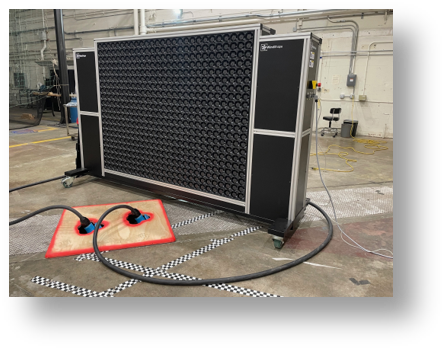
A cutting-edge WindShaper fan array has been introduced for advanced research in dynamic low-speed and hovering flight. This innovative system, equipped with a user-friendly Python API, allows researchers to generate complex wind gradients and gusts, facilitating a deeper understanding of aerodynamic behaviors. Accompanying the WindShaper is the WindProbe, designed for efficient flow surveys utilizing an OptiTrack motion capture system.
Features of the WindShaper Fan Array
The WindShaper fan array boasts an impressive configuration that significantly enhances its research capabilities. Measuring 9 feet by 7 feet, it comprises 1,134 individual fans organized into 567 distinct ‘wind pixels.’ This arrangement enables precise control over airflow, making it possible to simulate various wind conditions that aircraft might encounter during flight.
- Large dynamic fan array: 9’x7’, 1134 fans arranged as 567 ‘wind pixels’
- Wind speeds: 0 to 16 m/s (0 to 36 mph/31 kts)
- Acceleration: 4 m/s², Deceleration: 2.5 m/s²
- Each fan is programmable via Python scripting
- Replicates steady winds, gusts, and wind gradients
Programmable Features for Enhanced Control
The programming capabilities of the WindShaper are particularly noteworthy. Each fan can be controlled individually through Python scripting, allowing researchers to create specific wind patterns tailored to their experimental needs. This flexibility is crucial for studying various aerodynamic phenomena, including how different aircraft designs respond to changing wind conditions.
The ability to replicate steady winds as well as sudden gusts provides a comprehensive tool for testing aircraft stability and performance in real-time scenarios. Researchers can simulate everything from gentle breezes to turbulent gusts, enabling a thorough analysis of flight dynamics under varying environmental conditions.
The Role of the WindProbe in Flow Surveys
The WindProbe complements the WindShaper by offering quick and accurate surveys of airflow. Utilizing the lab’s OptiTrack motion capture system, it tracks the position and orientation of a specialized 5-hole cone probe located at its tip. This technology allows for precise measurements of wind direction and speed at various points within the airflow generated by the WindShaper.
This combination of tools not only accelerates data collection but also enhances the accuracy of flow measurements. By integrating motion capture technology with wind measurement devices, researchers can gain insights into complex flow structures that would be difficult to analyze using traditional methods.
Applications in Aerodynamics Research
The introduction of the WindShaper and WindProbe systems opens up new avenues for research in aerodynamics. With their ability to generate customizable wind conditions and accurately measure airflow dynamics, these tools are invaluable for both academic researchers and industry professionals alike. Potential applications include testing new aircraft designs, evaluating drone performance in varying environments, and studying the effects of wind on various vehicles.
This technology is particularly relevant as industries increasingly focus on improving fuel efficiency and safety in aviation. By providing a controlled environment for testing aerodynamic properties, researchers can develop more effective designs that respond better to real-world conditions.
What This Means for Future Research
The launch of the WindShaper fan array represents a significant advancement in aerodynamic research capabilities. By allowing for detailed simulations of complex wind patterns and providing precise measurement tools through the WindProbe, this technology will likely lead to enhanced understanding of flight dynamics and improved aircraft designs. As researchers leverage these tools in their studies, they may uncover new insights that could shape the future of aviation technology.
For more information, read the original report here.