





















A Glimpse into the Cosmos: The Magnificent Spiral Galaxy NGC 3285B
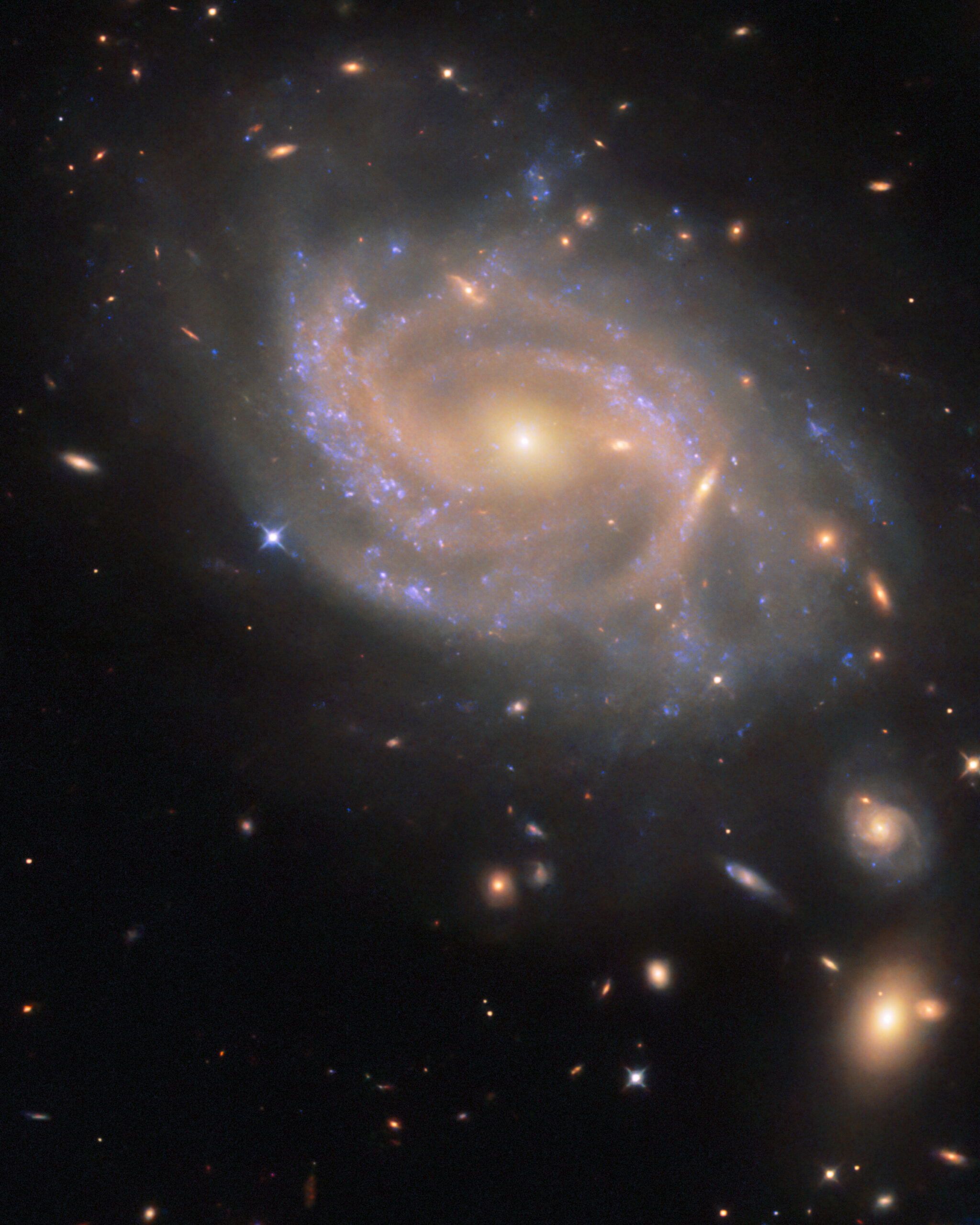
Nestled deep within the constellation Hydra lies the spiral galaxy NGC 3285B, a captivating celestial body captured in a recent image by the Hubble Space Telescope, a joint endeavor by NASA and the European Space Agency (ESA). This astronomical wonder is located approximately 137 million light-years from Earth, a testament to the vastness of our universe. Hydra, known as the Water Snake, boasts the largest area among the 88 constellations that adorn our sky. It stretches an impressive 100 degrees across the celestial sphere, requiring the equivalent of nearly 200 full moons, lined up side by side, to span its length.
The Enigmatic Hydra I Cluster
NGC 3285B is a distinguished member of the Hydra I cluster, one of the most expansive galaxy clusters in our cosmic vicinity. Galaxy clusters are massive structures, consisting of hundreds or even thousands of galaxies, all bound together by the force of gravity. At the heart of the Hydra I cluster lie two colossal elliptical galaxies, each measuring around 150,000 light-years in diameter. These giant galaxies outsize our own Milky Way by approximately 50%, highlighting the immense scale of the universe.
Interestingly, NGC 3285B is positioned on the fringes of the Hydra I cluster, far removed from the gravitational pull of the gigantic galaxies at the core. This spiral galaxy recently garnered attention from astronomers due to a significant astronomical event it hosted—a Type Ia supernova in 2023. Supernovae are powerful explosions marking the end of a star’s life cycle, and Type Ia supernovae, in particular, are of great interest to scientists. They occur when a white dwarf, a dense stellar remnant, undergoes a catastrophic explosion, triggering a sudden burst of nuclear fusion that causes it to shine as brightly as approximately 5 billion Suns. The supernova, identified as SN 2023xqm, is depicted in the Hubble image as a bluish dot situated on the left edge of the galaxy’s disk.
Unveiling Cosmic Mysteries through Supernova Observations
The observation of NGC 3285B by the Hubble Space Telescope is part of an ambitious research program targeting 100 Type Ia supernovae. This program involves observing these supernovae across different wavelengths, including ultraviolet, optical, and near-infrared light. The primary goal is to differentiate the effects of distance and interstellar dust, both of which can alter the perceived color, or redshift, of the supernovae. By achieving a clearer understanding of these factors, researchers aim to refine the measurement of cosmic distances, which are crucial for mapping the scale of the universe.
The Role of Type Ia Supernovae in Measuring Cosmic Distances
Type Ia supernovae play a pivotal role in cosmology as “standard candles.” These astronomical objects have a consistent intrinsic brightness, which allows scientists to use them as reference points for calculating distances across the vast expanses of space. By accurately measuring the distance to these supernovae, astronomers can determine the distance to the galaxies in which they reside. This is essential for constructing a three-dimensional map of the universe and understanding its expansion.
The study of Type Ia supernovae has also contributed to the discovery of dark energy, a mysterious force that is believed to be driving the accelerated expansion of the universe. By observing the light from these supernovae, scientists have been able to gather evidence suggesting that the universe is not just expanding, but doing so at an increasing rate.
Hydra: The Constellation of the Water Snake
The constellation Hydra, home to NGC 3285B, is a fascinating celestial feature in its own right. As the largest constellation in the sky, Hydra spans a vast area and contains numerous intriguing objects, including stars, galaxies, and nebulae. Its mythology is equally captivating, with roots in ancient Greek stories. Hydra was believed to embody the multi-headed serpent slain by Hercules in one of his legendary labors. The constellation’s elongated shape mirrors the serpentine creature it represents, snaking its way across the sky.
Hubble Space Telescope: A Window into the Universe
The Hubble Space Telescope has been instrumental in advancing our understanding of the universe since its launch in 1990. Named after the renowned astronomer Edwin Hubble, the telescope orbits Earth, providing a clear and unobstructed view of the cosmos. Its observations have led to numerous groundbreaking discoveries, from identifying new galaxies to studying the atmospheres of distant exoplanets. Hubble’s ability to capture images across different wavelengths allows scientists to explore the universe’s diverse phenomena, making it an invaluable tool for both astronomers and astrophysicists.
Conclusion: A Continuing Journey of Discovery
The observation of NGC 3285B and its accompanying supernova SN 2023xqm is yet another chapter in the ongoing exploration of the cosmos. As scientists continue to study these celestial events, they unravel the mysteries of the universe, shedding light on its origins, structure, and future. The data collected by the Hubble Space Telescope and other observatories around the world contribute to a deeper understanding of the fundamental forces and processes that shape our universe.
For those interested in astronomy and the wonders of space, the study of galaxies like NGC 3285B offers a glimpse into the beauty and complexity of the cosmos. As we look to the stars, we are reminded of our place in the universe and the endless possibilities for discovery that lie ahead.
For more detailed information and visual insights, you may visit the official page of the Hubble Space Telescope at [NASA’s Hubble Mission](https://science.nasa.gov/mission/hubble/).
For more Information, Refer to this article.