



















Hubble Space Telescope Captures Stunning Star Cluster in the Large Magellanic Cloud
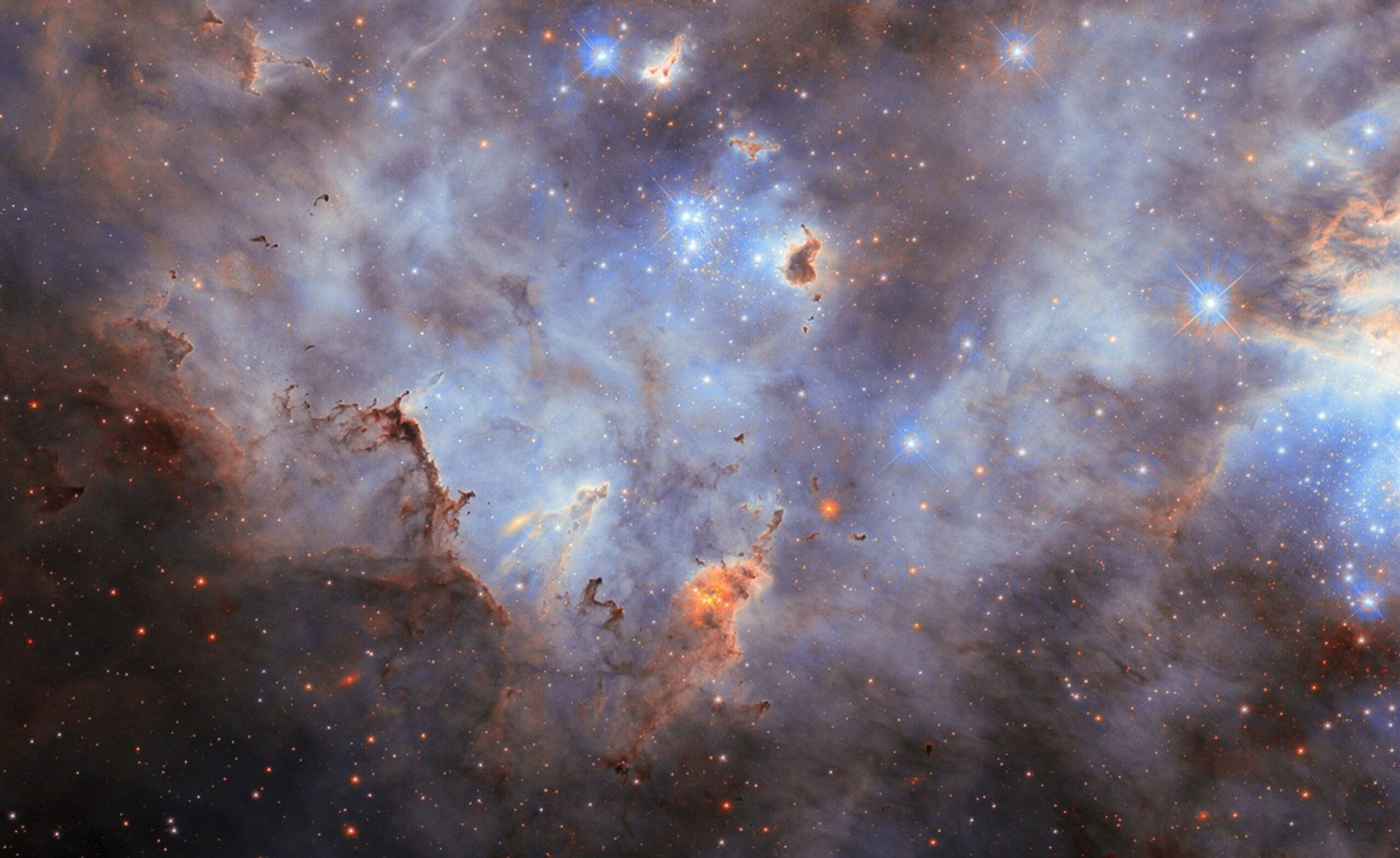
The Hubble Space Telescope, a collaborative effort between NASA and the European Space Agency (ESA), has once again delivered an awe-inspiring image of the cosmos. Released on September 12, 2025, this latest image reveals a breathtaking starscape nestled within a star cluster located in the Large Magellanic Cloud. This dwarf galaxy lies approximately 160,000 light-years away from us, residing in the southern sky constellations of Dorado and Mensa. Although it is much smaller than our own Milky Way galaxy, with a mass of only 10-20% of the Milky Way’s, the Large Magellanic Cloud remains the largest of the numerous small galaxies that orbit our own.
The Large Magellanic Cloud is a vibrant hub of star formation, hosting several massive stellar nurseries. These are regions where vast clouds of gas, like those captured in this image, come together to birth new stars. The area shown in the latest Hubble image is part of the galaxy’s second-largest star-forming region, known as N11. For context, the most active star-forming region in this galaxy is the Tarantula Nebula, which frequently catches the attention of Hubble’s cameras. Within the N11 region, brilliant young stars energize the surrounding gas clouds, shaping intricate dust structures through their powerful ultraviolet radiation.
This image is a remarkable combination of observations made over a span of approximately 20 years, highlighting the enduring capabilities of the Hubble Space Telescope. The initial observations date back to 2002-2003, employing the Advanced Camera for Surveys, which had just been installed at the time. This camera boasted exceptional sensitivity and resolution, allowing astronomers to achieve a groundbreaking feat. For the first time, they successfully cataloged all the stars within a young cluster, ranging in mass from just 10% of our Sun’s mass to as much as 100 times the Sun’s mass.
The more recent observations that contributed to this image come from Hubble’s latest technological marvel, the Wide Field Camera 3. This camera focused specifically on the dusty clouds that permeate the star cluster, offering a fresh perspective on the cosmic dust that fills our universe.
The Legacy of Hubble and Its Continuing Contributions
The Hubble Space Telescope has been a cornerstone of astronomical research for over three decades. Since its launch in 1990, Hubble has revolutionized our understanding of the universe, providing unprecedented insights into the formation and evolution of galaxies, stars, and planetary systems. Its longevity and continued operation are a testament to the robust engineering and regular maintenance missions that have kept it functioning far beyond its original expected lifespan.
The telescope’s ability to capture images with extraordinary clarity and detail has made it an invaluable tool for scientists worldwide. Hubble’s images not only serve as scientific data but also inspire awe and curiosity among the general public, bringing the wonders of the universe closer to home.
Understanding Star Formation in the Large Magellanic Cloud
The Large Magellanic Cloud (LMC) offers a unique laboratory for studying star formation. Its proximity to Earth allows astronomers to observe star-forming regions in greater detail than is possible in more distant galaxies. The LMC’s diverse environments provide insights into the various processes that lead to star formation and the subsequent evolution of stars and star clusters.
Star-forming regions like N11 are of particular interest to astronomers because they provide a glimpse into the early stages of stellar evolution. By studying these regions, scientists can learn about the conditions necessary for star formation, the factors that influence the mass and composition of new stars, and the role of massive stars in shaping their surroundings.
The Role of Cosmic Dust
Cosmic dust, though often overlooked, plays a crucial role in the life cycle of stars and galaxies. Composed of tiny solid particles, cosmic dust can absorb and scatter light, affecting how we perceive astronomical objects. It also serves as a catalyst for chemical reactions in space, contributing to the formation of molecules and the growth of new stars.
The observations made with Hubble’s Wide Field Camera 3 have provided new insights into the distribution and properties of cosmic dust in the N11 region. By studying these dusty clouds, astronomers can better understand how dust interacts with light and influences the dynamics of star-forming regions.
The Future of Space Telescopes
While the Hubble Space Telescope continues to be a vital tool for astronomers, the future of space-based astronomy is promising with the development of new telescopes. The James Webb Space Telescope (JWST), set to launch in the near future, will complement Hubble’s observations by providing even greater sensitivity in the infrared part of the spectrum. This will allow scientists to peer through dust clouds and observe the early stages of star and galaxy formation with unprecedented clarity.
In addition to JWST, other planned missions, such as the Nancy Grace Roman Space Telescope, will further enhance our understanding of the universe. These new observatories will build on Hubble’s legacy, continuing to explore the cosmos and unravel the mysteries of the universe in ways we can only begin to imagine.
Conclusion
The recent Hubble image of the N11 star-forming region in the Large Magellanic Cloud is a stunning reminder of the telescope’s enduring impact on astronomy. By capturing the intricate details of this distant galaxy, Hubble continues to expand our knowledge of the universe and inspire future generations of scientists and explorers. As we look forward to new discoveries and advancements in space-based astronomy, the Hubble Space Telescope remains a symbol of human curiosity and the quest to understand our place in the cosmos.
For more Information, Refer to this article.