




















Satellite Innovations Enhance Tsunami Forecasting: A Step Towards Safer Coastal Communities
In a groundbreaking development, data from a collaborative satellite initiative between NASA and the French space agency CNES is significantly enhancing tsunami forecasting models, offering potentially life-saving benefits to coastal communities worldwide. The Surface Water and Ocean Topography (SWOT) satellite recently captured vital information about a tsunami generated by a powerful earthquake near Russia’s Kamchatka Peninsula, illustrating how advanced satellite technology is transforming our understanding and prediction of these natural disasters.
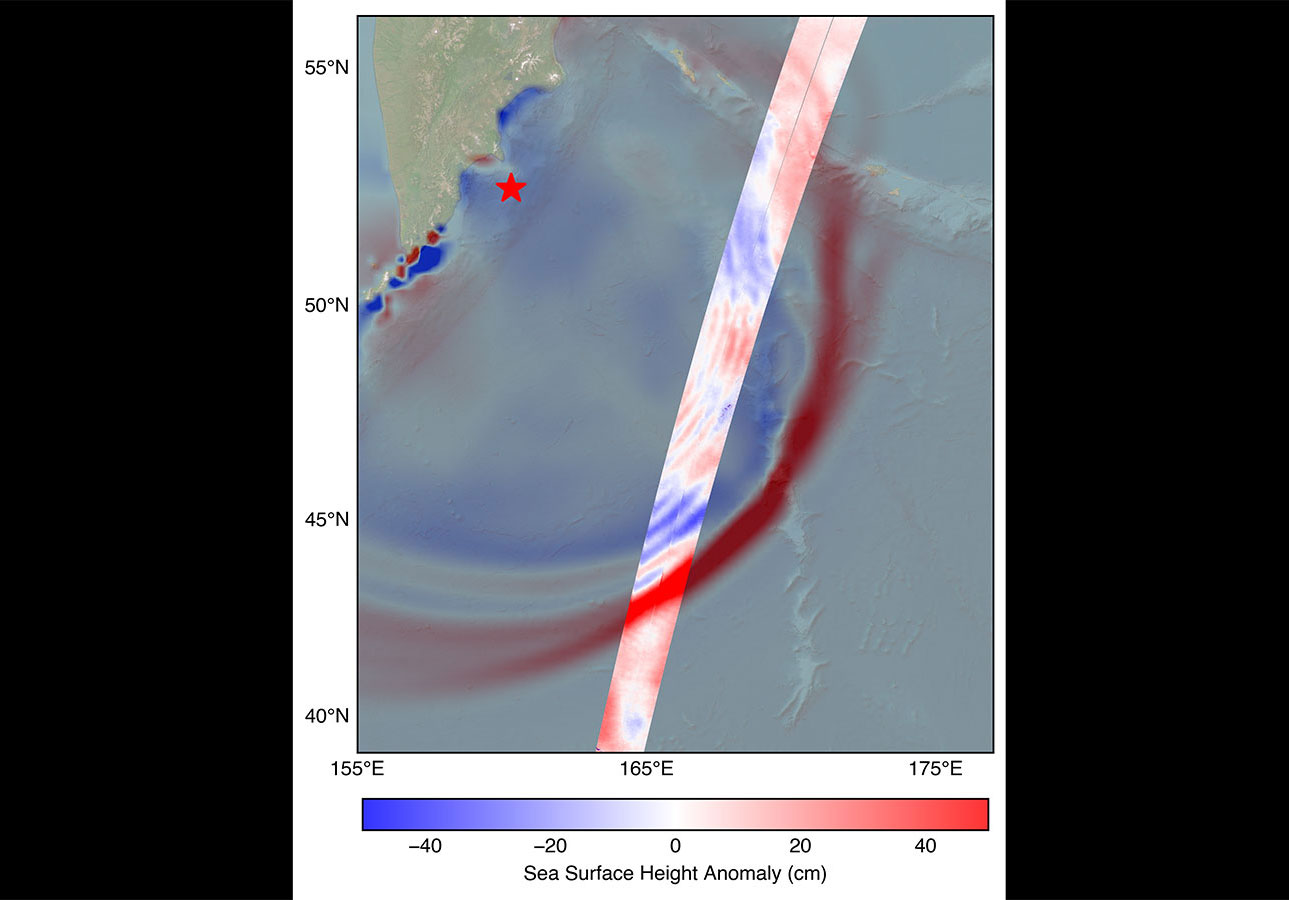
On July 30th, a massive earthquake measuring 8.8 on the Richter scale struck off the Kamchatka coast at 11:25 a.m. local time. This seismic event triggered a tsunami, which was recorded by the SWOT satellite approximately 70 minutes later. The satellite, a joint venture between NASA and the French space agency, is equipped to monitor and record such oceanographic phenomena, providing invaluable data to scientists and researchers.
When a significant geological disturbance occurs, such as an earthquake or an underwater landslide, it can displace an entire column of seawater. This displacement initiates a series of waves, known as a tsunami, that travel across the ocean, similar to the ripples created when a stone is dropped into still water. The SWOT satellite’s ability to capture these events in detail marks a significant advancement in our capacity to understand and predict tsunamis.
Nadya Vinogradova Shiffer, a leading scientist at NASA, emphasized the importance of the SWOT satellite’s contributions. She noted, "The broad, paintbrush-like strokes of SWOT over the ocean provide crucial real-world validation, unlocking new physics and marking a leap towards more accurate early warnings and safer futures." This statement underscores the satellite’s role in enhancing our predictive models and improving safety measures for communities at risk.
The data collected by SWOT offers a multidimensional perspective of the tsunami’s leading edge, which was triggered by the Kamchatka earthquake. These measurements included a wave height of more than 1.5 feet (approximately 45 centimeters), represented in red in the satellite’s imagery. This data not only showed the wave height but also revealed the shape and direction of the tsunami’s leading edge. By comparing SWOT’s observations with forecast models from the U.S. National Oceanic and Atmospheric Administration (NOAA) Center for Tsunami Research, scientists can validate and refine their models to improve accuracy.
Ben Hamlington, an oceanographer at NASA’s Jet Propulsion Laboratory, explained the potential impact of these measurements. "A 1.5-foot-tall wave might not seem like much, but tsunamis are waves that extend from the seafloor to the ocean’s surface," he said. "What might only be a foot or two in the open ocean can become a 30-foot wave in shallower water at the coast." This highlights the importance of accurate measurements in predicting the potential impact of tsunamis on coastal areas.
The data gathered from SWOT is proving to be a valuable asset for scientists at NOAA’s Center for Tsunami Research. It aids in refining their tsunami forecast models, which are crucial for issuing timely alerts to communities that may be in the path of a tsunami. These models utilize a combination of historical earthquake-tsunami scenarios and real-time ocean sensor data to make predictions.
Josh Willis, another oceanographer at JPL, highlighted the significance of SWOT’s role in enhancing these models. "The satellite observations help researchers to better reverse engineer the cause of a tsunami, and in this case, they also showed us that NOAA’s tsunami forecast was right on the money," he remarked. This serves to reassure coastal communities that the forecasts they rely on are grounded in accurate and reliable data.
Vasily Titov, chief scientist at the NOAA Center for Tsunami Research in Seattle, expressed optimism about the potential applications of SWOT data. "It suggests SWOT data could significantly enhance operational tsunami forecasts — a capability sought since the 2004 Sumatra event," he stated. The Sumatra earthquake in 2004 generated a catastrophic tsunami that claimed thousands of lives and caused extensive damage in Indonesia, underscoring the urgent need for improved forecasting methods.
The development of the SWOT satellite was a collaborative effort between NASA and CNES, with additional contributions from the Canadian Space Agency (CSA) and the UK Space Agency. NASA’s Jet Propulsion Laboratory (JPL) in Pasadena, California, managed the U.S. component of the project, which included providing key instruments such as the Ka-band radar interferometer (KaRIn), a GPS science receiver, and a laser retroreflector. CNES was responsible for the satellite platform, ground operations, and other essential components, with support from international partners.
For those interested in learning more about the SWOT mission and its capabilities, further information is available on the official website: SWOT Mission.
This remarkable achievement in satellite technology not only represents a significant step forward in our ability to predict and prepare for tsunamis but also highlights the power of international collaboration in advancing scientific understanding and safeguarding lives. As technology continues to evolve, the promise of more accurate and timely tsunami forecasts offers hope for reducing the devastating impacts of these natural disasters on vulnerable coastal communities around the globe.
For more Information, Refer to this article.