





















The use of open-source technology is a cornerstone for researchers across the globe. Recognizing this, NVIDIA is making significant strides to expand its offerings in open AI models, datasets, and tools. These advancements hold potential applications across various fields of research, particularly in the realms of digital and physical artificial intelligence (AI).
### NVIDIA’s Latest Open AI Models Unveiled at NeurIPS
The NeurIPS conference, one of the premier events in the AI domain, is where NVIDIA has chosen to unveil its latest contributions to the field of AI. By introducing open physical AI models and tools, NVIDIA is supporting research with cutting-edge technology. Among these innovations is the Alpamayo-R1, touted as the world’s first industry-scale open reasoning vision language action (VLA) model specifically designed for autonomous driving. Additionally, NVIDIA is releasing new models and datasets focusing on speech and AI safety in the digital AI sector.
NVIDIA’s involvement at NeurIPS is expansive, with researchers presenting over 70 papers, talks, and workshops. These presentations cover a diverse range of topics, including AI reasoning, medical research, and the development of autonomous vehicles (AV).
### NVIDIA’s Commitment to Open Source
NVIDIA’s dedication to open-source technology is underscored by its recognition in the Artificial Analysis Openness Index. This independent organization evaluates the openness of AI technologies, and NVIDIA’s Nemotron family has been ranked among the most open in the AI ecosystem. This ranking takes into account the permissibility of model licenses, data transparency, and the availability of technical details.
### The Alpamayo-R1: A New Frontier in Autonomous Driving
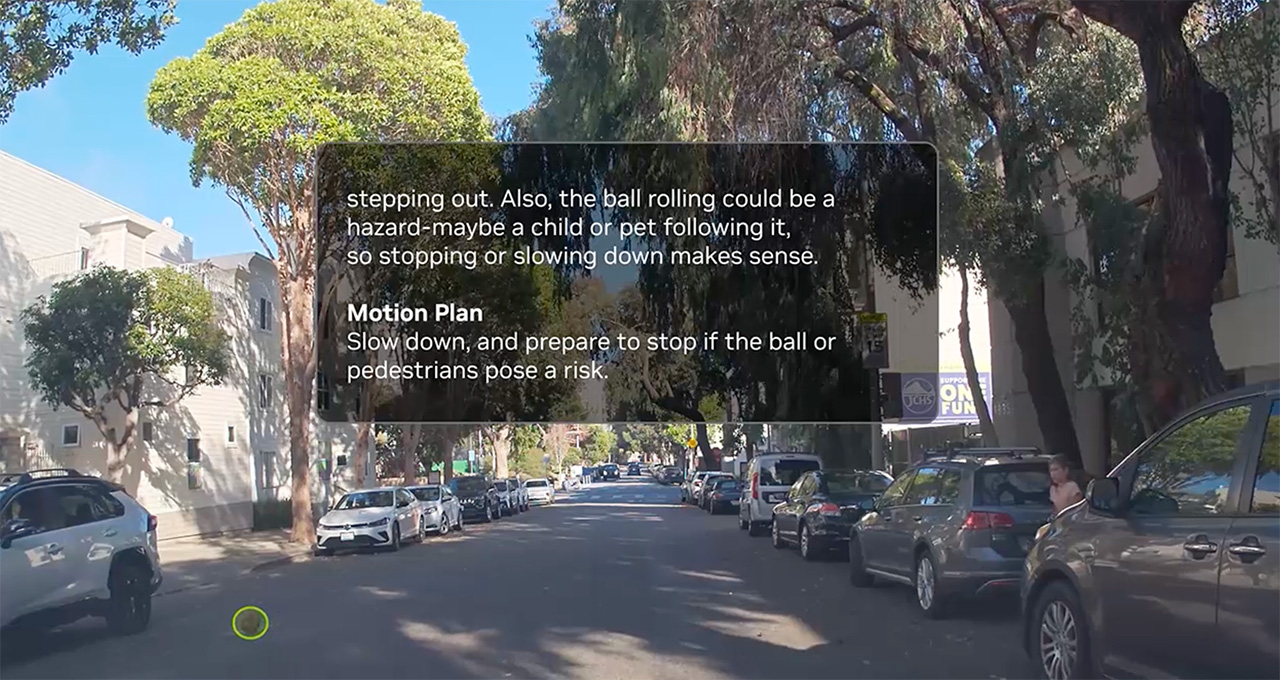
The NVIDIA DRIVE Alpamayo-R1 (AR1) is a groundbreaking model in the realm of AV research. AR1 is the first open reasoning VLA model that integrates AI reasoning with path planning, a critical component for enhancing AV safety in complex road scenarios and achieving level 4 autonomy. Previous self-driving models often struggled with complex situations, such as navigating pedestrian-heavy intersections or dealing with unexpected obstacles like double-parked vehicles. However, AR1 uses reasoning to enable vehicles to drive more like humans, considering all possible trajectories and contextual data to select the best route.
For instance, in a scenario with heavy pedestrian traffic and adjacent bike lanes, AR1 can analyze data to determine the safest trajectory, such as adjusting its path away from the bike lane or stopping for potential jaywalkers. This reasoning capability allows for more human-like decision-making by autonomous vehicles.
The open nature of AR1, built on NVIDIA Cosmos Reason, allows researchers to adapt the model for their non-commercial applications, whether for benchmarking purposes or developing experimental AV applications. Post-training AR1 using reinforcement learning has shown significant improvements in its reasoning capabilities compared to the pretrained model.
NVIDIA DRIVE Alpamayo-R1 will be accessible on platforms like GitHub and Hugging Face. Additionally, a subset of the data used for training and evaluating the model is available in the NVIDIA Physical AI Open Datasets. To facilitate AR1 evaluation, NVIDIA has also released the open-source AlpaSim framework.
### Customizing NVIDIA Cosmos for Physical AI
Developers interested in utilizing Cosmos-based models can find comprehensive guidance through the Cosmos Cookbook. This resource provides step-by-step recipes, quick-start inference examples, and advanced post-training workflows, covering every aspect of AI development from data curation to model evaluation.
Cosmos-based applications have virtually limitless potential. NVIDIA has showcased several examples, including LidarGen, the first world model capable of generating lidar data for AV simulation, and Omniverse NuRec Fixer, a model designed for AV and robotics simulation that quickly resolves artifacts in neurally reconstructed data.
Other examples include Cosmos Policy, a framework that turns large pretrained video models into robust robot policies, and ProtoMotions3, an open-source framework for training digital humans and humanoid robots in realistic scenes generated by Cosmos world foundation models (WFMs).
These policy models can be trained in environments like NVIDIA Isaac Lab and Isaac Sim. The data generated from these models can then be used to enhance NVIDIA GR00T N models for robotics.
### NVIDIA Nemotron: Enhancing the Digital AI Toolkit
In the realm of digital AI, NVIDIA is introducing new multi-speaker speech AI models, reasoning-enhanced models, and datasets focused on AI safety. These tools include MultiTalker Parakeet, an automatic speech recognition model that can handle multiple speakers in real-time, and Sortformer, a model that accurately distinguishes speakers within an audio stream.
The Nemotron Content Safety Reasoning model is another significant release, offering reasoning-based AI safety measures that enforce custom policies across various domains. Additionally, the Nemotron Safety Audio Dataset aids in training models to detect unsafe audio content, supporting the development of guardrails across text and audio formats.
NeMo Gym, an open-source library, simplifies the creation of reinforcement learning environments for training large language models (LLMs). It includes a collection of training environments that facilitate Reinforcement Learning from Verifiable Reward (RLVR). The NeMo Data Designer Library, now open-sourced under Apache 2.0, provides a complete toolkit for generating, validating, and refining synthetic datasets for generative AI development.
NVIDIA’s partners, such as CrowdStrike, Palantir, and ServiceNow, are utilizing these tools to build secure, specialized AI applications.
### Advancements in Language AI
NVIDIA is also making strides in language AI, contributing numerous research papers at NeurIPS. These papers focus on advancing language models, showcasing NVIDIA’s ongoing innovation in AI technology.
For those interested in exploring NVIDIA’s contributions further, the Nemotron Summit at NeurIPS offers an in-depth look at these advancements, with keynotes and presentations from NVIDIA’s experts.
In conclusion, NVIDIA’s commitment to open-source technology and its advancements in both digital and physical AI continue to shape the future of AI research and development. With tools and models designed to enhance safety, reasoning, and customization, NVIDIA is paving the way for more innovative and practical AI applications across various industries.
For more Information, Refer to this article.