












![[Video] Samsung Spatial Signage: How To Make Your Brand Stand Out in Crowded Spaces](https://www.hawkdive.com/media/samsung-tvs-and-displays-samsung-spatial-signage-samsung-vxt_thumb932-218x150.jpg "Samsung Spatial Signage: Elevate Your Brand in Crowded Environments")








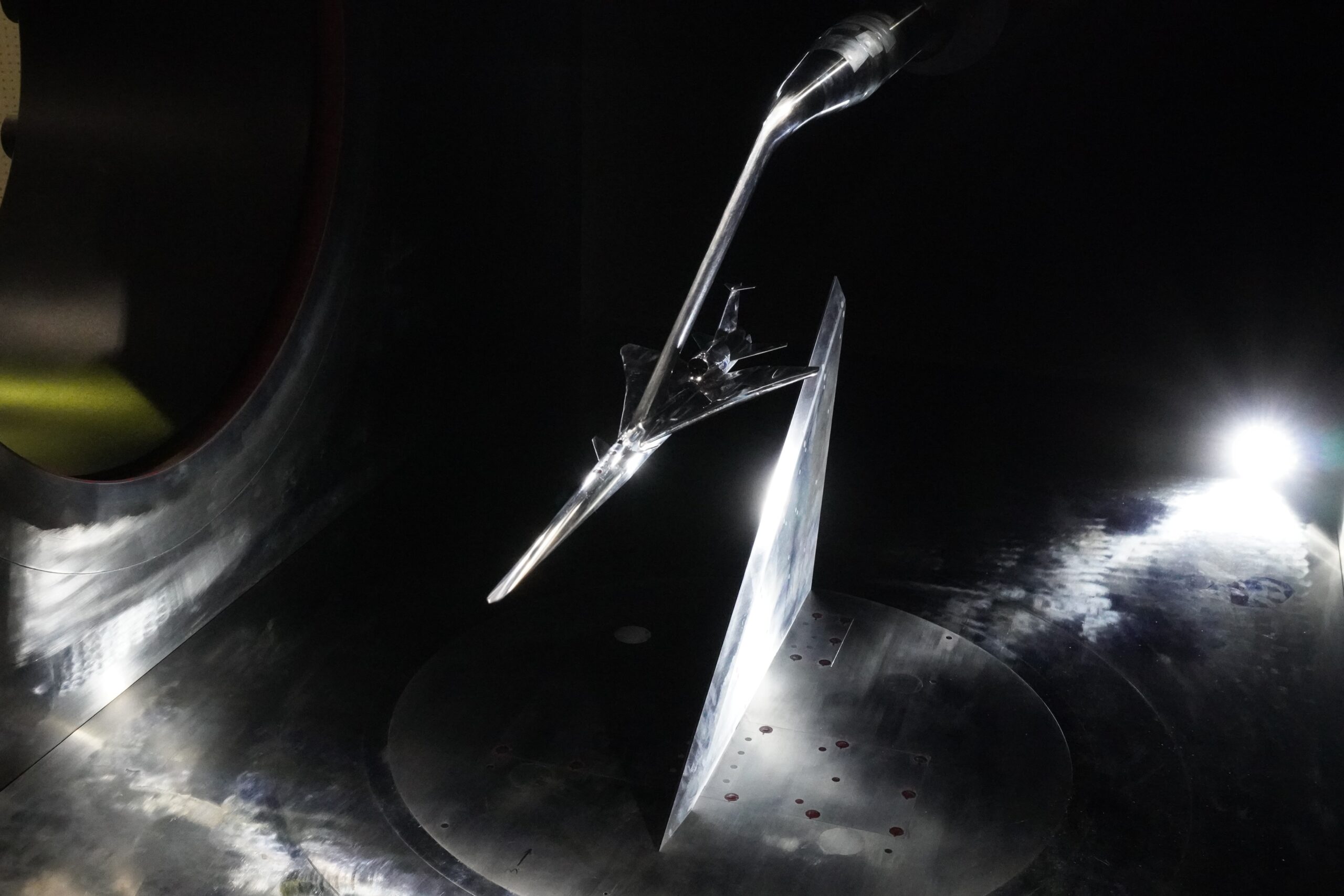
In a groundbreaking collaboration, researchers from NASA and the Japanese Aerospace Exploration Agency (JAXA) have successfully conducted a series of tests on a scale model of the experimental X-59 aircraft. These tests took place in a supersonic wind tunnel located in Chofu, Japan. The primary goal was to evaluate the noise levels that would be audible beneath the aircraft as it travels faster than the speed of sound.
The X-59 represents an innovative leap in aerospace design, aiming to achieve supersonic speeds without the disruptive sonic boom typically associated with such travel. This development is crucial for the future of commercial supersonic flights, as minimizing noise pollution is a significant concern for communities living under potential flight paths.
The X-59 aircraft itself measures 99.7 feet in length with a wingspan of 29.7 feet. However, for the purpose of wind tunnel testing, researchers utilized a model that was scaled down to just 1.62% of the actual size, measuring approximately 19 inches from nose to tail. This model was subjected to conditions simulating the aircraft’s planned cruising speed of Mach 1.4, which is roughly equivalent to 925 miles per hour.
This particular series of tests is not an isolated event but part of an ongoing effort to refine the X-59’s design. It marks the third round of wind tunnel tests for the X-59 model, following previous assessments at JAXA and NASA’s Glenn Research Center in Ohio. The data collected from these tests are invaluable, providing researchers with critical insights that complement predictions made through Computational Fluid Dynamics (CFD) modeling. CFD is a sophisticated method used in aerospace engineering to simulate how air flows around an aircraft, allowing for more accurate predictions of aerodynamic performance and noise levels.
Understanding the behavior of shock waves generated by the X-59 is central to these tests. Traditional supersonic aircraft often produce a loud sonic boom because their shock waves merge together. In contrast, the X-59 is uniquely designed to prevent these shock waves from merging, resulting in a much quieter “sonic thump.” This quieter sound is essential for making supersonic travel viable over land, where noise restrictions currently limit such flights.
The construction of the X-59 took place in Palmdale, California, at Lockheed Martin’s Skunk Works, a division renowned for its cutting-edge aerospace projects. As the aircraft undergoes final ground tests, anticipation builds for its historic first flight planned for later this year.
NASA’s Quesst mission, which supports the development of the X-59, aims to revolutionize the future of quiet supersonic travel. By using the X-59 to gather public feedback on acceptable noise levels, NASA hopes to inform regulatory bodies and shape future policies for supersonic flight over populated areas.
The Quesst mission is not just about creating a single aircraft but paving the way for a new class of quiet supersonic airliners. By delivering design tools and technologies, NASA aims to enable commercial operators to achieve high speeds without causing a disturbance to people on the ground. This initiative could potentially transform air travel, reducing flight times significantly while maintaining a peaceful environment for those on the ground.
The implications of this research are vast. If successful, the X-59 could lead to more efficient air travel, opening up new possibilities for global connectivity. The ability to fly supersonically without the loud booms could reignite interest in commercial supersonic travel, which has been dormant since the retirement of the Concorde.
Moreover, the collaboration between NASA and JAXA exemplifies the importance of international partnerships in advancing aerospace technology. By pooling resources and expertise, these organizations are pushing the boundaries of what’s possible in flight.
In conclusion, the ongoing tests and developments surrounding the X-59 are a testament to human ingenuity and the relentless pursuit of innovation. As the world awaits the results of this ambitious project, the potential benefits for future air travelers and the aerospace industry are immense. The X-59 stands as a beacon of progress, heralding a new era of quieter, faster, and more efficient air travel.
For more Information, Refer to this article.