

















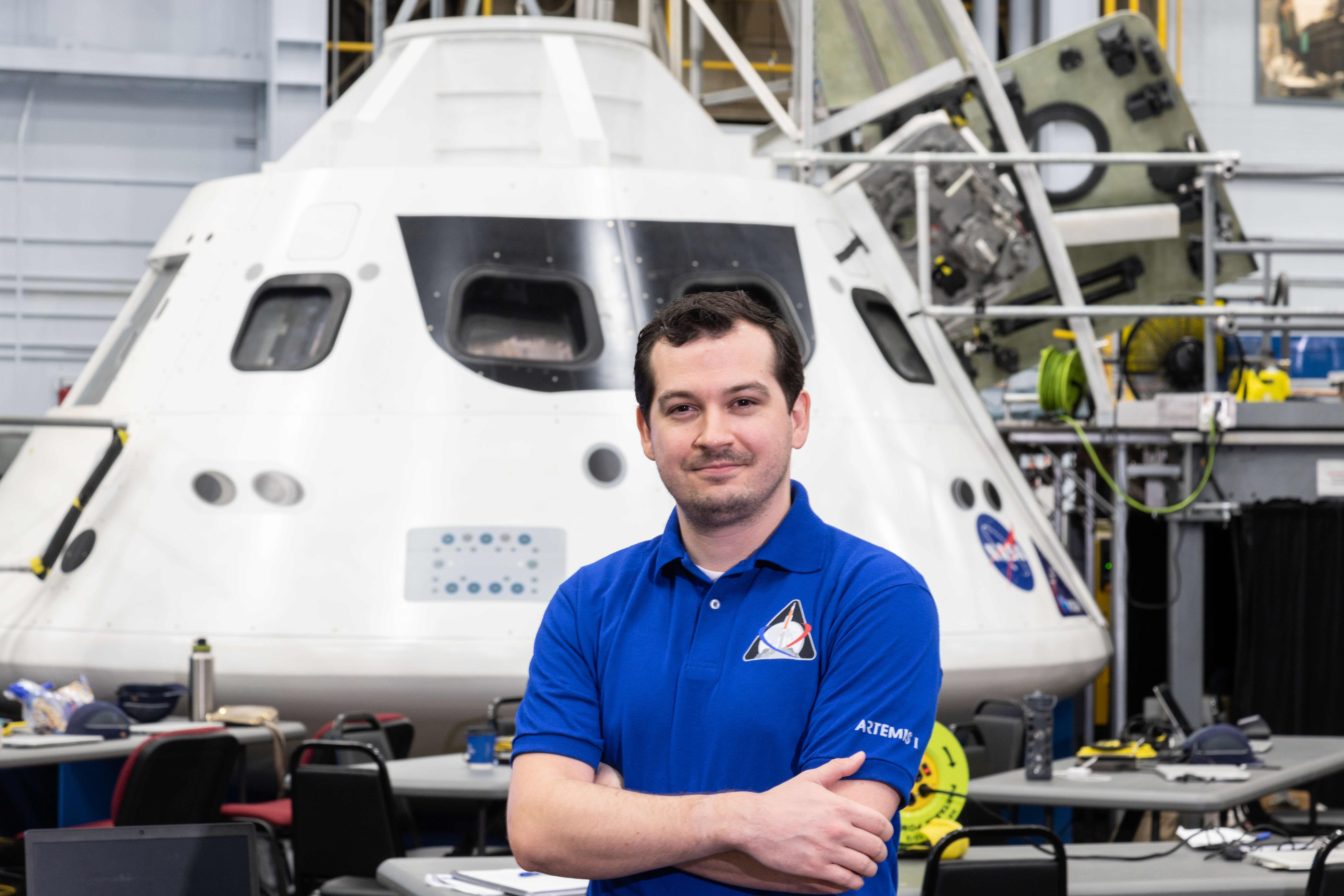
In an inspiring journey from childhood dreams to pivotal roles in space exploration, Mark Cavanaugh stands as a testament to dedication and passion in his role at NASA. As an Orion integration lead at the Johnson Space Center in Houston, Mark plays a crucial role in ensuring that the Orion spacecraft is prepared for its ambitious mission around the Moon as part of Artemis II. This mission marks NASA’s first crewed lunar venture since the historic Apollo missions.
Mark Cavanaugh’s primary responsibility is to ensure the seamless integration of critical systems within both the U.S.-built crew module and the European-built service module of the Orion spacecraft. The European Service Module is a vital component, providing the necessary power, propulsion, and life support for the spacecraft. Under Mark’s vigilant oversight, systems essential for the crew’s survival, including oxygen, nitrogen, water storage, temperature regulation, and the structural integrity of the spacecraft, are meticulously aligned and verified.
With nearly a decade of experience at NASA, Cavanaugh is well-acquainted with the intricacies of space missions. His expertise is not only confined to integration work; he also serves as an Orion Mission Evaluation Room (MER) manager. The MER functions as the engineering nerve center during Artemis flights, where real-time monitoring and decision-making occur. From the moments leading up to launch until the spacecraft’s splashdown, Mark leads a team of engineers dedicated to tracking the health and status of the vehicle, troubleshooting anomalies, and maintaining direct communication with the flight director to ensure the safety and success of the mission.
Mark’s passion for space exploration was kindled at an early age. Reflecting on his journey, he shares, “I’ve wanted to be an aerospace engineer since I was six years old.” His interest was further fueled by his uncle, also an aerospace engineer, who introduced him to wind tunnel tests and flight museums. A pivotal moment in his life came during a fifth-grade trip from Philadelphia to Houston with his grandfather, where he visited NASA’s Johnson Space Center for the first time. This visit ignited a dream that would eventually lead him to contribute to NASA’s groundbreaking work.
The path to realizing his childhood dream was not straightforward. Cavanaugh graduated from Pennsylvania State University in 2011, coinciding with the end of NASA’s Space Shuttle Program. Amidst a scarcity of job opportunities in the space industry, he initially worked with Boeing in Houston on the International Space Station’s Passive Thermal Control System. His career path included supporting thermal teams for the Artemis Moon rocket, known as the Space Launch System, and the Starliner spacecraft. It was during this time that a mentor highlighted a NASA job posting that proved to be a perfect fit for him.
Upon joining NASA, Mark initially served as the deputy system manager for Orion’s Passive Thermal Control System. His leadership capabilities soon saw him stepping into his current role in the broader Orion integration team. Reflecting on his journey, he expresses gratitude for the supportive colleagues he has worked with, saying, “I’ve been very lucky to work with some of the best and most supportive teammates you can imagine.”
In tackling the challenges that arise in space exploration, Mark emphasizes the importance of collaboration and empathy. “I’ve learned to look at things from the other person’s perspective,” he explains. Despite differing viewpoints, he highlights the collective goal of achieving incredible feats, which fosters a constructive environment and prevents misunderstandings. Additionally, Mark underscores the significance of creative problem-solving, asserting, “For me, overcoming technical challenges comes down to seeking different perspectives, questioning assumptions, and not being afraid to try something new—even if it sounds a little ridiculous at first.”
Outside his professional life, Mark channels his love for speed and precision into riding motorcycles. He owns three motorcycles and has even taken laps at the Circuit of the Americas track in Austin, Texas. Beyond his passion for engineering and speed, Mark is committed to inspiring the next generation through student outreach. “The thing I always stress when I talk to students is that nothing is impossible,” he shares. Despite initial doubts about his chances of working in the space industry, let alone at NASA, he remained open to opportunities that deviated from his original expectations.
Mark Cavanaugh’s journey from a young dreamer to a key player in NASA’s Artemis missions serves as an inspirational narrative for aspiring engineers and space enthusiasts alike. His story highlights the impact of perseverance, collaboration, and an openness to new opportunities. As Artemis II prepares for its historic journey around the Moon, Mark’s contributions ensure that the mission is not only ambitious but also safe and successful. For more detailed insights on NASA’s Artemis missions, you can visit NASA’s official website for updates and information.
For more Information, Refer to this article.