NASA’s Dual Spacecraft Mission to Understand Mars’ Magnetic Environment
NASA has embarked on an ambitious mission with two spacecraft aimed at studying Mars’ magnetic environment and its interaction with solar activity. This mission, known as ESCAPADE (Escape and Plasma Acceleration and Dynamics Explorers), is a significant step toward enabling future human exploration of Mars. The mission’s primary goal is to help scientists understand how the Sun influences the Martian environment, which is crucial for preparing for human missions to the Red Planet.
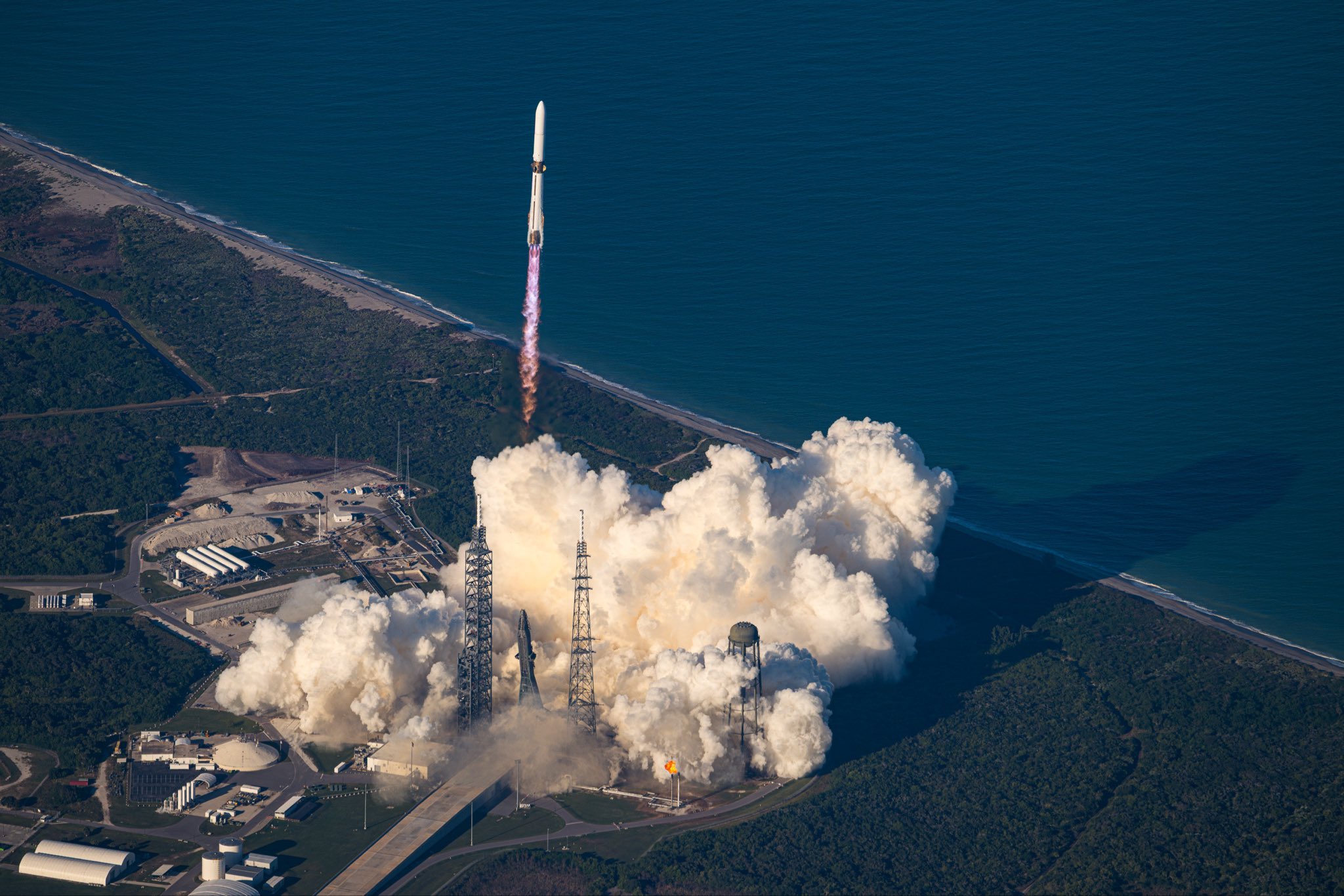
The ESCAPADE spacecraft were launched on a Blue Origin New Glenn rocket from Cape Canaveral Space Force Station in Florida. The launch occurred on a Thursday afternoon, marking an important milestone for the collaborative efforts between NASA, Blue Origin, Rocket Lab, and the University of California, Berkeley. The mission is particularly focused on understanding how Mars, once a planet with surface water, became the arid desert planet we know today.
The Science Behind ESCAPADE
The twin spacecraft, designed and built by Rocket Lab, will delve into the effects of the solar wind—a relentless stream of charged particles emitted by the Sun—on Mars. This solar wind has gradually stripped away the Martian atmosphere, causing a significant drop in surface temperatures and the evaporation of water. By studying these interactions, ESCAPADE aims to provide insights into the historical climatic changes on Mars.
NASA established communication with both spacecraft shortly after launch, marking the beginning of a journey that will deepen our understanding of Martian space weather. This knowledge is vital for ensuring the safety of future astronauts who will be exposed to these extreme environmental conditions.
Advanced Communication Technology
In addition to the primary mission objectives, the New Glenn rocket carried a space communications technology demonstration from Viasat Inc. This demonstration is part of NASA’s initiative to commercialize next-generation satellite relay services, which are crucial for future science missions. By transmitting launch telemetry data via Viasat’s geostationary satellite network, NASA is exploring new ways to enhance communication capabilities for space missions.
Overcoming Solar Challenges
The launch of the ESCAPADE mission faced a slight delay due to recent solar activity, which had triggered widespread auroras on Earth. This decision was made to protect the spacecraft from potential damage caused by solar storms. Once ESCAPADE reaches Mars, it will study the real-time impact of solar wind and storms on the planet, providing critical data that will inform future Mars missions.
A Unique Trajectory to Mars
ESCAPADE’s journey to Mars is unlike any other. Instead of heading directly to the Red Planet, the spacecraft will first travel to a gravitationally stable point in space known as Lagrange point 2. This approach is necessary because Earth and Mars are currently on opposite sides of the Sun, making direct travel more challenging. By November 2026, when the planets are better aligned, ESCAPADE will use Earth’s gravity to slingshot towards Mars.
This innovative trajectory, also referred to as an "Earth-proximity" or "loiter" orbit, allows for more flexible launch windows. Traditionally, Mars missions have had to launch during specific periods when the planets are aligned, which occurs every two years. ESCAPADE’s approach could revolutionize future missions by allowing launches at almost any time, with spacecraft waiting in space until conditions are optimal for interplanetary travel.
Exploring Earth’s Magnetotail
As part of its journey, ESCAPADE will be the first mission to pass through a distant region of Earth’s magnetotail. The magnetotail is part of Earth’s magnetic field that extends away from the Sun, influenced by the solar wind. This exploration will contribute valuable data to our understanding of Earth’s magnetic environment as well.
Synchronized Study of Mars
After a 10-month journey, ESCAPADE is expected to arrive at Mars in September 2027. It will become the first coordinated dual-spacecraft mission to orbit another planet. Initially, the two spacecraft will follow each other closely in a "string-of-pearls" formation, allowing them to observe and measure space weather conditions in quick succession. This synchronized study will provide insights into how these conditions vary over short timescales.
Six months into their mission, the spacecraft will shift into separate orbits. One will orbit closer to Mars, while the other will travel farther away. This configuration will enable simultaneous study of the solar wind and Mars’ upper atmosphere, offering a comprehensive view of how the planet reacts to solar activity.
Understanding Mars’ Ionosphere
ESCAPADE will also gather data on Mars’ ionosphere, the upper atmospheric layer that future astronauts will rely on for communication and navigation signals. Understanding the ionosphere is crucial for ensuring the success of human missions to Mars, providing reliable communication channels for astronauts on the planet’s surface.
Collaborative Efforts and Future Prospects
The ESCAPADE mission is funded by NASA’s Heliophysics Division and is part of the Small Innovative Missions for Planetary Exploration program. Several institutions, including NASA’s Goddard Space Flight Center, Embry-Riddle Aeronautical University, and Advanced Space, are supporting the mission. The launch was managed by NASA’s Launch Services Program, highlighting the collaborative efforts that make such groundbreaking missions possible.
For those interested in learning more about this mission, detailed information is available on NASA’s official website. This mission not only represents a step forward in our understanding of Mars but also exemplifies the innovative approaches being taken to explore our solar system.
Conclusion
The ESCAPADE mission is set to expand our knowledge of Mars and its interaction with the Sun, laying the groundwork for future human exploration. This mission showcases the power of collaboration and innovation in space exploration, paving the way for a new era of scientific discovery. As we look to the future, understanding Mars’ magnetic environment will be key to unlocking the mysteries of our neighboring planet and ensuring the safety of those who may one day call it home.
For more Information, Refer to this article.