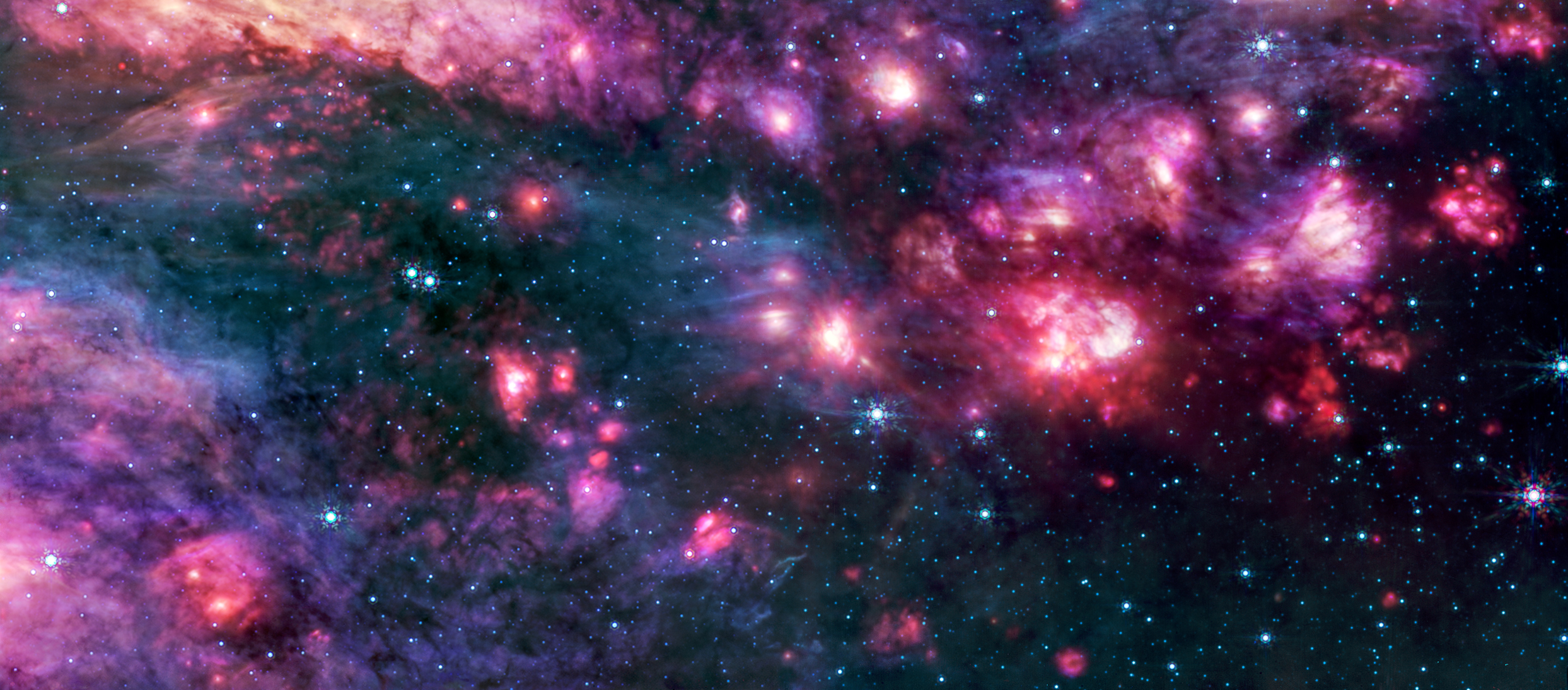
NASA’s James Webb Space Telescope Unveils Unprecedented Details of Star Formation in Sagittarius B2
NASA’s James Webb Space Telescope (JWST) has once again demonstrated its remarkable capabilities by capturing an awe-inspiring image of the Sagittarius B2 (Sgr B2) molecular cloud. This was achieved using its cutting-edge Mid-Infrared Instrument (MIRI), and the image was released on September 24, 2025. The revelation of this image has provided scientists and astronomy enthusiasts with a rare glimpse into the enigmatic star-forming processes occurring within our galaxy’s most massive and active regions.
Understanding Sagittarius B2
Sagittarius B2 is not just any molecular cloud. It is the largest and most active star-forming region in the Milky Way galaxy, located merely a few hundred light-years away from the supermassive black hole that resides at our galaxy’s center. Despite containing only about 10% of the gas present in the galactic center, Sgr B2 is responsible for producing 50% of the stars in that region. This unusual level of activity has piqued the interest of astronomers who are keen to understand the mechanisms driving such prolific star formation.
The Role of the Mid-Infrared Instrument
MIRI, a key tool on the James Webb Space Telescope, is equipped with both a camera and a spectrograph. It operates by detecting light in the mid-infrared range of the electromagnetic spectrum, a region that is particularly useful for observing cooler objects like star-forming regions, planetary atmospheres, and cosmic dust. The ability to capture mid-infrared light allows MIRI to reveal the intricate details of stars and the surrounding clouds of gas and dust that are otherwise obscured in visible light.
What the Image Reveals
The breathtaking image captured by MIRI showcases a vibrant array of stars interspersed with bright clouds of gas and dust. These clouds are heated by young, massive stars, which cause them to glow in the mid-infrared spectrum. The level of detail in this image is unprecedented, providing a new perspective on the processes that govern star formation in such dense and active regions of space.
Further analysis of this image will allow astronomers to delve into the characteristics of the stars within Sgr B2, including their masses and ages. By understanding these properties, scientists can gain valuable insights into the lifecycle of stars and the conditions that lead to star formation in the heart of our galaxy.
The Significance of MIRI’s Observations
The observations made by MIRI on the James Webb Space Telescope are groundbreaking for several reasons. Firstly, they provide a clearer picture of the star-forming activities within Sgr B2, a region that plays a crucial role in the Milky Way’s stellar population. Secondly, this data helps astronomers refine their models of star formation and the influence of molecular clouds on this process.
Moreover, the mid-infrared capabilities of MIRI allow for the study of objects and phenomena that are otherwise hidden from view in other wavelengths. This includes the ability to penetrate through thick cosmic dust, which often obscures regions of intense star formation in visible light.
The Broader Implications
The insights gained from studying Sagittarius B2 have broader implications for our understanding of galactic evolution and the formation of stars and planets throughout the universe. By examining the conditions and processes in such an active region, astronomers can draw parallels and contrasts with other star-forming regions both within and beyond our galaxy.
This knowledge is instrumental in piecing together the complex history of the Milky Way and other galaxies, and it contributes to our overarching understanding of the cosmos.
Looking Ahead
As the James Webb Space Telescope continues its mission, astronomers eagerly anticipate further discoveries that will shed light on the mysteries of our universe. The insights gained from MIRI’s observations are just the beginning, and the potential for new revelations is vast.
With each new image and data set, the astronomy community moves closer to unlocking the secrets of star formation, galaxy evolution, and the fundamental processes that shape the cosmos.
Conclusion
The recent image of Sagittarius B2 captured by the Mid-Infrared Instrument on NASA’s James Webb Space Telescope marks a significant milestone in our exploration of the universe. By providing unprecedented details of this active star-forming region, the JWST is enhancing our understanding of the intricate processes that govern the birth and evolution of stars.
As we continue to explore the depths of space with advanced technology, new discoveries await, promising to deepen our understanding of the universe and our place within it.
For more information about the James Webb Space Telescope and its mission, visit the official NASA website.
For more Information, Refer to this article.