
























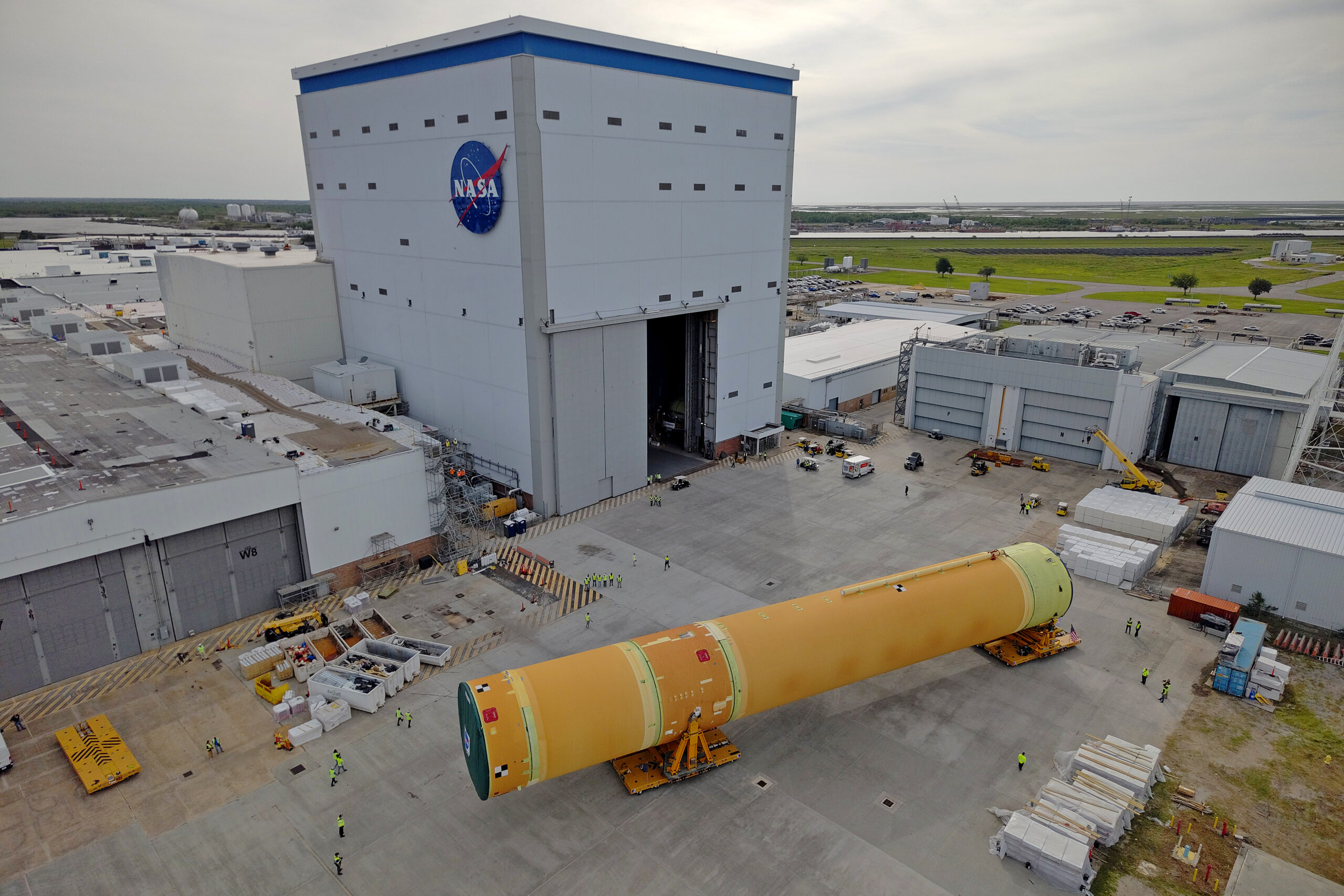
NASA Advances Artemis III Mission with Core Stage Rollout
NASA has taken a significant step forward in its Artemis program by rolling out the core stage of the Space Launch System (SLS) rocket, which is set to launch the crewed Artemis III mission in 2027. The core stage, the largest section of the SLS, departed from the Michoud Assembly Facility in New Orleans on Monday and is en route to NASA’s Kennedy Space Center in Florida, marking a pivotal moment in preparations for a historic lunar landing.
Transporting the Core Stage
The transportation of the SLS core stage involved specialized transporters that carefully maneuvered the top four-fifths of the rocket. This section houses crucial components such as the liquid hydrogen tank, liquid oxygen tank, intertank, and forward skirt. Once it arrives at Kennedy Space Center, teams will complete outfitting and vertical integration of the stage. The Exploration Ground Systems Program at NASA will then stack all components of the rocket in preparation for its launch.
Significance of the Core Stage
The completed core stage will stand at an impressive 212 feet tall when fully assembled. It includes two propellant tanks that together hold over 733,000 gallons of super-chilled liquid propellant necessary to fuel four RS-25 engines. During launch, this integrated stage will operate for more than eight minutes, generating over 2 million pounds of thrust to propel astronauts aboard NASA’s Orion spacecraft into orbit.
Lori Glaze, acting associate administrator for NASA’s Exploration Systems Development Mission Directorate, emphasized the significance of this milestone. She stated that seeing the SLS hardware roll out serves as a powerful reminder of progress toward returning humans to the Moon. As preparations continue for Artemis III, NASA aims to test critical capabilities essential for landing astronauts on lunar soil and eventually paving the way for crewed missions to Mars.
Collaborative Efforts Behind SLS Development
The development and transportation of the SLS core stage is a collaborative effort involving two prime contractors: Boeing and L3Harris Technologies. Boeing oversees overall design and assembly, while L3Harris manufactures the RS-25 engines that power the rocket. Recent announcements from NASA Administrator Jared Isaacman have focused on standardizing SLS configurations and streamlining operations to enhance production efficiency within the Artemis program.
Future Missions Under Artemis Program
The upcoming Artemis III mission is set to launch astronauts into Earth’s orbit aboard Orion atop the SLS rocket. This mission will test rendezvous and docking capabilities between Orion and commercial spacecraft required for future missions like Artemis IV, which aims to land astronauts on the Moon in 2028. Notably, NASA’s SLS is uniquely capable of sending Orion along with astronauts and supplies to lunar destinations in a single launch.
As part of what NASA describes as a Golden Age of innovation and exploration, Artemis astronauts will undertake increasingly challenging missions aimed at exploring more regions of the Moon. These endeavors are expected not only to yield scientific discoveries but also economic benefits while establishing a sustainable human presence on lunar terrain—laying groundwork for future crewed missions to Mars.
What This Means
The rollout of the SLS core stage marks an important milestone in NASA’s ongoing efforts to return humans to lunar exploration through its Artemis program. With each step forward—whether it be transporting vital components or preparing for upcoming missions—the agency moves closer to achieving its ambitious goals. As humanity prepares for further exploration beyond Earth, these developments underscore both technological advancements and international collaboration in space exploration.
For more information, read the original report here.