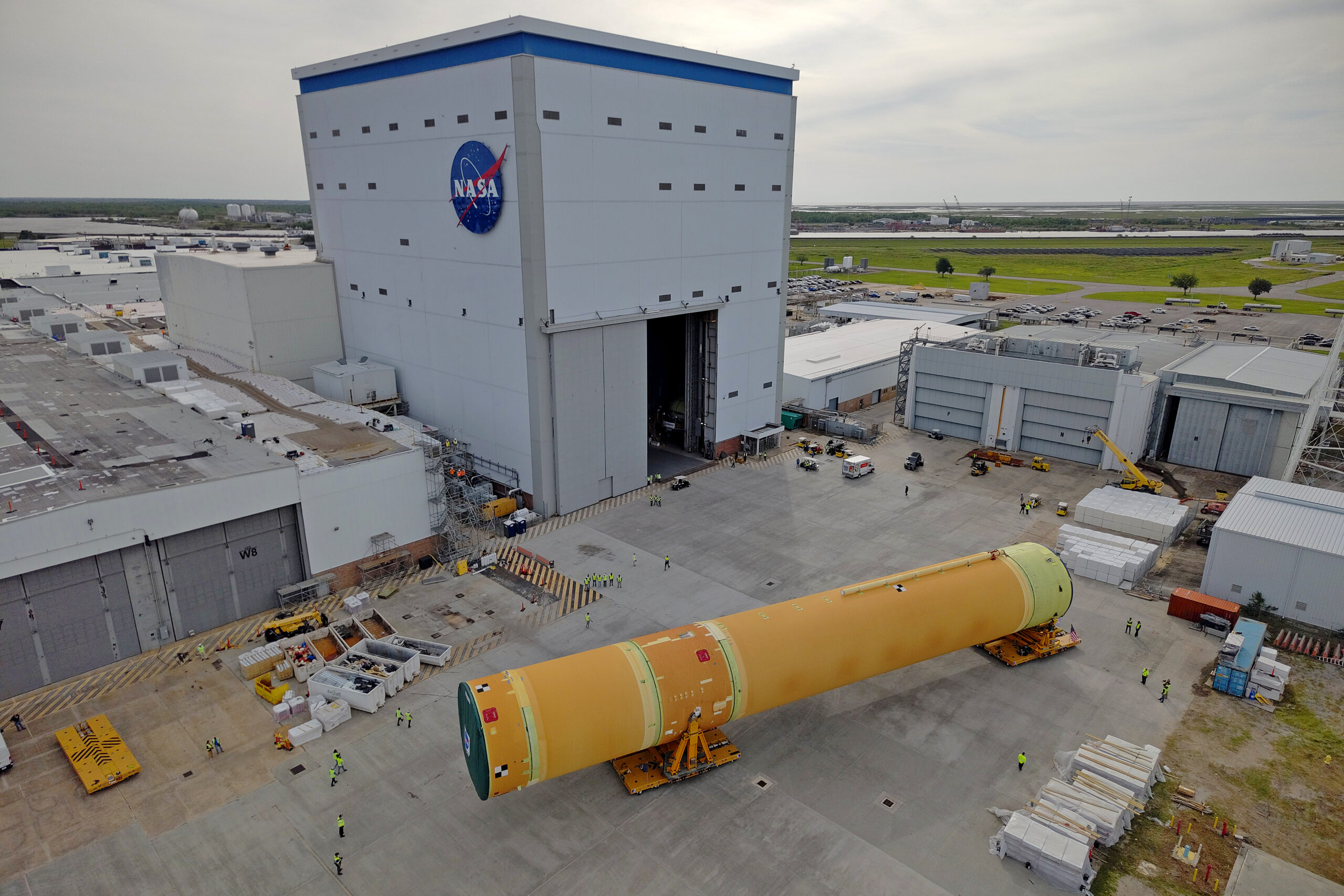
NASA Advances Artemis III Mission with Core Stage Rollout
NASA has taken a significant step forward in its Artemis program by rolling out the core stage of the Space Launch System (SLS) rocket, which is set to launch the crewed Artemis III mission in 2027. This milestone occurred on Monday when the core stage departed from NASA’s Michoud Assembly Facility in New Orleans, heading to the Kennedy Space Center in Florida for final preparations. This rollout follows the successful test flight of the Artemis II mission around the Moon, underscoring NASA’s commitment to returning humans to lunar exploration.
Details of the Core Stage and Its Journey
The core stage of the SLS rocket is a critical component that includes essential elements such as the liquid hydrogen tank, liquid oxygen tank, intertank, and forward skirt. Engineers used specialized transporters to carefully maneuver this massive structure—comprising four-fifths of the total rocket height—onto NASA’s Pegasus barge for transport. Upon arrival at Kennedy Space Center, teams will complete outfitting and vertical integration processes before stacking all components in preparation for launch.
Lori Glaze, acting associate administrator for NASA’s Exploration Systems Development Mission Directorate, emphasized the importance of this progress. “Seeing this SLS rocket hardware roll out is a powerful reminder of our progress toward returning humans to the lunar surface,” she stated. The core stage will ultimately measure 212 feet tall when combined with its engine section and is designed to produce over 2 million pounds of thrust through its four RS-25 engines during launch.
Collaboration Between Contractors
The development and transportation of the SLS core stage is a result of collaboration between two primary contractors: Boeing and L3Harris Technologies. Boeing oversees the overall design and assembly of the core stage, while L3Harris is responsible for manufacturing the RS-25 engines that power it. Recent announcements from NASA Administrator Jared Isaacman have focused on standardizing SLS configurations and optimizing production processes, which aim to accelerate timelines for future Artemis missions.
Looking Ahead: The Artemis III Mission
The upcoming Artemis III mission is poised to be a pivotal moment in lunar exploration. Scheduled for next year, this mission will see astronauts launched into Earth’s orbit aboard Orion spacecraft atop the SLS rocket. A key objective will be testing rendezvous and docking capabilities between Orion and commercial spacecraft, which are essential for subsequent missions like Artemis IV, planned for 2028. Notably, NASA’s SLS is uniquely capable of sending both Orion and necessary supplies to the Moon in a single launch—a critical feature that distinguishes it from other rockets.
The Broader Impact of Artemis Program
The Artemis program represents what many consider a Golden Age of space exploration and innovation. As part of this initiative, NASA aims to send astronauts on increasingly complex missions that not only enhance scientific understanding but also foster economic opportunities on the Moon. Establishing a sustained human presence on lunar soil will serve as a foundation for future crewed missions to Mars.
What This Means
The rollout of the SLS core stage marks a crucial milestone in NASA’s ambitious plans for lunar exploration under the Artemis program. With each step forward—from successful test flights to hardware rollouts—NASA demonstrates its commitment to advancing human spaceflight capabilities. The implications extend beyond just returning humans to the Moon; they lay groundwork for future interplanetary exploration, particularly missions aimed at Mars. As these developments unfold, they signal not only technological progress but also an enduring human presence beyond Earth.
For more information, read the original report here.