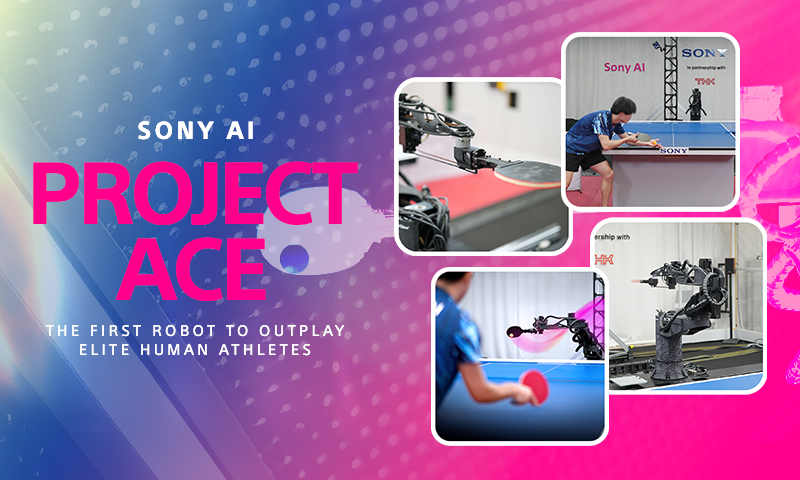
Sony AI Unveils Ace: The First Robot to Compete with Elite Table Tennis Players
On April 23, 2026, Sony AI announced a groundbreaking achievement in robotics and artificial intelligence (AI) with the introduction of Ace, the first autonomous robot capable of competing against elite human table tennis players. This milestone was highlighted in the research paper titled “Outplaying Elite Table Tennis Players with an Autonomous Robot,” published on the cover of the prestigious journal Nature. Ace’s performance not only marks a significant leap in AI capabilities but also sets a new standard for real-world applications of robotics in competitive sports.
A Leap from Virtual to Physical AI
Historically, AI systems have excelled in digital environments, showcasing superhuman abilities in games like chess and Go. However, translating these capabilities into physical realms has posed substantial challenges. The fast-paced nature of sports like table tennis requires instantaneous perception, planning, and execution—tasks that unfold within milliseconds. Sony AI has successfully bridged this gap by integrating advanced sensor technology, reinforcement learning, and precision hardware into Ace.
Ace builds upon previous research conducted by Sony AI on Gran Turismo Sophy, a superhuman AI agent designed for virtual racing. By applying similar principles to real-world environments, Ace demonstrates how robots can interact dynamically and effectively at human-level speeds. This development paves the way for future AI systems capable of operating safely and reliably in complex physical settings, from sports to safety-critical applications.
Peter Dürr, Director of Sony AI in Zürich and project lead for Ace, emphasized the significance of this research: “This research has shown that an autonomous robot can win at a competitive sport, matching or exceeding the reaction time and decision-making of humans.” He noted that table tennis is particularly complex due to its fast-paced nature and the need for split-second decisions.
Pushing the Limits of Human–Robot Interaction
Table tennis serves as a rigorous test for robotics due to its demand for rapid decision-making and precise execution under unpredictable conditions. The ball’s speed and spin present unique challenges that previous robotic systems have struggled to manage effectively. To meet these challenges, Ace incorporates three innovative components:
- A high-speed perception system featuring nine active pixel sensor (APS) cameras equipped with IMX273 image sensors from Sony Semiconductor Solutions (SSS). This system accurately determines the ball’s 3D position while utilizing gaze control systems (GCS) with event-based vision sensors (EVS) to measure angular velocity and spin in real-time.
- A novel control system based on model-free reinforcement learning that allows rapid adaptation without relying on pre-programmed models.
- State-of-the-art high-speed robotic hardware designed for executing precise control during agile physical interactions.
Proving Performance at the Edge of Human Reaction Time
The results documented in Nature highlight Ace’s impressive performance during matches against five elite players and two professional table tennis players under International Table Tennis Federation (ITTF) regulations. In these competitions, Ace secured three victories out of five matches against elite players while demonstrating competitive skills throughout all encounters.
- Ace achieved over a 75% return rate against various spins up to 450 rad/s, showcasing its exceptional capability to handle complex shots—far surpassing previous benchmarks set by other competitive table tennis robots.
- The robot scored 16 direct points after serving against elite players while they collectively managed only eight points.
- Ace’s low-latency perception allowed it to react swiftly to unusual shots, such as those bouncing off the net—demonstrating its ability to adapt to unpredictable scenarios that are difficult to simulate.
This performance marks a pivotal moment in robotics research; it is the first instance where an autonomous system has outperformed human experts in real-time interactive tasks within a competitive setting. Previous attempts at robotic table tennis were limited primarily to cooperative rallies without achieving expert-level play.
Continued Progress Following Publication
Following the initial publication in Nature, additional competitive matches were held in December 2025 and March 2026. During these matches against new opponents—including both professional and elite players—Ace continued to demonstrate significant improvements. It won against two elite players and one professional player while losing only once against another professional opponent. These later evaluations showed enhanced shot speeds, more aggressive placements near the table edge, and faster-paced rallies compared to earlier performances.
Peter Stone, Chief Scientist at Sony AI, remarked on the broader implications of this breakthrough: “It represents a landmark moment in AI research… Once AI can operate at an expert human level under these conditions, it opens the door to an entirely new class of real-world applications that were previously out of reach.”
What This Means
The development of Ace signifies more than just advancements in robotics; it represents a transformative step toward integrating AI into everyday activities requiring quick thinking and precision. As autonomous systems like Ace become capable of outperforming humans in complex tasks involving real-time interaction, industries ranging from healthcare to manufacturing could see significant benefits. The implications extend beyond sports into areas where safety-critical decisions must be made rapidly—potentially reshaping how humans interact with machines across various sectors.
For more information, read the original report here.