

















NASA’s Rovers Unveil Mars’ Ancient History
NASA’s Curiosity and Perseverance rovers are making significant strides in uncovering the Red Planet’s geological history, with each rover exploring vastly different terrains. Curiosity, which has been operational for nearly 15 years, is examining younger layers near Mount Sharp, while Perseverance, active for five years, is investigating some of the oldest landscapes on Mars. This dual exploration is providing a comprehensive view of Mars’ past, revealing insights into its formation and potential for life.
Curiosity’s Journey Through Time
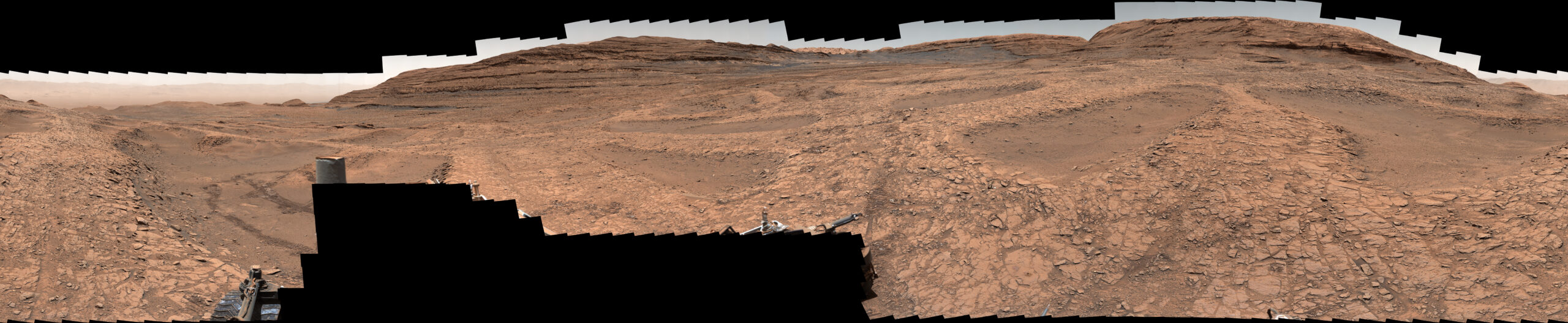
Curiosity has recently captured a stunning 360-degree panorama stitched together from 1,031 images taken between November 9 and December 7, 2025. This detailed view showcases a region characterized by unique boxwork formations—low ridges resembling giant spiderwebs—which were formed by groundwater that once flowed through cracks in the bedrock. The minerals left behind solidified into erosion-resistant structures that tell a story of Mars’ hydrological past.
Since landing on Mars in 2012, Curiosity has focused on determining whether the planet ever had conditions suitable for life. Within its first year, it confirmed the presence of ancient lakebeds with the right chemistry to support microbial life. As Curiosity ascends Mount Sharp—an impressive three-mile-high mountain formed from sedimentary layers deposited in ancient lakes—it is effectively traveling back through geological time. The rover’s exploration of these layers reveals a history marked by periods of wet and dry conditions.
In recent findings, Curiosity’s team reported that the mineral siderite may be storing carbon dioxide that was part of an ancient atmosphere. This discovery aligns with previous hypotheses regarding carbonate minerals forming in ancient lakes but had rarely been substantiated with physical evidence. Additionally, Curiosity has identified some of the largest organic molecules ever found on Mars, furthering the search for complex prebiotic chemistry on the planet.
Perseverance’s Quest for Ancient Life
Launched in 2020 and landing in Jezero Crater in February 2021, Perseverance aims to study ancient rocks and search for signs of past microbial life. The crater once hosted a river that fed into a lake billions of years ago, creating an environment where sediments could preserve traces of life. Recent discoveries include a rock nicknamed “Cheyava Falls,” which exhibited unique patterns indicative of microbial activity similar to those observed on Earth.
Unlike Curiosity, which pulverizes rock samples for analysis, Perseverance collects intact rock cores about the size of chalk pieces and stores them in metal tubes. So far, it has collected 23 samples that scientists hope to return to Earth for more detailed analysis using advanced laboratory equipment. This method allows for a more comprehensive examination of Martian geology and potential biosignatures.
Innovative Discoveries and Technological Advances
The missions have also led to groundbreaking technological advancements. Perseverance recently recorded electrical sparks from dust devils—phenomena previously theorized but never observed directly—using its microphones. Furthermore, it captured visible light auroras from Mars’ surface for the first time, providing new insights into atmospheric phenomena on other planets.
Both rovers are set to continue their explorations as they unravel more secrets about Mars. Curiosity is moving away from boxwork formations to explore layers enriched with sulfates—salty minerals that could provide further clues about the planet’s climatic shifts over time. Meanwhile, Perseverance is heading toward areas with exceptionally old terrain known as “Singing Canyon,” promising even more discoveries about Mars’ ancient environment.
The Future of Martian Exploration
Managed by Caltech’s Jet Propulsion Laboratory (JPL), both rovers are part of NASA’s broader Mars Exploration Program aimed at understanding the planet’s history and its potential to support life. As they continue their missions across vast distances—over 2,300 miles apart—the complementary data they gather will enhance scientific understanding not only of Mars but also provide insights applicable to other celestial bodies.
What This Means
The ongoing work by Curiosity and Perseverance underscores humanity’s commitment to exploring our solar system and understanding planetary evolution. Their findings contribute significantly to astrobiology (the study of life in the universe) and planetary science by revealing how environments change over time and what conditions might support life beyond Earth. As these missions progress, they pave the way for future exploration endeavors aimed at returning samples to Earth and potentially sending humans to Mars.
For more information, read the original report here.