






























NVIDIA’s Innovations Transform Manufacturing with Physical AI
NVIDIA has unveiled significant advancements in manufacturing technology, emphasizing the integration of high-fidelity simulation and artificial intelligence (AI) to enhance operational efficiency. By leveraging OpenUSD (Universal Scene Description), NVIDIA is enabling manufacturers to produce synthetic training data that closely mirrors real-world conditions, thus improving the design-build-test cycle. This shift is poised to revolutionize how industries approach factory environments, making them more adaptive and intelligent.
The Shift Towards Synthetic Training Data
Traditionally, the manufacturing sector relied heavily on real-world testing as the primary method for validating designs and processes. However, this approach is being challenged by the emergence of synthetic training data generated through high-fidelity simulations. These simulations are accurate enough to support production-grade AI systems, allowing for more effective perception systems and reasoning models in live factory settings.
OpenUSD has become a crucial standard in this transition, providing a framework that facilitates the seamless transfer of digital assets across various platforms. As manufacturers adopt this standard, they are already witnessing measurable improvements in their workflows and outcomes.
SimReady: A New Standard for 3D Assets
As physical AI gains traction within industrial operations, manufacturers face challenges related to asset compatibility across different 3D pipelines. Often, when assets move from computer-aided design (CAD) tools to simulation platforms, critical information such as physics properties and metadata is lost. This necessitates rebuilding assets from scratch, leading to inefficiencies.
To address this issue, NVIDIA has introduced SimReady—a content standard built on OpenUSD that defines the essential components required for 3D assets to function reliably across rendering, simulation, and AI training environments. Additionally, NVIDIA Omniverse libraries offer a photorealistic simulation layer where AI models can be trained and validated before deployment, ensuring consistency and accuracy throughout the development process.
Real-World Applications of NVIDIA’s Physical AI Stack
ABB Robotics Achieves Near-Perfect Simulation Accuracy
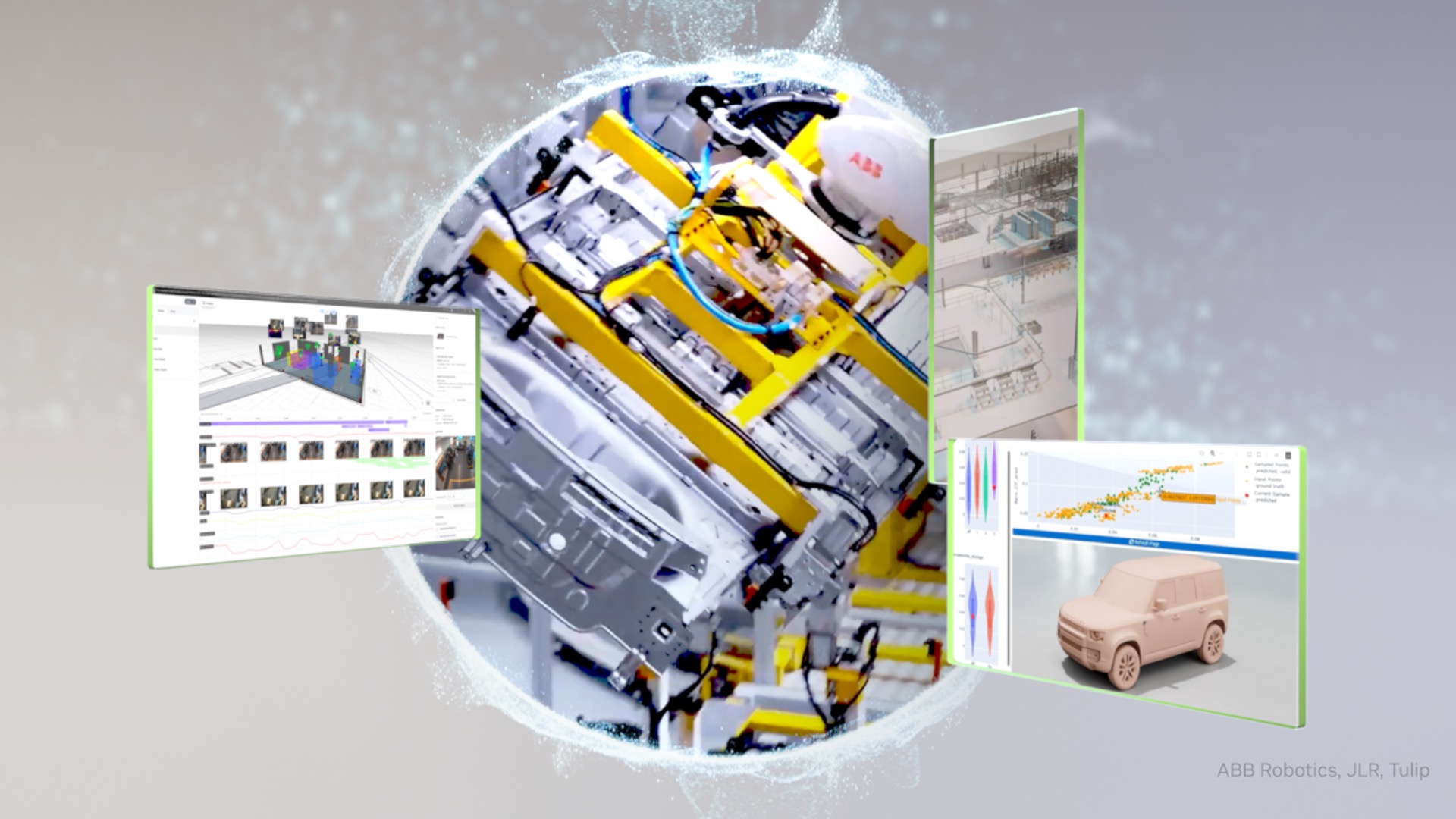
ABB Robotics has successfully integrated NVIDIA Omniverse libraries into its RobotStudio HyperReality simulation platform. This platform is utilized by over 60,000 engineers worldwide and allows for the representation of robot stations as USD files that mirror their physical counterparts’ firmware. This innovation enables engineers to train robots and validate AI models prior to actual production line implementation.
The platform generates synthetic training variations—such as changes in lighting conditions or geometric differences—at scale, covering scenarios that would be impractical to replicate manually. Craig McDonnell, managing director of business line industries at ABB Robotics, stated that they have achieved an impressive 99% accuracy in simulated environments. The resulting efficiencies include a 50% reduction in product introduction cycles and an 80% decrease in commissioning time.
JLR Streamlines Aerodynamic Simulation Processes
Jaguar Land Rover (JLR) has adopted a simulation-first approach for vehicle aerodynamics by training neural surrogate models using over 20,000 wind-tunnel-correlated computational fluid dynamics simulations. With 95% of their aero-thermal workloads now processed on NVIDIA GPUs, JLR has significantly improved its design workflow.
The Neural Concept Design Lab—developed on Omniverse—enables real-time visualization of aerodynamic changes as designers modify vehicle geometry. This continuous loop replaces the previous sequential design-and-simulate cycle; what once took four hours can now be completed in just one minute.
Tulip Interfaces Enhances Factory Intelligence at Terex
Once production begins at a factory, additional challenges arise that cannot be addressed solely through simulation. Tulip Interface’s Factory Playback platform illustrates how existing infrastructure can be transformed into an intelligence layer that extracts actionable insights from operational records. Built on NVIDIA’s Metropolis VSS Blueprint—a reference architecture for processing factory camera feeds—Factory Playback connects camera streams with machine sensor data to create a unified timeline of factory operations.
This system is currently deployed at Terex, a global industrial equipment manufacturer with over 40 plants. It utilizes NVIDIA Cosmos Reason—a vision language model—to interpret camera streams and operator behaviors in real time. The expected outcomes include a 3% increase in yield and a 10% reduction in rework costs.
Getting Started with SimReady Assets
NVIDIA’s SimReady assets and Omniverse libraries provide developers with a robust foundation for integrating physical AI into their industrial applications. Organizations looking to enhance their manufacturing processes can begin by adopting these standards and tools to streamline workflows and improve overall efficiency.
What This Means
The integration of high-fidelity simulations and AI into manufacturing processes signifies a paradigm shift towards more intelligent production environments. By adopting standards like OpenUSD and utilizing tools such as SimReady assets and Omniverse libraries, manufacturers can expect not only improved accuracy but also significant reductions in time-to-market and operational costs. As these technologies continue to evolve, they will likely redefine industry benchmarks for efficiency and innovation.
For more information, read the original report here.







