























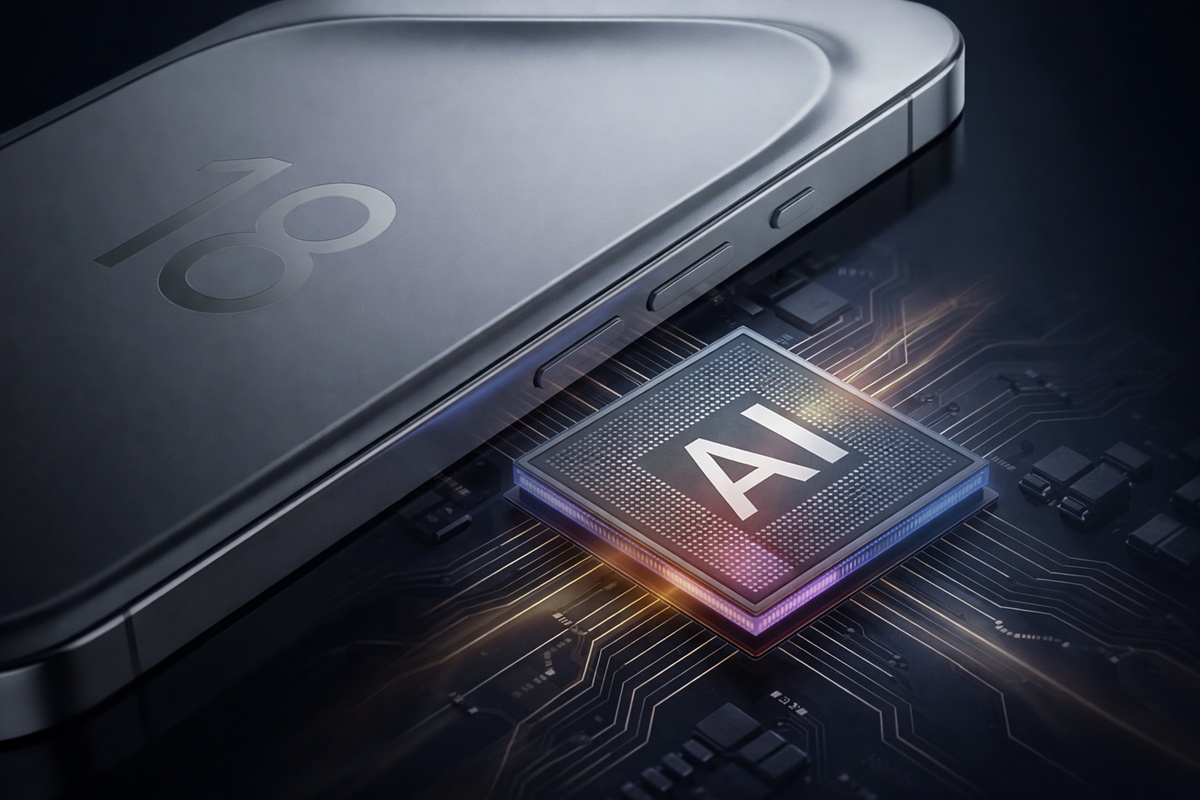
There is a ritual that plays out every year in the Apple ecosystem, predictable as a lunar cycle: the moment one iPhone ships, the rumor mill fires up for the next one. But what’s happening with the iPhone 18 feels different. The whispers aren’t just louder — they’re more structurally significant. We’re not talking about a new color finish or a marginally upgraded camera sensor. We’re talking about Apple potentially rewiring the very cadence and architecture of how it releases iPhones, debuting its first-ever foldable phone, and quietly preparing a silicon leap that could reshape what “on-device AI” means in practice.
Apple, of course, has confirmed exactly none of this. The company’s current public focus remains on the iPhone 17 lineup — and that’s precisely where Cupertino wants every conversation to stay. But the supply chain is a leaky ship, and in early 2026, the leaks are pouring in.
Here’s what the rumor landscape looks like — and what it might actually mean.
The Calendar Is Changing: A Split Launch Strategy That Would Redefine the Fall Event
The most disruptive rumor isn’t about a camera or a chip. It’s about timing.
For nearly a decade, Apple’s September event has been one of tech’s most reliable fixtures. Every fall, a full iPhone lineup. That tradition may be on the verge of a significant structural shake-up. According to multiple supply chain sources and analysts — including the consistently well-sourced Ming-Chi Kuo — Apple is planning to split the iPhone 18 launch across two separate release windows.
The fall 2026 wave, expected between early and mid-September, would bring the flagship models: the iPhone 18 Pro, iPhone 18 Pro Max, and the headline-grabbing first-generation foldable iPhone. The base iPhone 18 and a refreshed iPhone 18e, by contrast, would be held until spring 2027 — a move that would represent a fundamental departure from how Apple has operated since the Steve Jobs era.
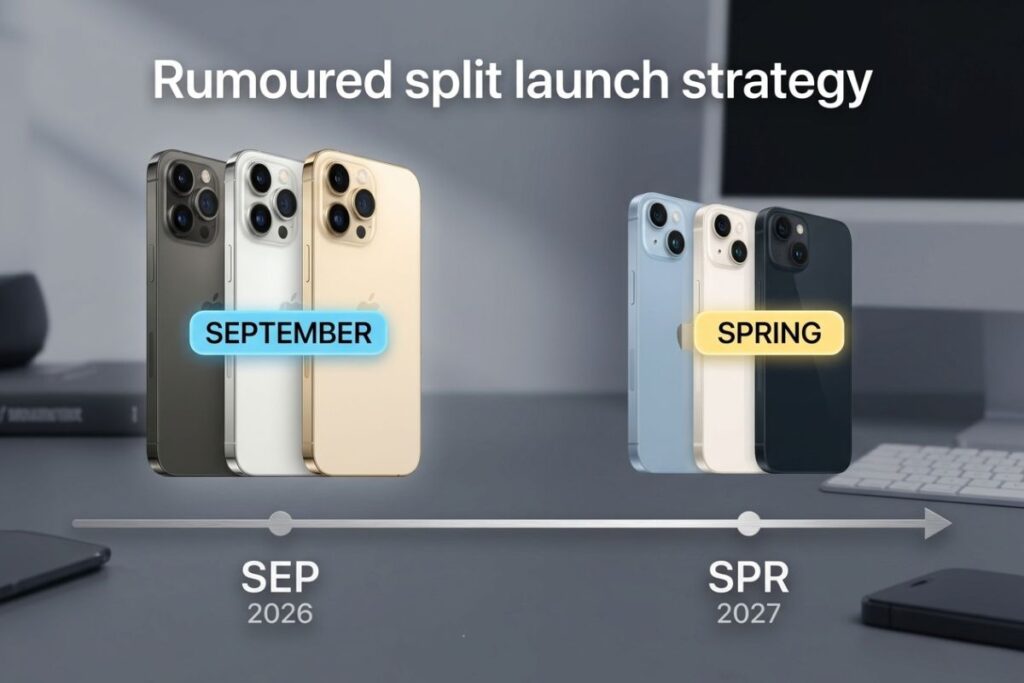
The rationale, per supply chain reporting, is partly pragmatic. The demands of manufacturing Apple’s first foldable device — alongside the complexities of pushing a new 2-nanometer chip into mass production — are straining Cupertino’s traditional production timelines. Separating the premium tier from the mainstream tier may simply be the most realistic way to ship everything without compromising quality or yield rates.
But there’s a strategic dimension too. By leading with its highest-margin, most technically ambitious devices in the fall, Apple concentrates its marketing firepower exactly where its revenue impact is greatest. The Pro models and the Fold will command the headlines, the analyst upgrades, and the upgrade cycles of Apple’s most profitable customers. The base models can follow quietly in the spring, filling in the lineup without cannibalizing the premium moment.
Whether this is a one-time adjustment or the beginning of a new two-season iPhone calendar remains an open question — but it’s a question worth taking seriously.
The Fold: Apple’s Most Anticipated Product in Years
No single rumored product in the iPhone 18 lineup generates more excitement — or more skepticism — than Apple’s first foldable iPhone.
Samsung has been selling foldable phones since 2019. Google entered the segment with the Pixel Fold. Apple, characteristically, has waited. When it finally ships, the company’s entry into the category will be scrutinized on a level that no competitor’s device has ever been. Every seam, every crease, every software compromise will be measured against the perfection Apple has trained its users to expect.
What the leaks describe is a book-style foldable — think Galaxy Z Fold rather than Razr-style flip — with an outer display measuring around 5.3 inches and a large inner display opening to approximately 7.6 inches. When unfolded, it would be among the most expansive canvases Apple has ever shipped. Thickness estimates vary between sources, with Kuo pegging the unfolded measurement at a remarkably slim 4.5mm, while other leakers suggest closer to 4.8mm. Either way, the engineering ambition is evident.
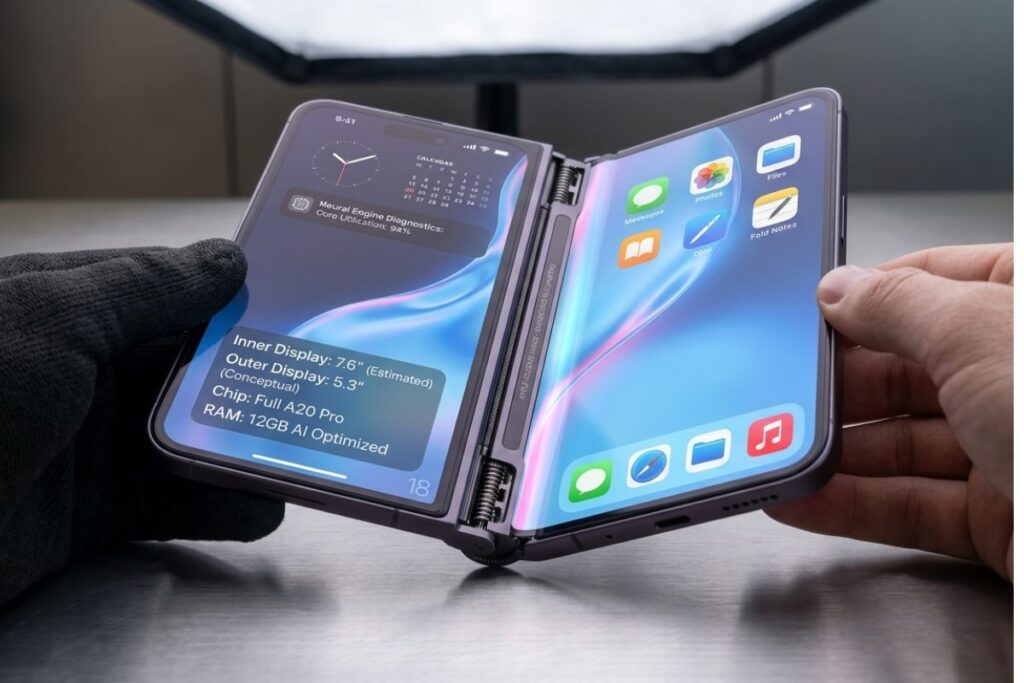
Apple’s foldable is expected to run the full A20 Pro chip — not a compromised or down-clocked variant — and will reportedly include 12GB of RAM, bringing it fully in line with the Pro lineup it’s expected to accompany. This isn’t a novelty device. If the leaks hold, it’s positioned as a flagship product in the most complete sense.
The company’s typical reluctance to ship anything until it’s confident in the durability and polish gives some reason for optimism that the first Apple foldable won’t suffer the early hinge reliability issues that plagued some of Samsung’s initial offerings. But it’s a first-generation product, and first-generation Apple products — AirPods aside — have historically had room to grow.
Under the Hood: The A20 and the AI Imperative
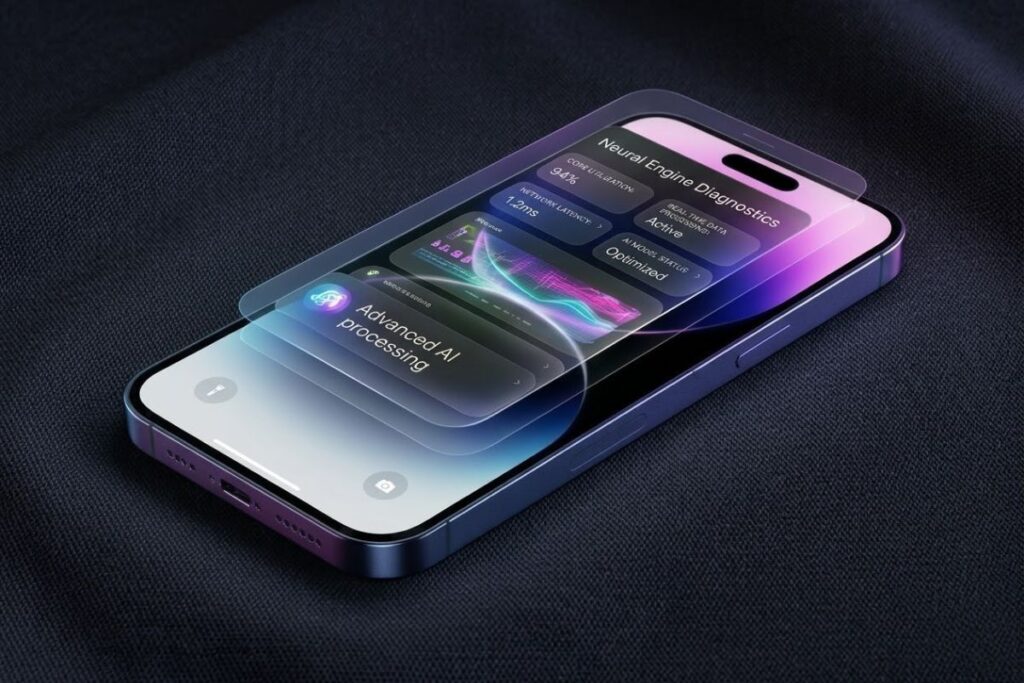
Every new iPhone generation brings a new chip. The pattern is reliable, and the gains are incremental. But the move from 3-nanometer to 2-nanometer fabrication — the process Apple is expected to use for the A20 and A20 Pro chips powering the iPhone 18 lineup — is a more significant architectural shift than most annual updates.
TSMC’s second-generation 3nm process (N3E) powered the A17 Pro. The company’s 3nm nodes have delivered strong results. But the jump to 2nm brings a new transistor architecture — Gate-All-Around (GAA) technology — that promises meaningful improvements in both peak performance and power efficiency. Early supply chain reporting suggests Apple may be paying a premium for early access to TSMC’s 2nm capacity, with die costs potentially running notably higher than previous generations. Apple will almost certainly absorb that cost rather than pass it on; multiple leaks suggest pricing will hold roughly steady with the iPhone 17 series.
Why does the chip matter so much beyond the usual performance benchmarks? Because of what Apple is trying to do with Apple Intelligence.
Apple’s on-device AI ambitions — accelerated Siri, generative tools, real-time processing across camera and productivity workflows — are increasingly constrained by the memory bandwidth and compute headroom available on current silicon. The A20’s combination of 2nm efficiency and the reported move to 12GB of RAM across the entire lineup isn’t just a spec upgrade. It’s infrastructure for a more capable, more private, more responsive AI-driven experience. Where today’s on-device models require offloading complex tasks to Apple’s servers, tomorrow’s may not need to.
Face ID Gets Invisible: The End of the Dynamic Island?
Since Apple replaced the notch with the Dynamic Island on the iPhone 14 Pro in 2022, the animated pill cutout has become one of the most recognizable design signatures in smartphones. It’s clever. It’s functional. It’s also, in the eyes of display purists, still a concession — a compromise between the technology Apple had and the invisible front panel it was always working toward.
The iPhone 18 Pro may be where that gap finally closes, at least in part.
According to multiple credible sources — including display analyst Ross Young and supply chain reporting from The Information — Apple is preparing to move the Face ID sensor array under the display on the iPhone 18 Pro and Pro Max. The infrared flood illuminator is expected to migrate beneath the screen, with the remaining components consolidating into a significantly smaller central module. The result would be a markedly reduced cutout — a small punch hole rather than the Dynamic Island pill — giving the Pro lineup a dramatically cleaner front-facing aesthetic.
One earlier report suggested the front camera itself would shift to the upper-left corner of the display. A subsequent clarification from multiple sources indicates this was likely a mistranslation: the main camera and core Face ID components are expected to remain in the center, just in a far more compact form. The Dynamic Island as a software concept may persist — there’s no reason to abandon a UI paradigm that works — but the hardware real estate it occupies is set to shrink substantially.
Camera: Variable Aperture and the Pursuit of Optical Control
While the silicon and the design changes are drawing the biggest headlines, the camera system rumored for the iPhone 18 Pro may represent the most practically impactful upgrade for everyday users.
According to leakers including the Weibo-based Digital Chat Station, the iPhone 18 Pro Max will gain a variable aperture lens on its main camera — a feature that has existed on some Android flagships but has never appeared on an iPhone. Variable aperture means the physical opening of the lens can shift between values, giving photographers real-time control over depth of field and light intake that no software algorithm can fully replicate. Shoot wide open in a dim venue; narrow down in harsh midday sun. The creative and technical flexibility it enables is genuine.
Beyond the headline variable aperture feature, the broader camera system is expected to benefit from improvements in low-light processing, AI-assisted computational photography, and potentially larger sensor configurations. All iPhone 18 models are rumored to receive a 24-megapixel front camera, up from 18 megapixels on the current generation — a meaningful upgrade for video creators and portrait photography enthusiasts alike.
Battery Life: The Pro Max Goes Bigger
One area where iPhone 18 Pro Max rumors have reached near-consensus: battery capacity is going up, significantly.
Multiple supply chain sources peg the Pro Max battery at somewhere between 5,100mAh and 5,200mAh — a notable step up from the current generation. Paired with the efficiency gains of the 2nm A20 Pro chip, the expectation among analysts is that the iPhone 18 Pro Max will set a new bar for iPhone endurance, with estimates suggesting it could approach or exceed 40 hours of typical mixed use. For power users who have long viewed battery anxiety as one of the iPhone’s persistent Achilles heels relative to some Android competitors, that would be a material quality-of-life improvement.

Design Language: Refined, Not Reinvented
Away from the foldable and the front-panel changes, the broader iPhone 18 design language appears to be evolutionary rather than revolutionary. The base iPhone 18 is expected to retain the form factor and camera layout of the iPhone 17, with Apple’s focus on that device centering on the internal A20 upgrade. The Pro models keep the raised camera plateau — familiar from the iPhone 17 Pro — with refinements rather than structural changes.
One detail that has surfaced via Weibo: the charging area on the back of the Pro models may incorporate a section of “slightly transparent” ceramic shield material. What exactly that means in practice — aesthetic texture, a subtle visual change, or something more functional — remains unclear. Color-wise, leakers suggest the Pro palette will shift toward Coffee, Purple, and Burgundy, potentially dropping black from the lineup as Apple did with the iPhone 17 Pro generation.
What All of This Actually Means
Step back from the spec sheet, and the picture that emerges is of an Apple making unusually bold structural bets in a single year.
The split launch calendar is perhaps the most underappreciated element of the iPhone 18 story. If it works — if Apple can sustain consumer interest across two distinct release windows, each anchored by compelling new hardware — it could become the new normal. Two iPhone moments per year instead of one. Two peaks of consumer demand. Two opportunities to capture the news cycle. For a company that generates the majority of its hardware revenue from iPhones, the implications for the earnings calendar are significant.
The foldable, meanwhile, puts Apple in a market it has watched from the sidelines for half a decade. Unlike early Android foldables — often admired by enthusiasts but marginal in mainstream sales — Apple’s version arrives backed by iOS, the App Store, and an installed base of over a billion users. The real question isn’t whether people will be curious about the iPhone Fold. It’s whether Apple can make the form factor feel as inevitable and necessary as it made the App Store, Touch ID, or the AirPods case.
And the AI angle runs through all of it. The A20’s power, the RAM upgrade, the camera intelligence, the tighter integration between hardware and Apple Intelligence services — these aren’t independent features. They’re components of a cohesive strategy to make the iPhone the most capable and private AI device a consumer can carry. How well that strategy is executing is something Apple’s September keynote will reveal with far more clarity than any supply chain leak ever could.
For now, the rumor machine has done its job. The question is whether Apple’s engineers can do theirs.
All details in this article are based on supply chain leaks, analyst reports, and third-party sources. Apple has not officially confirmed any aspect of the iPhone 18 lineup. Specifications and design details may change before announcement.