


















Discovery of Betelgeuse’s Elusive Companion Star
A long-standing astronomical theory regarding Betelgeuse, one of the most luminous stars visible from Earth, has finally been confirmed. A team of astrophysicists, spearheaded by a researcher from NASA’s Ames Research Center in California’s Silicon Valley, has discovered that Betelgeuse is accompanied by a close orbiting companion star. This revelation was documented in a study published in The Astrophysical Journal Letters, titled “Probable Direct Imaging Discovery of the Stellar Companion to Betelgeuse.”
Betelgeuse, a red supergiant and the nearest of its kind to our planet, has long intrigued scientists with its fluctuating brightness and velocity. These variations hinted at the possible presence of a companion star. However, Betelgeuse’s intense luminosity made it exceedingly difficult to directly observe any dimmer neighbor stars.
Recent investigations by astronomers revisited the companion star hypothesis. They analyzed over a century’s worth of Betelgeuse observations to predict the potential partner’s location and luminosity. These predictions indicated that if a smaller star existed, scientists had a limited timeframe to observe it when it would be most visible at its farthest point from Betelgeuse. After this period, it would again be enveloped by the larger star’s radiance, necessitating a three-year wait for another opportunity.
Initial efforts to identify the companion relied on space telescopes, as Earth’s atmosphere can distort images of celestial bodies. However, these attempts were unsuccessful. Recognizing the potential of the Gemini North telescope in Hawai’i, one of the world’s largest ground-based telescopes, Steve Howell, a senior research scientist at Ames, saw an opportunity. This telescope, equipped with NASA’s specialized high-resolution camera, could potentially capture the elusive companion despite atmospheric interference.
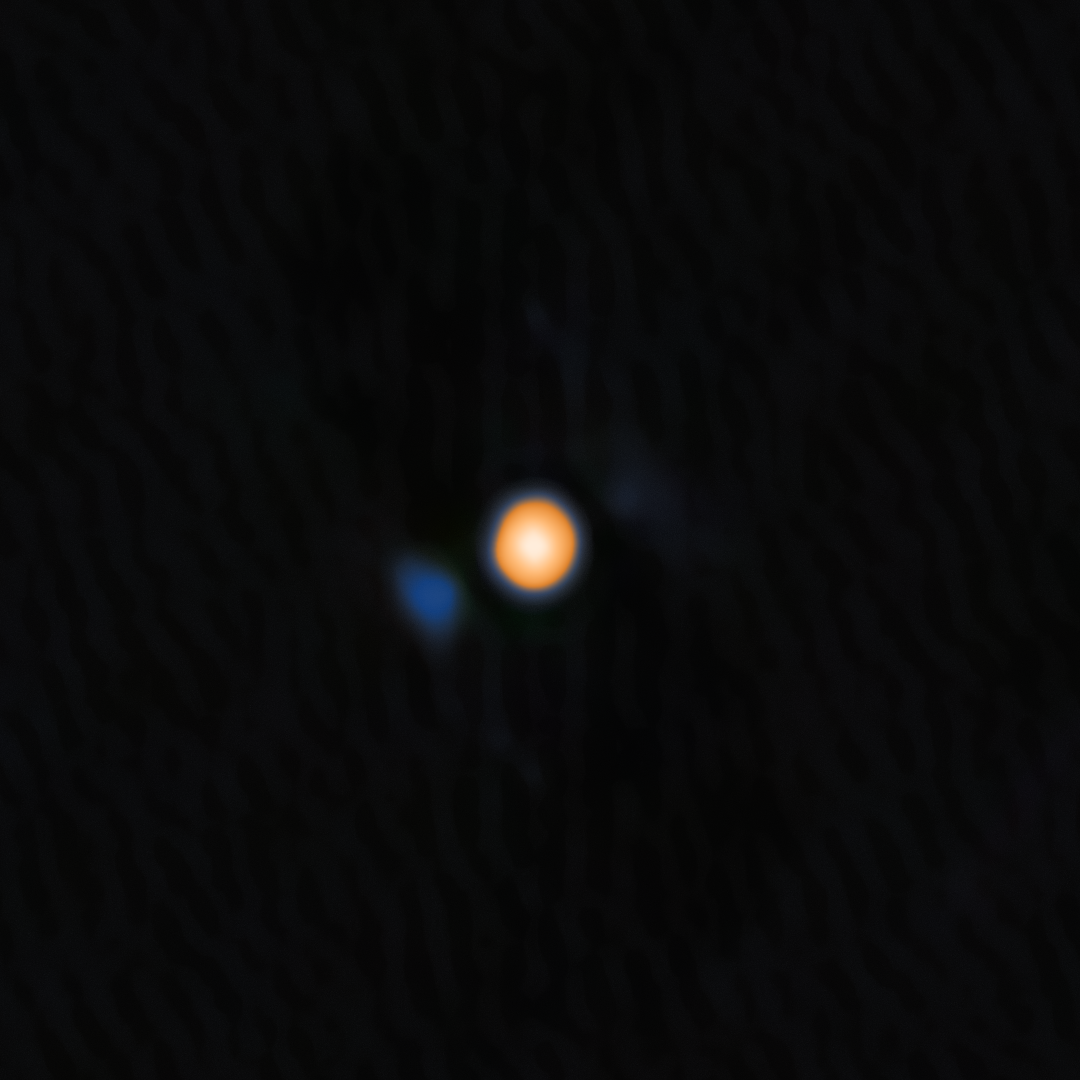
The camera, known as the ‘Alopeke speckle instrument, is an advanced imaging device. It allowed the team to capture thousands of short exposures, which were then processed to correct atmospheric distortions. This meticulous process successfully produced an image of Betelgeuse and its companion.
To their excitement, Howell’s team identified the faint companion star exactly where predictions had placed it, orbiting close to Betelgeuse’s outer edge. Howell expressed his enthusiasm for their findings, stating, "I hope our discovery excites other astrophysicists about the robust power of ground-based telescopes and speckle imagers – a key to opening new observational windows. This can help unlock the great mysteries in our universe."
This discovery not only confirms the existence of Betelgeuse’s companion but also provides insights into why other red supergiants exhibit periodic brightness changes over several years. Howell intends to continue observing Betelgeuse’s companion to gain a deeper understanding of its characteristics. The companion star is expected to reach its maximum separation from Betelgeuse again in November 2027, which will offer another prime opportunity for observation.
With the companion star identified, Howell’s team decided to name it. The name "Betelgeuse" originates from Arabic, meaning "the hand of al-Jawza’," referring to a female figure in ancient Arabian lore. Appropriately, the team named the companion star "Siwarha," meaning "her bracelet."
This discovery is part of a broader initiative known as the NASA–National Science Foundation Exoplanet Observational Research Program (NN-EXPLORE). This program aims to advance U.S. exoplanet science by providing researchers with access to state-of-the-art ground-based observational facilities. Managed by NASA’s Exoplanet Exploration Program, NN-EXPLORE complements space missions like Kepler, TESS, Hubble, and the James Webb Space Telescope by offering crucial follow-up observations from Earth. This collaboration enhances the scientific yield of space-based discoveries by integrating ground-based characterizations.
To explore more about the NN-EXPLORE program and its contributions to exoplanet research, you can visit their official page at NN-EXPLORE Overview.
This groundbreaking discovery not only sheds light on the dynamics of Betelgeuse but also exemplifies the synergy between space and ground-based observational technologies. The use of advanced imaging techniques and collaborative scientific efforts continues to push the boundaries of our understanding of the universe. As we delve deeper into the cosmos, each discovery brings us closer to unlocking the secrets held by the stars.
For more Information, Refer to this article.