




















An Ingenious Save: NASA’s JunoCam Brought Back to Life
In an impressive feat of engineering and ingenuity, NASA’s Juno spacecraft, currently orbiting Jupiter, has managed to revive its onboard camera, JunoCam, through an innovative experimental technique. This development not only underscores the resilience and adaptability of space technology but also offers valuable insights that could benefit future spacecraft dealing with high radiation environments.
A Glimpse into Juno’s Mission
Launched as part of NASA’s New Frontiers Program, the Juno spacecraft has been exploring Jupiter since it entered the planet’s orbit. Juno’s mission is to gather data on Jupiter’s composition, gravitational field, magnetic field, and polar magnetosphere. A pivotal component of this mission is JunoCam, a color, visible-light camera designed to capture striking images of the planet’s atmosphere and its moons, providing both scientists and the public with breathtaking views of the Jovian system.
JunoCam is situated outside the heavily shielded radiation vault of Juno, which protects the spacecraft’s sensitive electronic components. This positioning exposes the camera to the harshest radiation belts in our solar system. Initially, mission designers estimated that JunoCam could withstand the radiation for the first eight orbits around Jupiter, but beyond that, the camera’s longevity remained uncertain.
The Problem Emerges
Throughout Juno’s initial 34 orbits, JunoCam functioned optimally, generating images that were integral to the mission’s scientific objectives. However, during its 47th orbit, the camera started showing signs of radiation damage. By the time Juno reached its 56th orbit, most images captured were significantly corrupted, making it challenging to gather clear visual data.
The mission team suspected that the radiation damage was likely impacting a critical component of JunoCam’s power supply: the voltage regulator. Identifying the exact nature of the damage from millions of miles away was a daunting task. In the face of limited recovery options, the team decided to attempt a technique known as annealing to potentially repair the damage.
The Annealing Solution
Annealing involves heating a material to a specific temperature and then allowing it to cool gradually. This process can sometimes correct defects in materials like silicon at a microscopic level. However, its effectiveness on JunoCam’s damage was uncertain.
Jacob Schaffner, an imaging engineer with Malin Space Science Systems, which developed JunoCam, explained the team’s cautious optimism: “We knew annealing could potentially alter silicon at a microscopic level, but we weren’t sure it would repair the damage in JunoCam.”
To execute this, JunoCam’s heater was commanded to raise the camera’s temperature to 77 degrees Fahrenheit, which was significantly warmer than its typical operating temperature. The team then anxiously awaited the results.
Encouraging Results Amid Uncertainty
Following the annealing process, JunoCam began producing clearer images for several orbits. However, as Juno delved deeper into Jupiter’s intense radiation fields, the camera once again began to exhibit problems by its 55th orbit. The images returned were marred by streaks and noise, prompting the team to experiment with various image processing techniques in an attempt to improve clarity, albeit unsuccessfully.
With a close flyby of Jupiter’s moon Io approaching, the team resorted to a more extreme form of annealing by significantly increasing the heater’s temperature. Early test images after this process showed little enhancement, but as the spacecraft neared Io, the image quality improved dramatically.
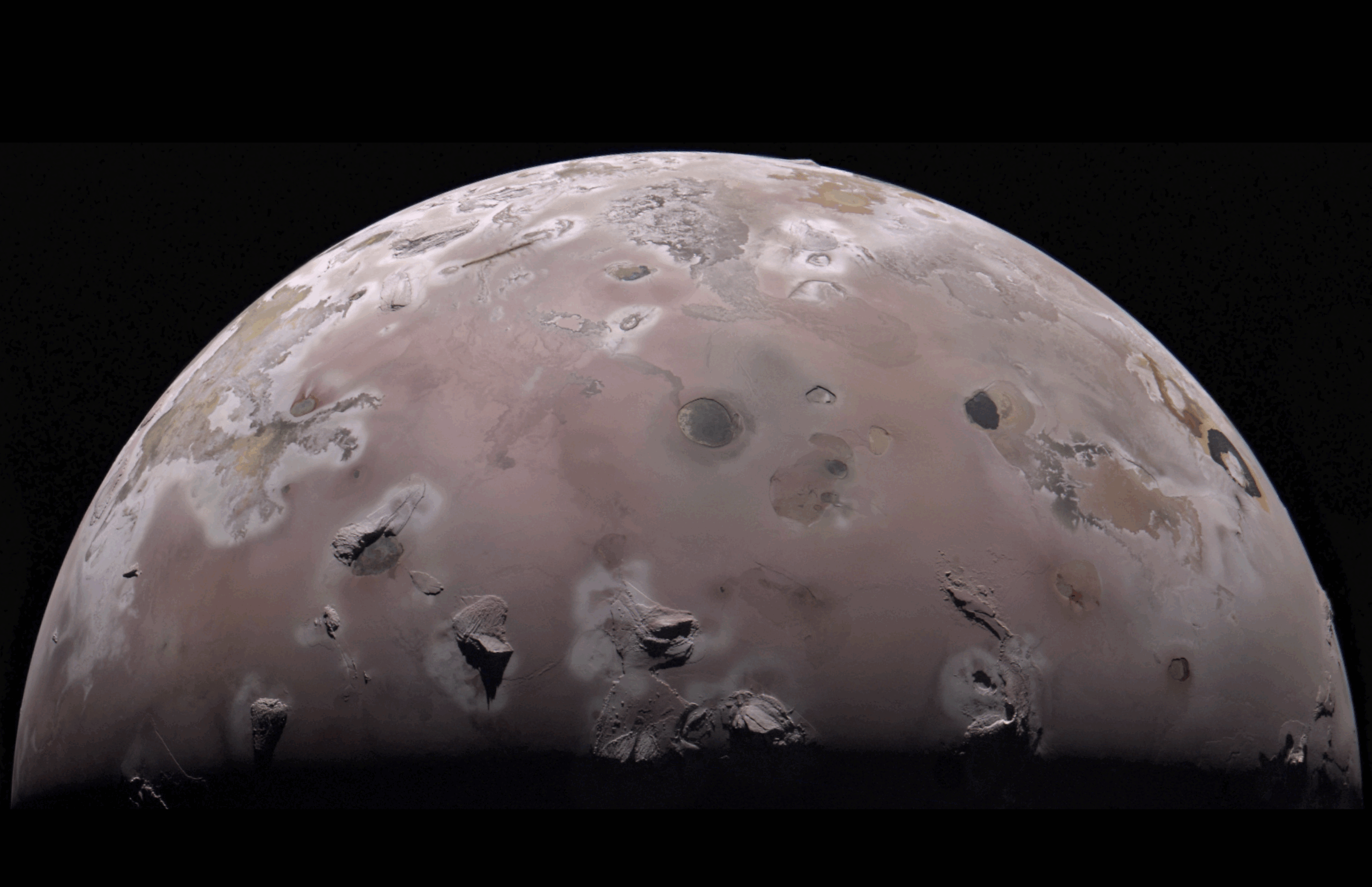
When Juno came within 930 miles of Io’s surface on December 30, 2023, JunoCam captured exquisite images of the moon’s north polar region. These pictures revealed mountainous features coated in sulfur dioxide frost and previously undiscovered volcanoes with expansive lava flows.
Continuing Challenges and Future Applications
As of now, Juno has completed 74 orbits around Jupiter. Nonetheless, image noise reappeared during the 74th orbit, indicating the persistent challenges posed by Jupiter’s radiation.
The innovative annealing technique used on JunoCam has since been adapted for other instruments and subsystems on Juno, demonstrating its potential as a valuable tool for spacecraft maintenance in high-radiation environments. This experience is expected to inform the design and operation of future space missions, including both defense and commercial satellites, as well as other NASA projects.
Scott Bolton, Juno’s principal investigator, emphasized the broader implications of these developments: “Juno is teaching us how to create and maintain spacecraft that are tolerant to radiation. The insights gained here will benefit satellites orbiting Earth and future missions exploring other parts of the solar system.”
The Broader Impact of Juno’s Mission
Managed by NASA’s Jet Propulsion Laboratory in Pasadena, California, the Juno mission involves a collaborative effort among several institutions. The spacecraft itself was built and is operated by Lockheed Martin Space in Denver. Additionally, the Italian Space Agency contributed to the mission by funding the Jovian InfraRed Auroral Mapper, one of Juno’s many scientific instruments.
Juno’s successful navigation of Jupiter’s harsh environment and the innovative techniques employed to sustain its functionality contribute significantly to our understanding of space exploration. These advancements promise to enhance the resilience of future spacecraft, ensuring the continued exploration of our solar system and beyond.
For more information on the Juno mission, you can visit [NASA’s Juno page](https://www.nasa.gov/juno).
For more Information, Refer to this article.