





















NASA’s Roman Space Telescope Makes Significant Progress Towards Launch
NASA’s Nancy Grace Roman Space Telescope, poised to become a pivotal instrument in the exploration of space, has made substantial progress toward its anticipated launch. This advanced telescope has recently passed a series of rigorous tests designed to ensure its readiness for the harsh conditions of space travel.
This fall, the outer structure of the telescope underwent two critical tests: a vibration test and an acoustic test. These assessments are essential to confirm that the telescope can withstand the intense forces experienced during a rocket launch. Additionally, the inner components of the observatory were subjected to a comprehensive 65-day thermal vacuum test. This test is crucial to guarantee that the telescope will operate effectively in the extreme temperatures of space. As NASA’s next flagship space telescope, the Roman Space Telescope aims to tackle some of the most profound questions in astrophysics, dark energy, and the study of planets beyond our solar system.
Rebecca Espina, a deputy test director at NASA’s Goddard Space Flight Center, emphasized the importance of these tests, stating, “We want to make sure Roman will withstand our harshest environments. From a mechanical standpoint, our heaviest loads and stresses come from launch, so we use testing to mimic the launch environment.” Her remarks underline the critical nature of these tests in ensuring the telescope’s successful deployment and operation.
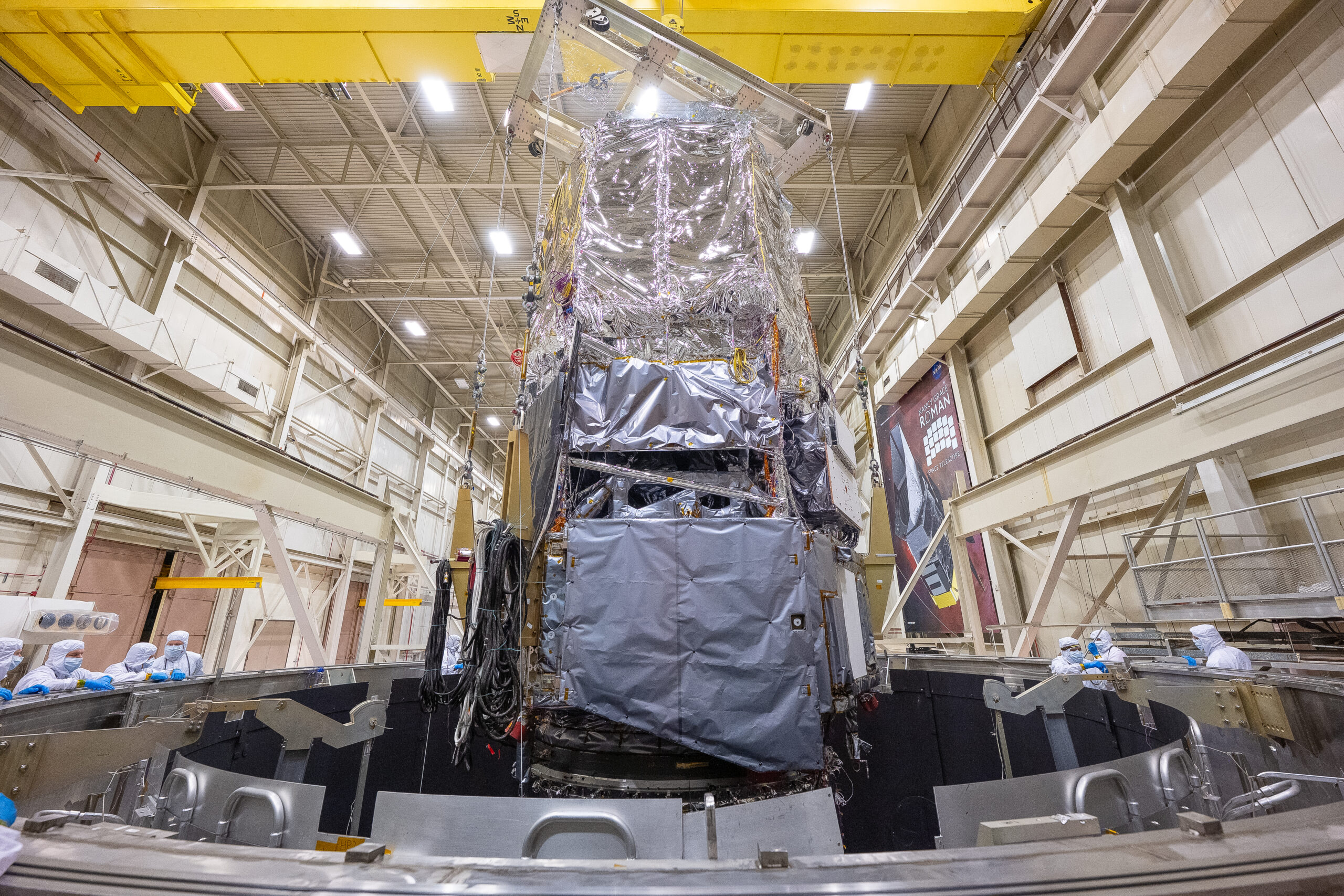
The vibration and acoustic tests were the final set of simulations for the outer section of the Roman observatory. This segment includes the outer barrel assembly, a deployable aperture cover, and newly installed solar panels. During the acoustic testing, a large chamber equipped with enormous horns replicated the deafening sounds of a rocket launch. These sounds generate high-frequency vibrations capable of challenging the structural integrity of the equipment. To monitor the hardware’s response, a variety of sensors were employed, and the sound levels were gradually increased to a peak of 138 decibels, which is louder than the noise of a jet plane taking off at close proximity.
Following the acoustic tests, the outer assembly was subjected to a series of vibration tests. These were conducted on a massive shaker table to simulate the lower-frequency vibrations experienced during a rocket launch. Each test lasted approximately one minute, with frequencies ranging from 5 to 50 hertz. To put this in perspective, the lowest note on a grand piano vibrates at about 27.5 hertz. NASA engineers conducted these tests over several weeks, analyzing data in real-time to ensure the integrity of the equipment.
Similar to the acoustic tests, the vibration tests involved the use of sensors to capture the assembly’s response. Engineers and structural analysts utilize this data not only to assess the success of the tests but also to refine models for future assessments. Shelly Conkey, the lead structural analyst for the assembly at NASA Goddard, expressed pride in their achievements, highlighting the significant effort involved in completing such extensive test programs.
The core section of the observatory, which includes the telescope, instrument carrier, two instruments, and the spacecraft bus, was moved into the Space Environment Simulator at NASA Goddard in August. In this chamber, the equipment was exposed to extreme temperature fluctuations to mimic the cold of space and the heat of the sun. Over 200 people were involved in running continuous simulations for more than two months, assessing the telescope’s optics and overall mission readiness.
Dominic Benford, Roman’s program scientist at NASA Headquarters in Washington, noted the significance of these tests, stating, “The thermal vacuum test marked the first time the telescope and instruments were used together. The next time we turn everything on will be when the observatory is in space!” His comments highlight the critical nature of these tests in ensuring that all components work seamlessly together.
Looking ahead, the team plans to integrate Roman’s two major components in November, culminating in a fully assembled observatory by the end of the year. Following the final tests, the telescope will be transported to NASA’s Kennedy Space Center in Florida in preparation for its launch, which is expected to occur as early as fall 2026, with a target launch date by May 2027.
The Nancy Grace Roman Space Telescope project is managed by NASA’s Goddard Space Flight Center, with contributions from several other institutions, including NASA’s Jet Propulsion Laboratory in Southern California, Caltech/IPAC in Pasadena, California, and the Space Telescope Science Institute in Baltimore. These organizations work in collaboration with a team of scientists from various research institutions. The primary industrial partners involved in the project are BAE Systems Inc. in Boulder, Colorado; L3Harris Technologies in Rochester, New York; and Teledyne Scientific & Imaging in Thousand Oaks, California.
For more information on the Nancy Grace Roman Space Telescope, visit NASA’s Roman Space Telescope page.
This milestone marks another step towards the launch of a telescope that promises to expand our understanding of the universe, tackling questions that have intrigued scientists for decades. The Roman Space Telescope is expected to provide unprecedented insights into the nature of dark energy, the discovery of exoplanets, and the broader field of astrophysics. As the project advances, the scientific community and the public alike eagerly anticipate the wealth of knowledge that Roman will bring back from the cosmos.
For more Information, Refer to this article.