











![[Interview] Inside Spatial Signage: How Samsung Brought Glasses-Free 3D Displays to Life](https://www.hawkdive.com/media/samsung-tvs-and-displays-spatial-signage-interview_thumb932-218x150.jpg "Samsung’s Glasses-Free 3D Displays: The Inside Story [Interview]")






Enhancing STEM Education: A Collaborative Journey with NASA and Educators
The foundation of any progressive educational system is its ability to adapt and incorporate cutting-edge learning experiences, especially in fields as dynamic as Science, Technology, Engineering, and Mathematics (STEM). STEM educators are pivotal in driving the evolution of these learning ecosystems, transforming theoretical concepts into practical, everyday applications. This transformation not only enriches classroom instruction but also nurtures a generation of informed citizen scientists.
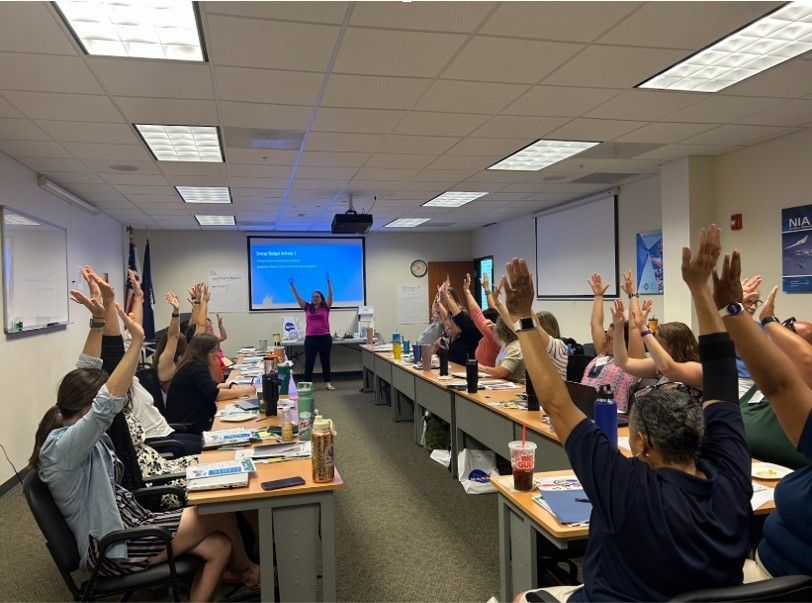
In the face of an intense heat wave on June 24-25, 2025, a group of 24 dedicated educators from various school districts across the Hampton Roads region of southeastern Virginia gathered at the National Institute of Aerospace (NIA) in Hampton, VA. These educators hailed from diverse districts, including Newport News, Hampton City, Virginia Beach City, Isle of Wight County, Poquoson City, Norfolk, York County, and Suffolk Public Schools. They convened for a professional development workshop meticulously organized by experts from NASA Langley Research Center and the NASA Science Activation program’s NIA-led NASA eClips team.
This two-day intensive workshop was crafted in collaboration with the NASA Science Activation team, GLOBE Mission Earth, and was supported by the Coastal Virginia STEM Hub (COVA STEM). COVA STEM is a vibrant ecosystem designed to engage learners from pre-K through adulthood in Coastal Virginia, fostering a continuous learning environment. The workshop aimed to provide comprehensive resources, such as lesson plans, pacing guides, classroom activities, and books, which educators could seamlessly integrate into their teaching methods.
Empowering Educators with Citizen Science Tools
A key highlight of the workshop was the training on the GLOBE program, which stands for Global Learning and Observations to Benefit the Environment. This initiative is dedicated to enhancing our understanding of Earth’s systems through data collected by citizen scientists—volunteer contributors who aid scientific research. The GLOBE program invites educators, students, and the general public to engage in scientific data collection related to clouds, surface temperatures, and land cover. Such data is gathered using the GLOBE Observer app, a user-friendly tool accessible via smartphones, making it easy for anyone to contribute to scientific research on local, regional, and global scales.
During the workshop, educators delved into sample lessons suited for K-20 classrooms, engaged in hands-on activities, and explored the functionalities of the GLOBE Observer app. By the end of the session, participants became GLOBE Certified Educators, equipped with the knowledge and tools to inspire their students. Detailed Earth System science lessons, activities, and instructions for downloading the GLOBE Observer app are readily available on the GLOBE website.
Similarly, NASA eClips, an initiative focused on enhancing STEM literacy among K-12 students, provided participants with free, standards-based educational resources. These resources included educator guides, informational videos, engineering design packets, and interactive activities. Both educators and students can access these materials on the NASA eClips website. Throughout the training, educators collaborated in grade-level groups, brainstorming innovative ways to integrate these valuable NASA science resources into their curricula.
Innovative Teaching Approaches Inspired by NASA Resources
The workshop sparked creativity and enthusiasm among educators, as they envisioned new ways to incorporate NASA’s resources into their teaching practices. One teacher planned to integrate GLOBE’s cloud resources and NASA eClips videos into her energy budget unit, while others discussed modifying experiments to include factors like humidity and heat capacity. An urban heat island lesson plan from GLOBE was particularly well-received, with one educator expressing excitement about the hands-on components, stating, “The hands-on elements are going to be really great deliverables!” The atmosphere was charged with a palpable passion for education and collaboration.
The commitment of both NIA and NASA Langley to education and community support was evident throughout the workshop. The professional learning experience not only provided educators with ready-to-use classroom activities but also fostered connections among NASA science, NASA eClips, the GLOBE Program, and fellow educators from different districts. The value of networking was highlighted by one participant who appreciated the opportunity to “collaborate with our colleagues so we can plan for our future units during the school year.” Another educator expressed enthusiasm about integrating the program into their curriculum, stating, “This is a great program…I am going to start embedding [this] in our curriculum.”
NASA’s Science Activation Portfolio: Connecting Science with Communities
The workshop was part of NASA’s broader Science Activation Portfolio, which includes programs like GLOBE Mission Earth (supported by NASA under cooperative agreement award number NNX16AC54A) and NASA eClips (supported by NASA under cooperative agreement award number NNX16AB91A). This portfolio aims to connect NASA science experts, authentic content, and experiences with community leaders, engaging them in scientific activities that stimulate minds and deepen the understanding of our planet and beyond. To learn more about Science Activation, visit the NASA Science Activation Portal.
In conclusion, the professional development workshop exemplified the power of collaboration and innovation in education. By harnessing the resources and expertise provided by NASA, educators are better equipped to inspire the next generation of scientists and thinkers, fostering a deeper understanding of the world around us. As these teachers return to their classrooms, they carry with them new tools, fresh ideas, and a renewed enthusiasm for STEM education, ready to inspire and educate their students in meaningful ways. For more details and resources, you can explore the original article on the National Institute of Aerospace’s website.
For more Information, Refer to this article.