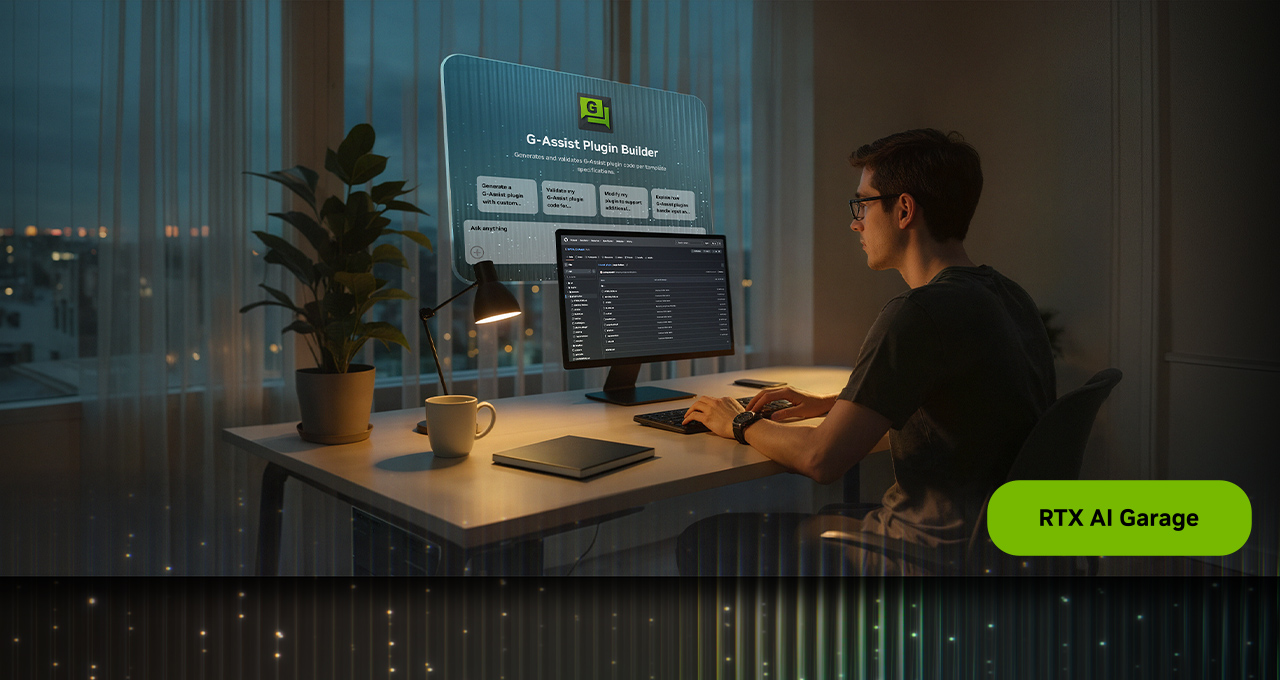
In an exciting development for tech enthusiasts and developers, NVIDIA has announced its “Plug and Play: Project G-Assist Plug-In Hackathon,” inviting participants to submit their innovative ideas and solutions. The deadline for entries is set for Sunday, July 20, at 11:59 PM PT. This hackathon is a golden opportunity for developers to explore and expand the capabilities of NVIDIA’s experimental AI assistant, Project G-Assist, which is accessible through the NVIDIA App.
NVIDIA’s RTX AI Garage is providing comprehensive tools and resources to assist participants in their creative endeavors. This initiative encourages individuals to enhance the functionality of G-Assist, which is designed to help users manage and optimize their NVIDIA GeForce RTX systems efficiently.
### Understanding Project G-Assist
In the fast-paced world of gaming and creative projects, users often find it challenging to adjust PC settings without losing focus. Traditionally, optimizing GPU performance or tweaking system parameters required users to leave their current applications, disrupting their workflow.
Project G-Assist steps in to resolve this issue by allowing users to control their RTX GPU and other system settings through natural language. This innovative tool operates via a small language model that runs directly on the device, accessible through the NVIDIA overlay within the NVIDIA App. This eliminates the need to switch programs, thereby maintaining user concentration.
Moreover, Project G-Assist can be expanded with plug-ins and connected to agentic frameworks like Langflow. Developers can create G-Assist plug-ins using various programming languages. Python is ideal for rapid development, C++ is suitable for performance-critical applications, and custom system interactions enable hardware and operating system automation.
To utilize Project G-Assist, users need a GeForce RTX 50, 40, or 30 Series Desktop GPU with a minimum of 12GB of VRAM, a Windows 11 or 10 operating system, a compatible CPU, specific disk space, and the latest GeForce Game Ready Driver or NVIDIA Studio Driver.
### Preparing for the Hackathon
As the submission deadline nears, NVIDIA’s RTX AI Garage is offering valuable resources to aid participants. Sydney Altobell, a senior software engineer at NVIDIA, has shared insights and strategies for developing G-Assist plug-ins in an on-demand webinar. This presentation, along with a Q&A session, is available on the NVIDIA Developer YouTube channel.
The NVIDIA Developer Discord server is another platform where community developers are collaborating and exchanging ideas. Altobell, along with the G-Assist engineering team, is actively engaging with participants, answering queries about plug-in submissions.
For those interested in developing with G-Assist, NVIDIA’s GitHub repository provides comprehensive resources, including step-by-step guides and documentation for building custom functionalities. Sample plug-ins are available for inspiration, demonstrating how G-Assist can integrate with platforms like Discord, IFTTT, and Google Gemini.
Additionally, the ChatGPT Plug-In Builder is a useful tool for transforming creative ideas into functional G-Assist plug-ins with minimal coding. This tool leverages OpenAI’s custom GPT builder to generate plug-in code, simplifying the development process.
NVIDIA’s technical blog offers a detailed walkthrough of the G-Assist plug-in architecture, using a Twitch integration as an example. This resource explains how plug-ins operate, communicate with G-Assist, and can be built from scratch.
### Submission Guidelines and Additional Resources
For more information on the submission process and requirements, participants can visit the Hackathon entry page. The RTX AI Garage blog series is a valuable resource for learning about community-driven AI innovations, NVIDIA NIM microservices, AI Blueprints, and building AI agents, creative workflows, and productivity apps on AI PCs and workstations.
To stay updated on the latest developments, enthusiasts can connect with NVIDIA AI PC on social media platforms such as Facebook, Instagram, TikTok, and X. Subscribing to the RTX AI PC newsletter is also recommended for regular updates.
For professionals interested in NVIDIA workstation solutions, following NVIDIA Workstation on LinkedIn and X will provide insights into the latest advancements and offerings.
In conclusion, NVIDIA’s “Plug and Play: Project G-Assist Plug-In Hackathon” represents an exciting opportunity for developers to push the boundaries of AI technology. With substantial resources and support from NVIDIA, participants have the chance to showcase their creativity and technical skills, contributing to the evolution of AI-assisted gaming and productivity solutions. For further details, visit the official NVIDIA website.
For more Information, Refer to this article.