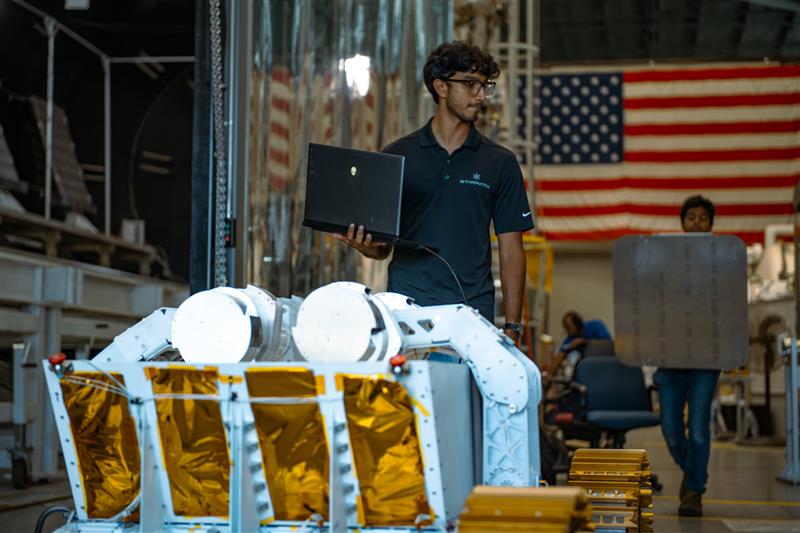
Starpath’s Innovative Rover Undergoes Testing at NASA’s Marshall Space Flight Center
In a remarkable achievement, the innovative technology startup Starpath, based in Hawthorne, California, recently embarked on a pivotal journey to NASA’s Marshall Space Flight Center in Huntsville, Alabama. This visit marked a significant milestone for the startup, occurring one year after it clinched second place in NASA’s prestigious Break the Ice Lunar Challenge. The primary objective of this trip was to test their advanced lunar regolith excavation and transportation rover in the center’s formidable 20-foot thermal vacuum chamber, a crucial step in realizing their vision for lunar exploration.
The Break the Ice Lunar Challenge, a part of NASA’s Centennial Challenges, is a unique competition designed to spur the development of cutting-edge robotic technologies capable of excavating and transporting the icy, rocky dirt known as regolith found on the Moon. The competition concluded with a live demonstration and finale in June 2024, where Starpath impressively secured second place overall. This was no small feat, considering the complex requirements and the tough competition from other innovative teams.
"NASA’s Centennial Challenges serve as an exceptional platform to unearth new, groundbreaking technologies that could be pivotal for future lunar and Martian missions," stated Naveen Vetcha, the Break the Ice Lunar Challenge manager at NASA Marshall. "Engaging with winners like Starpath after the competition ends exemplifies how we can leverage NASA’s facilities to continue refining these technologies, generating invaluable solutions for both the agency and the broader industry."
Starpath’s rover, an engineering marvel, is equipped with four wheels and is adept at excavating, collecting, and transporting materials under the extreme conditions simulating the lunar South Pole. A standout feature of this rover is its dual drum barrel, which extends from the robot’s body, mimicking the movement of a crab’s claws. This design allows the rover to efficiently scrape into the rough, hard regolith, ensuring rapid excavation without exhausting its limited battery life.
Before embarking on their 2,000-mile journey from California to Alabama, the dedicated staff at NASA Marshall’s Engineering Test Facility meticulously prepared a concrete slab with rocky terrain. This setup served as a testbed, providing a realistic environment for the rover within the chamber. The V-20 Thermal Vacuum Chamber, located at Marshall’s Environmental Test Facility, is a state-of-the-art structure capable of simulating harsh conditions by adjusting variables such as vacuum, temperature, humidity, and pressure. During their three-day session at NASA Marshall in August, the Starpath team rigorously tested their rover, conducting excavation and mobility trials while collecting critical data on its performance.
The primary focus of Starpath’s technological development is missions aimed at the permanently shadowed regions of the lunar South Pole. This area is of particular interest as it is a prospective landing site for NASA’s Artemis missions, which aim to send astronauts to the Moon and eventually prepare for sending the first Americans to Mars. The lunar South Pole is believed to contain ice within its regolith, a valuable resource that can be extracted and purified for use as drinking water or converted into rocket fuel. The Break the Ice Lunar Challenge was conceived with this goal in mind, emphasizing the need for robust technologies capable of excavating and transporting lunar ice efficiently.
NASA’s Break the Ice Lunar Challenge ran from 2020 to 2024 and was spearheaded by NASA’s Marshall Space Flight Center with crucial support from NASA’s Kennedy Space Center in Florida. The Centennial Challenges are an integral part of NASA’s Prizes, Challenges, and Crowdsourcing program, which falls under the agency’s Space Technology Mission Directorate. These challenges are designed to inspire and engage the brightest minds in developing technologies that can address the complex challenges of space exploration.
As the Starpath team continues to refine their technology, their work stands as a testament to the power of innovation and collaboration in pushing the boundaries of what is possible in lunar exploration. The insights gained from their testing at NASA’s facilities will undoubtedly contribute to the advancement of technologies essential for future space missions.
For more information on NASA’s challenges and initiatives, visit nasa.gov/winit.
In conclusion, the journey of Starpath exemplifies the dynamic intersection of creativity, technology, and determination. As we look to the stars and plan for future missions to the Moon and beyond, endeavors like these underscore the importance of fostering innovation and collaboration in the pursuit of space exploration. The potential to unlock lunar resources and pave the way for sustained human presence on the Moon is within reach, thanks to the pioneering efforts of teams like Starpath and the continued support of organizations like NASA.
For more Information, Refer to this article.