

























Apple announced the MacBook Neo on March 4, 2026 — a laptop that lands at $599 and immediately dismantles every assumption about what a budget Mac should look, feel, or perform like. It is the company’s cheapest laptop ever, the first Mac to run a chip originally designed for the iPhone, and a machine that hands-on testing confirms feels dramatically more expensive than it costs.
It goes on sale March 11, 2026 across 30 countries and regions. Pre-orders are open now at Apple’s website and in the Apple Store app. Here is everything worth knowing before you buy.
Key Highlights
- Price: Starts at $599 — or $499 with education pricing — Apple’s lowest-ever laptop price
- Chip: Apple A18 Pro · 6-core CPU · 5-core GPU · 16-core Neural Engine · 8GB unified memory — the first iPhone chip ever placed inside a Mac
- Display: 13-inch Liquid Retina · 500 nits · 1 billion colors · uniform bezels · no notch
- Battery: Up to 16 hours per charge (Apple-tested)
- AI: Full Apple Intelligence — Writing Tools, Genmoji, Clean Up, Private Cloud Compute
- Design: Recycled aluminum in four colors — Silver, Blush, Citrus, Indigo — with color-matched keyboards
- Ships: March 11, 2026 · 30 countries · pre-order open now
What’s New: A Mac Unlike Any Before It
Every Mac before the Neo used a chip from Apple’s M-series line — silicon engineered specifically for Mac computers. The MacBook Neo breaks that tradition by running the A18 Pro, the same chip Apple introduced in the iPhone 16 Pro in late 2024. This is a deliberate choice, not a compromise: the A18 Pro is a modern, powerful chip with a strong per-core architecture and a 16-core Neural Engine purpose-built for AI workloads.
At $599, the MacBook Neo directly challenges Windows laptops and Chromebooks at mainstream price points — categories Apple has never seriously competed in before. With education pricing at $499, it reaches even further into the student market where Chromebooks have long dominated.
The Build: Premium Where It Counts
The MacBook Neo’s most surprising quality is one that doesn’t show up in a spec sheet: it feels like it costs considerably more than it does. The enclosure is machined from recycled aluminum — the same material class as the MacBook Air — and carries none of the plastic or flex associated with budget-tier laptops. Journalists who handled it at Apple’s launch event consistently reported that, without knowing the price, they would have placed it in the $800–$1,000 range.
The lid opens with one finger on a flat surface without the body lifting — a mechanical refinement that distinguishes premium laptops from cheaper alternatives. The keyboard delivers the same bouncy, precise feel as the MacBook Air’s Magic Keyboard. The side-firing speakers fill a room. And for the first time since Apple’s iBook, the keyboard is not black: each color variant carries a subtle tint through the keys, matched to the case, visible when light catches the surface. It is one of several small premium details that make the $599 price feel implausible in person.
Display: No Notch, Uniform Bezels
The MacBook Neo’s 13-inch display does something the MacBook Air and MacBook Pro do not: it has no notch. Instead of the cut-out that has appeared on Apple’s other laptops since 2021, the Neo uses uniform bezels on all four sides — the same symmetrical framing Apple uses on iPad. The Liquid Retina panel delivers 3.6 million pixels, 500 nits of brightness, and support for over one billion colors.
Specs & Features
Chip: A18 Pro
The A18 Pro has a 6-core CPU, 5-core GPU (the iPhone 16 Pro version has a 6-core GPU; the Mac Neo has one fewer), a 16-core Neural Engine, and 8GB of unified memory. Apple’s verified performance claims vs. the bestselling Windows PC with an Intel Core Ultra 5 and 8GB of RAM:
- Up to 50% faster for everyday tasks
- Up to 3× faster for on-device AI workloads including advanced photo effects
- Up to 2× faster for photo editing

Storage Configurations & Touch ID
The base $599 model ships with 256GB SSD and a standard Lock Key — no Touch ID. The $699 tier adds Touch ID for fingerprint login and Apple Pay, and doubles storage to 512GB. Both tiers run 8GB of unified memory. The education discount brings the base to $499.
Camera, Audio & Microphones
A 1080p FaceTime HD camera sits above the display — a genuine step forward over the 720p sensors found on older Macs. Sound comes from dual side-firing speakers with Spatial Audio and Dolby Atmos support. A dual-microphone array with beamforming isolates the speaker’s voice and suppresses background noise, making video calls and recordings noticeably cleaner.

Connectivity
The MacBook Neo has three ports total:
- USB-C 3 — faster data transfer, supports charging
- USB-C 2 — 480 Mbps maximum, also supports charging
- 3.5mm headphone jack
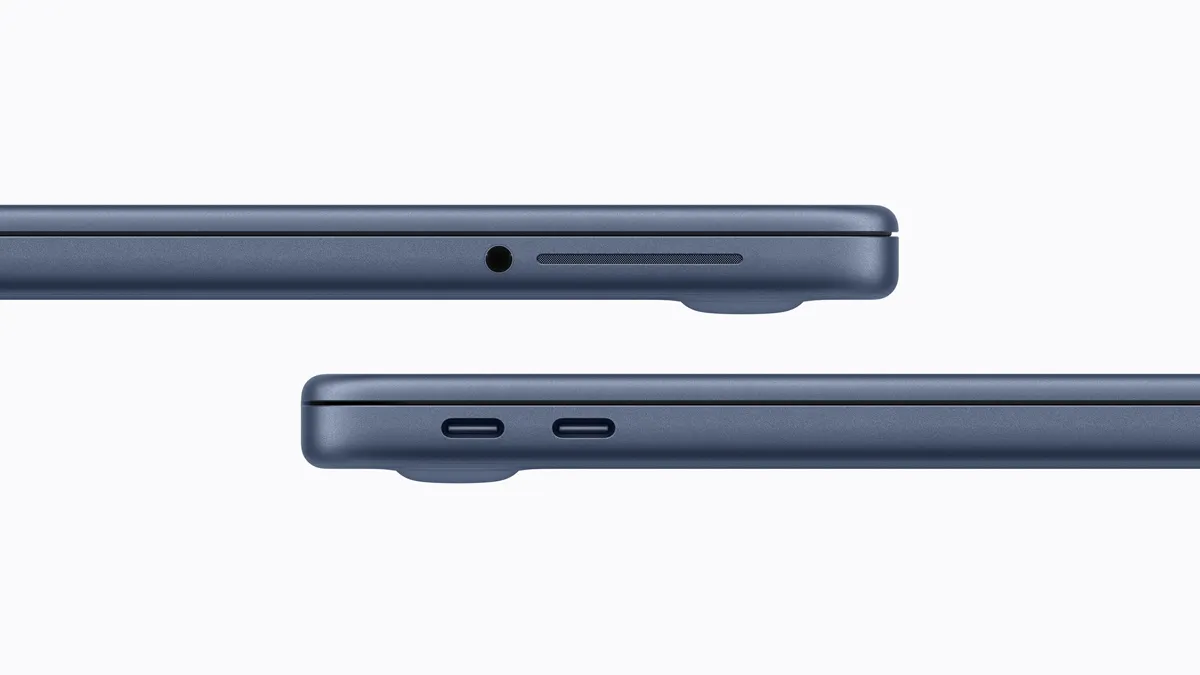
There is no MagSafe, no Thunderbolt, and no SD card slot. This is a meaningful limitation compared to the MacBook Air, which offers two Thunderbolt 4 ports and a dedicated MagSafe 3 charging port. The MacBook Neo also lacks Wi-Fi 7, which both the M5 MacBook Air and MacBook Pro carry via Apple’s N1 networking chip.
Apple Intelligence
The MacBook Neo ships with full Apple Intelligence support (in beta at launch), powered by the A18 Pro’s Neural Engine. Confirmed features:
- Writing Tools — proofread, rewrite, adjust tone, and summarize text across system apps
- Genmoji — generate custom emoji from text descriptions
- Clean Up (beta) — remove unwanted objects from photos with a single click
- Private Cloud Compute — complex AI requests processed on Apple silicon servers with on-device privacy protections
Popular third-party AI tools including ChatGPT and Canva run natively on the MacBook Neo. The device ships with macOS Tahoe, Apple’s latest operating system, featuring the new Liquid Glass visual design.

Mac + iPhone Integration
The full Apple Continuity suite is included: iPhone Mirroring (view and control your iPhone from the Mac screen), Handoff, Universal Clipboard, AirDrop, and Instant Hotspot (share iPhone cellular data with the Mac without Wi-Fi). iPhone calls and messages appear natively on the MacBook Neo.
Sustainability
Apple rates the MacBook Neo at 60% recycled content by weight — the highest of any Apple product ever released. The enclosure uses 90% recycled aluminum. Manufacturing runs on 45% renewable electricity. Packaging is 100% fiber-based with no plastic components.
Performance & Benchmarks
CPU performance results from testing conducted in the first days after the Neo’s announcement confirm that the A18 Pro’s architecture fits the machine’s purpose precisely. The chip has one fewer GPU core than the iPhone 16 Pro variant, so graphics scores come in marginally lower than the phone — a small and expected difference. CPU scores are virtually identical to iPhone 16 Pro, as expected from shared silicon.
Against the M1 MacBook Air — the machine the Neo most directly replaces at the entry level — the Neo’s single-core performance is substantially stronger, comparable to M3-generation chips. Multi-core performance sits close to M1 levels, reflecting a chip architecture optimized for speed per core rather than maximum parallel throughput.
| Device | Single-Core | Multi-Core | GPU Score |
|---|---|---|---|
| MacBook Neo (A18 Pro) | ~3,460 | ~8,670 | ~31,300 |
| iPhone 16 Pro (A18 Pro) | ~3,445 | ~8,625 | ~32,575 |
| M1 MacBook Air | ~2,345 | ~8,340 | ~33,150 |
| M4 MacBook Air | ~3,695 | ~14,730 | ~54,630 |
* Approximate figures from early published CPU performance testing, March 2026. Single-sample results; averages may vary slightly.
The benchmark profile matches the MacBook Neo’s design intent. Single-core speed — which governs web browsing, productivity apps, email, video calls, and Apple Intelligence — is strong and competes with M3-generation chips. Multi-core performance, which matters for video rendering and creative production workloads, sits near M1 levels. For the Neo’s target audience, those workloads are essentially irrelevant. The typical Neo buyer — someone in Safari, Pages, Keynote, Zoom, and Mail all day — will find this machine responsive and fast. The M4 MacBook Air’s multi-core lead only registers in workloads the Neo was never designed to handle.
Hands-on testing at launch confirmed the real-world experience aligns with specifications. The machine handles all standard everyday tasks smoothly. The display performs well above budget-laptop expectations at full brightness. One honest observation from early testing: the keyboard and trackpad, while functional and pleasant to use, have a slightly less planted feel than those on the MacBook Air or Pro — a minor trade-off in service of the $599 price point.

MacBook Neo vs. MacBook Air vs. MacBook Pro
Here is a confirmed side-by-side of Apple’s full MacBook lineup based on verified specifications:
| Feature | MacBook Neo | MacBook Air (M5) | MacBook Pro (M5 Pro) |
|---|---|---|---|
| Starting Price | $599 | $1,099 | $2,199 |
| Chip | Apple A18 Pro | Apple M5 | M5 Pro / M5 Max |
| Base RAM | 8GB unified | 16GB unified | 24GB unified |
| Base Storage | 256GB | 512GB | 1TB |
| Display Size | 13-inch | 13″ or 15″ | 14″ or 16″ |
| Display Panel | Liquid Retina | Liquid Retina | Liquid Retina XDR · 120Hz |
| Notch | None · uniform bezels | Notch | Notch |
| Battery Life | Up to 16 hrs | Up to 18 hrs | Varies by model |
| Charging | USB-C only | MagSafe 3 + USB-C | MagSafe 3 + USB-C |
| Data Ports | USB-C 3 + USB-C 2 | 2× Thunderbolt 4 | 3× Thunderbolt + HDMI + SD |
| Wi-Fi | Standard | Wi-Fi 7 | Wi-Fi 7 |
| Apple Intelligence | Yes | Yes | Yes |
| Education Price | $499 | Available | Available |
The connectivity gap between the Neo and the Air is the most practically significant difference. The Air’s two Thunderbolt 4 ports support fast external SSDs, high-resolution displays, and docking stations. The Neo’s USB-C 2 port tops out at 480 Mbps — adequate for everyday peripherals and charging, but limiting for large file transfers. Without MagSafe, charging the Neo occupies one of its only two USB-C ports.
The 8GB of base RAM is also worth noting. The MacBook Air starts at 16GB — double the Neo’s baseline — which is a meaningful advantage for multitasking and long-term software compatibility. For users who plan to keep their laptop four or more years, 8GB may become a constraint as application demands grow.
On design, the Neo holds an unexpected advantage: clean, uniform bezels and no notch. And at $500 less than the Air, the connectivity trade-offs are a fair exchange for the majority of everyday buyers.
Pricing & Availability
Configuration Tiers
- $499 — Education pricing · 256GB SSD · 8GB RAM · Lock Key
- $599 — Base consumer price · 256GB SSD · 8GB RAM · Lock Key
- $699 — 512GB SSD · 8GB RAM · Touch ID
Availability
- Pre-orders: Open now at apple.com and in the Apple Store app
- In-store & ships: March 11, 2026
- Countries at launch: 30 countries and regions
Colors
Silver, Blush (light pink), Citrus (warm yellow), and Indigo (deep blue). Each carries through to color-tinted keyboard keys — a design detail new to MacBook since the iBook era.
Financing
Apple Card Monthly Installments (ACMI) at 0% APR are available for qualified US buyers. Trade-in credit from eligible devices can reduce the purchase price further. Apple’s Personal Setup sessions are available free to help new buyers transfer data and configure their machine after purchase.
Real-World Impact: Consumers & Enterprise
For Everyday Consumers
The MacBook Neo removes the single barrier that has kept the Mac out of the mainstream laptop conversation for years: price. At $599 — and especially at $499 with education pricing — it competes directly with Windows laptops and Chromebooks that cannot match its build quality, software ecosystem, AI capabilities, security model, or long-term software support. For first-time Mac buyers and students, it is the most compelling entry point the platform has ever had.
The practical experience for a typical user — one who lives in a web browser, productivity suite, video call app, and messaging platform — will be fast, smooth, and all-day unplugged. The 16-hour battery and powerful single-core performance mean the Neo delivers where it counts for this audience every single day.
For Enterprise
The MacBook Neo’s connectivity limitations narrow its fitness for corporate IT deployments. The lack of Thunderbolt rules out compatibility with docking stations that are standard in many enterprise desk environments, and the slow USB-C 2 port limits high-speed external storage workflows common in professional settings.
Enterprise note: The MacBook Neo suits specific enterprise roles well — field staff, frontline workers, and cloud-first employees who don’t require Thunderbolt docking or high-speed local storage. For developer, creative, or power-user roles, the MacBook Air or MacBook Pro remains the appropriate hardware choice.
Pros & Cons
✓ Pros
- $599 starting price — Apple’s most affordable Mac laptop ever
- Premium aluminum build that far exceeds the price tier
- A18 Pro: strong single-core performance for everyday use
- Full Apple Intelligence included out of the box
- Up to 16 hours of battery life
- 1080p FaceTime HD camera
- No notch — clean, uniform bezels
- Four expressive colors with matched keyboards
- Spatial Audio + Dolby Atmos speakers
- 60% recycled content — highest of any Apple product
- Full iPhone Continuity feature set
- Free ongoing macOS updates
- $499 education pricing
✗ Cons
- No Thunderbolt — limits docking and fast external storage
- No MagSafe — charging ties up a USB-C port
- USB-C 2 port capped at 480 Mbps
- Only 3 ports total
- Touch ID costs $100 extra (only on $699 tier)
- 8GB RAM — half of the MacBook Air’s baseline
- Multi-core performance significantly below M4 MacBook Air
- Weaker GPU vs. MacBook Air for graphics tasks
- No Wi-Fi 7
- Apple Intelligence still in beta at launch
- Keyboard/trackpad slightly less solid-feeling than MacBook Air
How to Choose: Which MacBook Is Right for You?
You’re a student or first-time Mac buyer
The Neo covers every student workflow — writing, research, presentations, video calls, and streaming — at a price point the Mac has never reached before. At $499 with education pricing, it’s the most accessible entry point in Apple laptop history.
You live in a browser, email, and productivity apps
Safari, Mail, Pages, Keynote, Zoom, Messages. If this is your workflow, the A18 Pro handles every bit of it with speed and efficiency. You won’t feel limited for these tasks.
You need Thunderbolt, MagSafe, Wi-Fi 7, or more RAM
The M5 MacBook Air starts at $1,099 and brings Thunderbolt 4, MagSafe 3, Wi-Fi 7, 16GB base RAM, 512GB base storage, and 18 hours of battery. A $500 step up for meaningfully better connectivity and longevity.
You do video editing, audio production, or development
The M5 Pro MacBook Pro’s multi-core performance, 120Hz ProMotion display, comprehensive port selection, and 24GB base RAM are built for demanding creative and technical workloads that the Neo isn’t designed to handle.
Conclusion
The MacBook Neo is the most significant entry-level laptop Apple has released in a generation. It doesn’t just lower the price — it delivers genuine premium quality at that price: build materials, display performance, battery life, camera capability, and AI integration that all land meaningfully above what $599 has historically meant in the laptop market.
The trade-offs — no Thunderbolt, no MagSafe, only 8GB of RAM, Touch ID locked behind a $100 upgrade — are real and matter for certain buyers. Anyone who needs docking flexibility, fast external storage, or significant multitasking headroom will find the MacBook Air the better long-term investment.
But for the enormous segment of laptop buyers who spend their day in a browser and a handful of productivity apps, the MacBook Neo closes the one gap that has always stood between them and the Mac platform: cost. And it does so without asking them to accept a product that looks or feels cheap. That combination has essentially never existed before at this price point. The MacBook Neo earns its place as the clearest on-ramp to macOS the company has ever built.
What’s Next
The MacBook Neo goes on sale March 11, 2026 alongside the M5 MacBook Air and M5 Pro/Max MacBook Pro. Full long-form reviews, extended battery testing, thermal performance analysis, and real-world creative benchmark comparisons are expected from major publications shortly after launch day. Hawkdive will update this article with full review findings, any additional configuration pricing confirmed by Apple, and deeper performance data as it becomes available.
At a Glance
- ShipsMarch 11, 2026
- Edu price$499
- ChipA18 Pro
- Memory8GB unified
- Storage256 / 512GB
- Display13″ Liquid Retina
- Brightness500 nits
- BatteryUp to 16 hrs
- Camera1080p FaceTime HD
- Ports2× USB-C + 3.5mm
- Countries30 at launch
Early Performance Results
- Single-core~3,460
- Multi-core~8,670
- GPU score~31,300
Approx. · early published CPU tests · March 2026 · single sample
Config Tiers
- $499 edu256GB · Lock Key
- $599 base256GB · Lock Key
- $699512GB · Touch ID
Available Colors
Neo vs. Air — Key Gaps
- RAM8GB vs 16GB
- PortsUSB-C vs TB4
- ChargingUSB-C vs MagSafe
- Wi-FiStd vs Wi-Fi 7
- Battery16 vs 18 hrs
- Price gap$500