X-ray Computed Tomography Scans Reveal Surprising Features Inside Asteroid Bennu
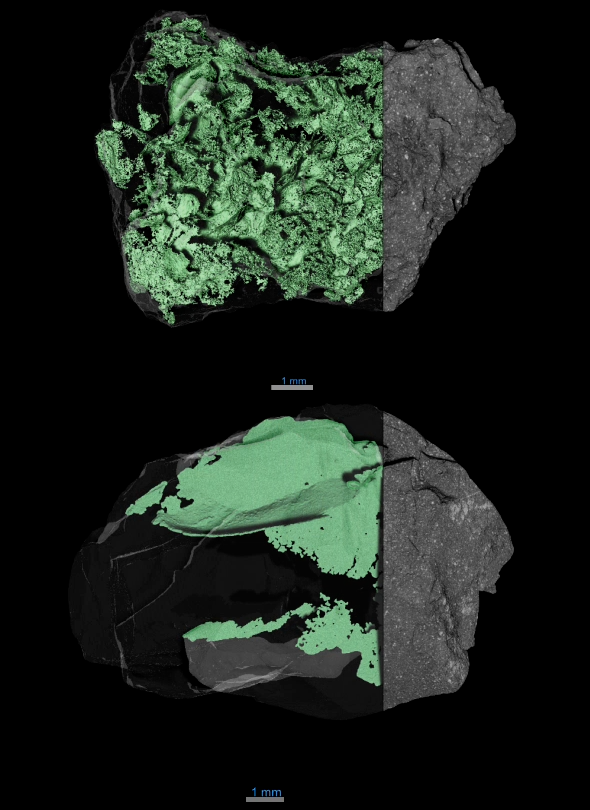
On March 17, 2026, a series of X-ray computed tomography (XCT) scans were released, offering a unique peek inside the asteroid known as Bennu. These scans unveiled the presence of crack networks within Bennu samples, shedding light on a long-standing mystery that had puzzled NASA scientists for years.
When NASA’s OSIRIS-REx spacecraft initially approached Bennu in 2018, researchers were anticipating to encounter smooth, sandy surfaces akin to a beach. However, what they discovered was quite the opposite – a rugged terrain dotted with boulders. The discrepancy between the initial expectations and the actual findings stemmed from observations made by NASA’s Spitzer Space Telescope in 2007, which indicated low thermal inertia on Bennu’s surface. This characteristic typically points towards an asteroid that rapidly heats up and cools down as it rotates, resembling a sandy beach on Earth. The presence of large boulders on Bennu, however, contradicted this thermal profile, as boulders are expected to retain heat for longer periods, similar to blocks of concrete.
Subsequent data collected by the OSIRIS-REx spacecraft during its survey of Bennu hinted at a potential explanation for this anomaly – the boulders on Bennu may be significantly more porous than initially assumed. Upon the safe return of the collected samples to Earth, researchers were able to delve deeper into this hypothesis.
The XCT scans of Bennu provided crucial insights into the composition and structure of the asteroid, offering a closer look at the intricate network of cracks that permeate the samples. These scans played a pivotal role in reconciling the disparities between the anticipated characteristics of Bennu and the actual features observed by the OSIRIS-REx spacecraft.
The utilization of XCT technology allowed scientists to visualize and analyze the internal structure of Bennu in unprecedented detail. By examining the distribution and morphology of the crack networks within the asteroid samples, researchers gained valuable information about the formation and evolution of Bennu over time.
The discovery of these crack networks represents a significant breakthrough in our understanding of asteroids and their complex compositions. The porous nature of the boulders on Bennu has opened up new avenues for research and exploration, providing valuable insights into the geological processes at play within these celestial bodies.
As we continue to unravel the mysteries of the universe, advancements in technology such as XCT scans offer us a glimpse into the hidden depths of asteroids like Bennu. By leveraging cutting-edge tools and techniques, we are able to expand our knowledge of the cosmos and uncover the secrets that lie beyond our planet.
In conclusion, the XCT scans of Bennu have provided us with a fascinating look into the internal structure of this enigmatic asteroid, offering valuable clues about its formation and composition. This groundbreaking research paves the way for further exploration and discovery in the realm of asteroid studies, bringing us one step closer to unlocking the mysteries of the universe.
Image credit: NASA/Scott Eckley
To learn more about how these XCT scans have revolutionized our understanding of Bennu, visit NASA’s official website.
For more Information, Refer to this article.