























NVIDIA Showcases AI-Driven Manufacturing at Hannover Messe 2026
At Hannover Messe 2026, taking place from April 20-24 in Hannover, Germany, NVIDIA and its partners are unveiling the future of manufacturing through AI-driven innovations. As industries face increasing pressure to optimize production processes amid shrinking skilled labor pools and accelerated design cycles, the emphasis has shifted from whether to adopt AI to how quickly and extensively it can be integrated into manufacturing systems.
AI Infrastructure: Powering Europe’s Next Industrial Era
The foundation for AI-driven manufacturing lies in robust infrastructure capable of supporting large-scale operations. The Industrial AI Cloud, developed by Deutsche Telekom on NVIDIA’s AI framework, is emerging as a pivotal asset for European industries. This cloud platform serves as a secure and scalable environment that facilitates the integration of AI and robotics across various sectors.
During the event, key industry players such as Agile Robots, SAP, Siemens, PhysicsX, and Wandelbots will demonstrate how they leverage this sovereign AI platform to execute complex workloads. These include real-time simulations powered by AI physics and the development of digital twins—virtual replicas of physical systems that enhance operational efficiency. Notably, EDAG has announced plans to run its industrial metaverse platform, metys, on this cloud infrastructure, further illustrating the potential of sovereign AI in automotive engineering.
In response to the growing demand for advanced AI infrastructure, major technology firms including Dell Technologies, IBM, Lenovo, and PNY are also showcasing NVIDIA-accelerated systems. These innovations span from edge computing solutions to comprehensive data center architectures designed to enhance simulation speeds and streamline the deployment of computer vision technologies in manufacturing environments.
AI-Driven Engineering
The complexity of modern industrial systems necessitates a transformation in engineering software capabilities. At Hannover Messe, NVIDIA’s partners are highlighting how integrating AI physics and agentic AI into design and simulation processes is unlocking new possibilities for engineers. Companies like Cadence, Dassault Systèmes, Siemens, and Synopsys are incorporating NVIDIA’s CUDA-X libraries alongside Omniverse technologies to facilitate real-time simulations grounded in physics.
This integration allows engineers to explore design alternatives more effectively while enabling agentic workflows that enhance productivity. By harnessing these advanced tools, organizations can better navigate the intricacies of modern manufacturing challenges.
Real-Time Factory Simulation
Digital twins are becoming essential tools for optimizing factory operations by enabling real-time simulations. At Hannover Messe, companies across various sectors will showcase how these digital models—constructed using Omniverse libraries—facilitate continuous optimization of processes. ABB is set to demonstrate how its Genix Industrial IoT suite integrates NVIDIA Omniverse with Microsoft Azure services to provide insights into asset performance while utilizing AI agents for root-cause analysis.
Dassault Systèmes will present its virtual twin experiences that leverage NVIDIA’s physical AI libraries for autonomous production systems. Similarly, Kongsberg Digital will illustrate how its Kognitwin platform utilizes digital twin models combined with live operational data to optimize performance before implementing changes in the physical world.
Microsoft will also highlight its collaboration with NVIDIA by showcasing real-time simulations that enhance organizational capabilities in designing and optimizing physical systems through integrated libraries.
Bringing AI Agents to the Factory Floor
The introduction of proactive AI agents marks a significant advancement over traditional automation methods constrained by rigid conditions. At Hannover Messe, attendees will witness how vision AI agents built on NVIDIA’s Metropolis libraries are enhancing operational efficiency across factories. These agents analyze multiple data streams from existing camera infrastructures to improve quality control and worker safety.
Invisible AI is set to launch its Vision Execution System at the event—a real-time analysis tool that captures every production cycle on the factory floor using advanced models like Nemotron and Cosmos Reason 2. This system aims to deliver actionable insights directly to operators before issues escalate.
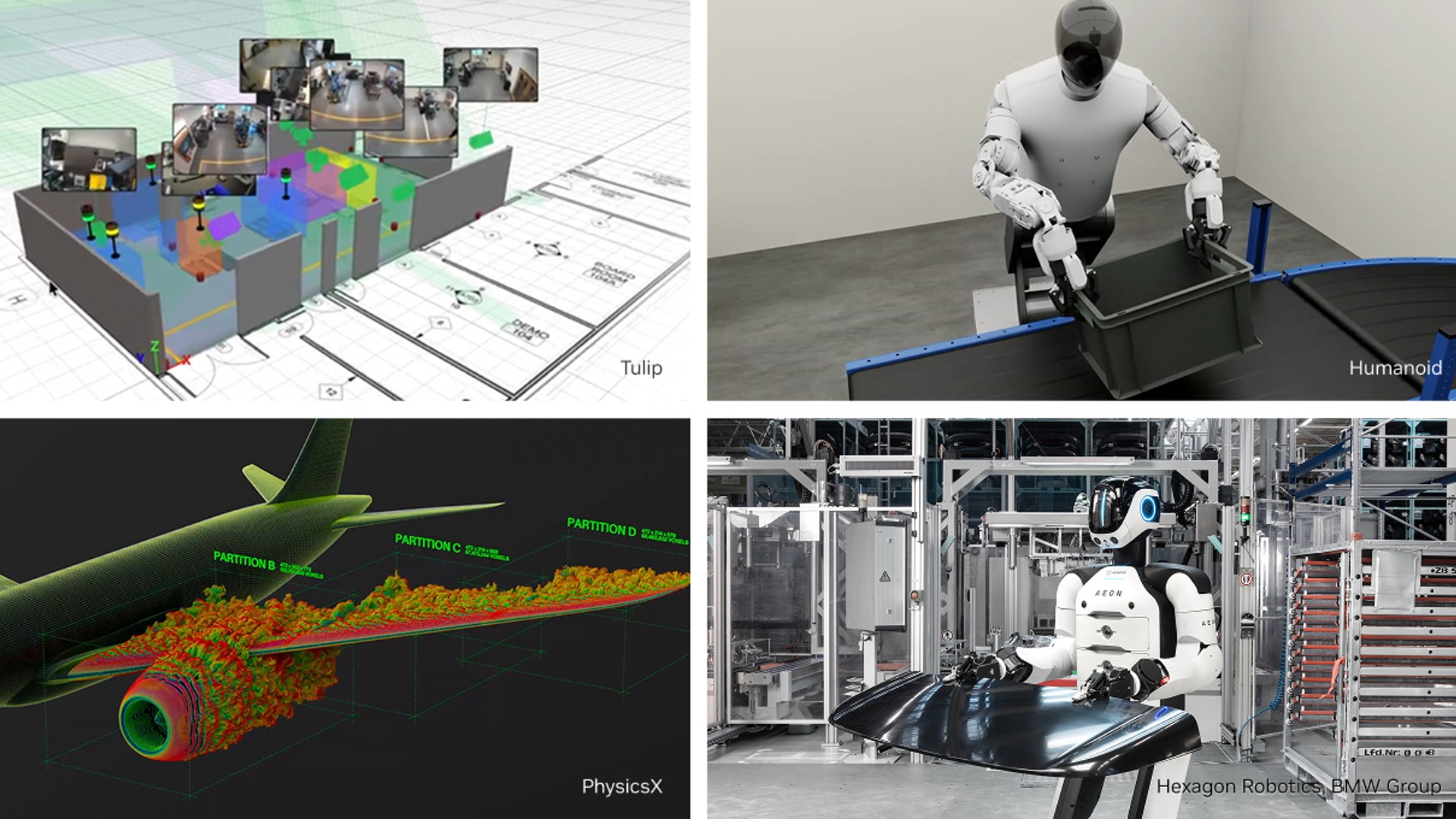
Tulip Interfaces will showcase its Factory Playback solution that synchronizes machine telemetry with operator workflows and quality events into a searchable timeline—helping manufacturers gain valuable insights into their operations while improving yield rates and reducing rework costs.
Machines That Can Think
The capabilities of industrial robots are evolving thanks to advancements in AI reasoning technologies that enable them to operate autonomously within unstructured environments. At Hannover Messe, various demonstrations will showcase robots executing complex tasks without extensive reprogramming or human intervention.
Siemens’ autonomous electronics factory in Erlangen will feature Humanoid’s HMND 01 wheeled humanoid robot completing logistics operations using NVIDIA’s Jetson Thor edge AI module. This proof-of-concept significantly reduces development time for robotic applications from years down to mere months.
SCHUNK’s GROW automation cell exemplifies how physical AI can be standardized for production environments by simulating robot behavior before deployment. Meanwhile, Hexagon Robotics is leveraging NVIDIA’s technology stack for accelerated robot training aimed at enhancing operational efficiency across manufacturing settings.
What This Means
The developments showcased at Hannover Messe 2026 underscore a pivotal shift toward integrating advanced artificial intelligence into manufacturing processes across Europe. As companies increasingly adopt these technologies, they stand to gain significant advantages in efficiency and productivity while addressing challenges posed by labor shortages and rapid market changes. The emphasis on building robust infrastructures capable of supporting these innovations suggests a future where intelligent automation becomes integral to industrial operations globally.
For more information, read the original report here.