






























Nasa’s Artemis II Mission Marks a New Era in Space Exploration
NASA’s Artemis II mission has successfully splashed down on Earth, marking a significant milestone in the agency’s efforts to return humans to the Moon and eventually explore Mars. The Orion spacecraft completed a remarkable 694,481-mile journey around the Moon before reentering Earth’s atmosphere and landing off the coast of San Diego on April 10. This mission sets the stage for future lunar surface missions, a Moon base, and subsequent missions to Mars.
Orion Spacecraft Performance Analysis
The Orion spacecraft’s reentry was a critical phase of the Artemis II mission, where it traveled at nearly 35 times the speed of sound. NASA’s thermal protection system effectively safeguarded both the crew and the spacecraft during this intense period. Initial inspections indicated that the heat shield performed as expected, with no unusual conditions detected. Notably, diver imagery captured after splashdown showed a significant reduction in char loss behavior compared to Artemis I, both in quantity and size.
Further analysis will be conducted on airborne imagery obtained during reentry, which will provide insights into heat shield performance and char loss timing. The crew module is scheduled to return to NASA’s Kennedy Space Center this month for additional examinations as part of its de-servicing process. This will involve detailed inspections, data retrieval, and removal of reusable components like avionics while ensuring all remaining hazards are addressed.
Over the summer, the heat shield will be sent to NASA’s Marshall Space Flight Center in Huntsville, Alabama, for further analysis through sample extraction and internal x-ray scans. The ceramic tiles on the upper conical backshell performed as anticipated, with reflective thermal tape still present in many areas—a sign that it functioned correctly during space travel but was not necessary for thermal protection upon reentry.
The precision of Orion’s splashdown was remarkable; it landed just 2.9 miles from its targeted site. Initial assessments confirmed that entry interface velocity was within one mile-per-hour of predictions. Several components were removed in San Diego for post-flight analysis before returning to Kennedy, including seats and various electronic units.
SLS Rocket Performance Overview
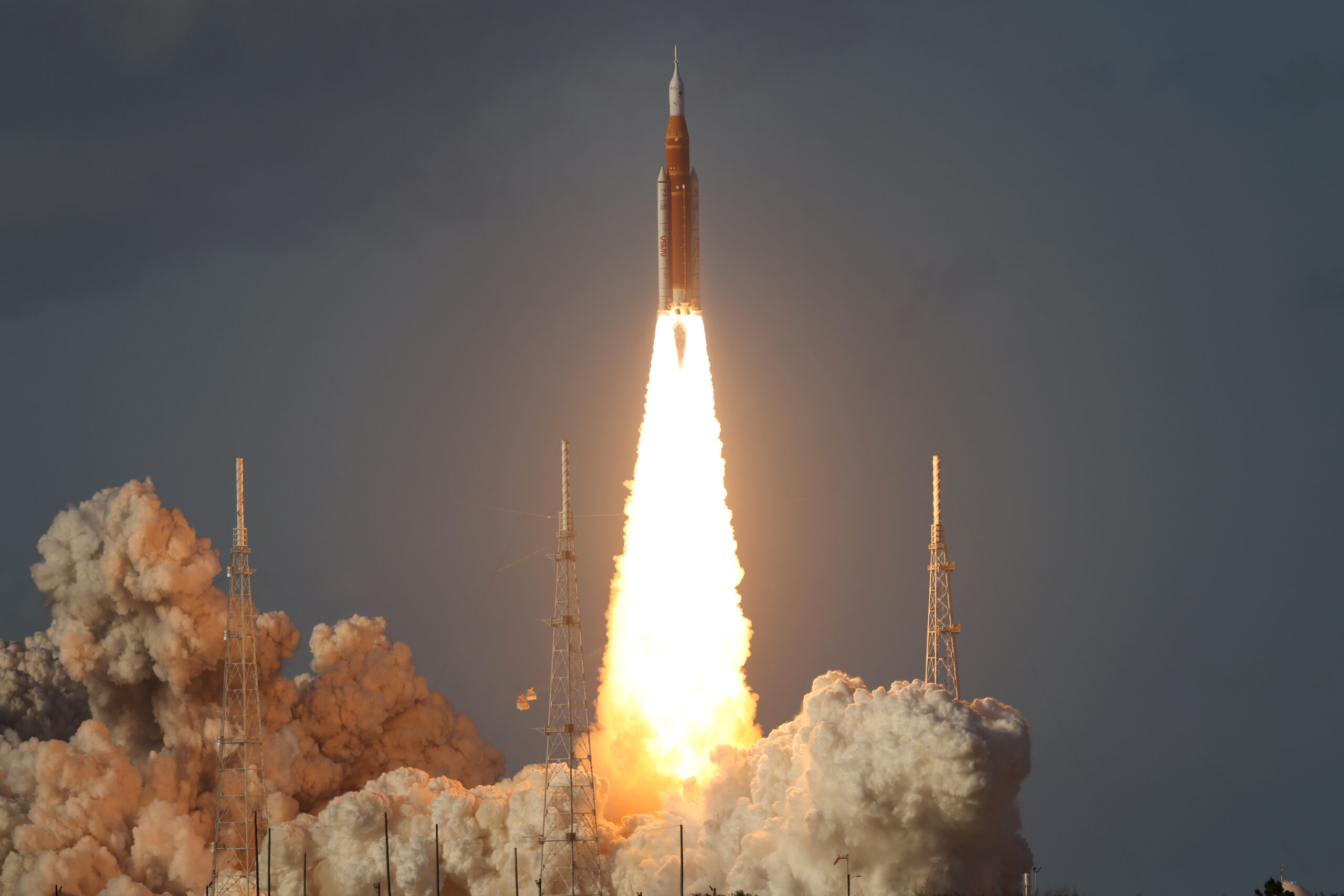
The Space Launch System (SLS) rocket that propelled Artemis II also met its mission objectives effectively. Engineers are currently analyzing data collected during the launch, but early assessments indicate that SLS successfully placed Orion into its intended orbit. At main engine cutoff—when the RS-25 liquid engines shut down—the spacecraft was traveling at over 18,000 miles per hour, achieving its required insertion velocity with pinpoint accuracy.
Ground Systems Assessment
Following the launch of Artemis II, engineers conducted a thorough assessment of the launch pad and mobile launcher systems used during liftoff. Lessons learned from Artemis I were applied to enhance ground support equipment resilience at Kennedy Space Center. Modifications included reinforcing components like elevator doors while allowing others—such as gaseous distribution panels—to flex under pressure from booster ignition.
These improvements minimized damage to both the mobile launcher and launch pad following liftoff. After launch operations concluded, teams promptly washed down ground systems to ensure operational integrity. NASA’s mobile launcher has since returned to Kennedy’s Vehicle Assembly Building for repairs in preparation for future missions.
Recovery Operations Post-Splashdown
The recovery operation following Orion’s splashdown was executed flawlessly by NASA’s recovery teams in collaboration with military partners. Navy divers retrieved each crew member from their spacecraft and transported them aboard USS John P. Murtha before assisting in recovering Orion itself for transport back to Naval Base San Diego.
Using valuable data gathered from this first crewed mission under Artemis II, NASA is actively preparing hardware and personnel for Artemis III set for 2027. This upcoming mission aims to lay further groundwork for lunar surface exploration starting in 2028.
What This Means
The successful completion of Artemis II signifies not just a triumph for NASA but also a pivotal moment for human space exploration as a whole. With each successful mission, NASA is building upon its capabilities and knowledge base needed for future endeavors on the Moon and beyond. As preparations continue for Artemis III and subsequent missions to Mars, these advancements underline humanity’s ongoing quest to explore new frontiers in space.
For more information, read the original report here.







