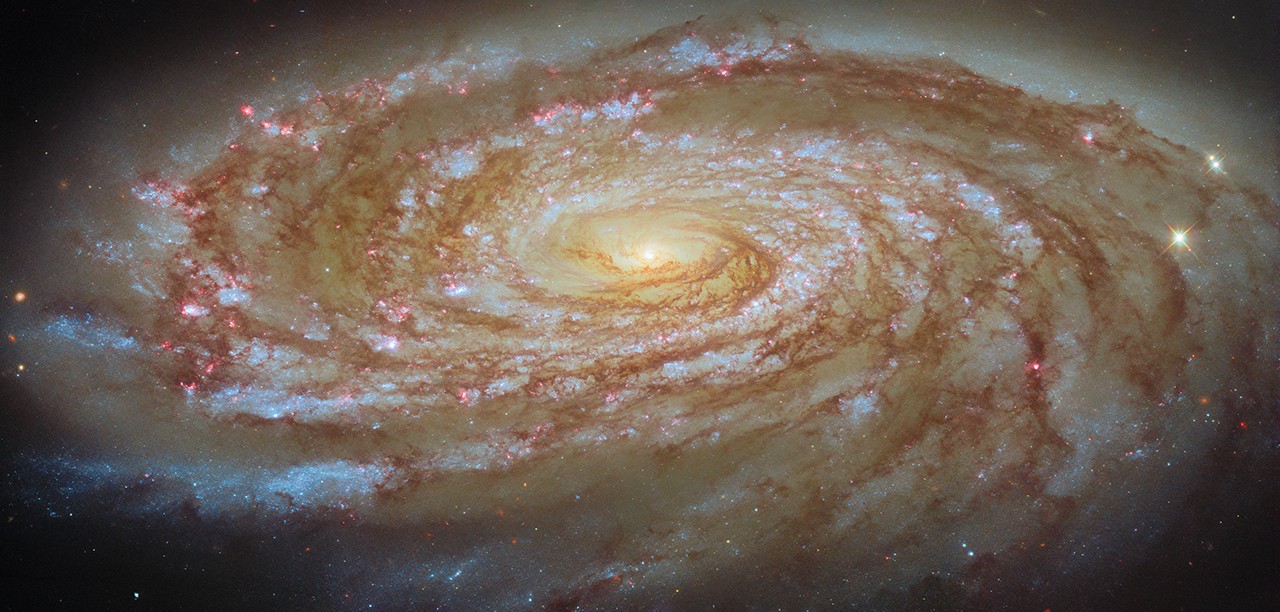
NASA’s Hubble Space Telescope Captures Messier 88’s Cosmic Journey
A recent image from NASA’s Hubble Space Telescope showcases the spiral galaxy Messier 88 (M88), located approximately 63 million light-years away in the constellation Coma Berenices. This active galaxy is on a long-term trajectory toward the center of the Virgo Cluster, where it will undergo significant changes due to gravitational interactions over hundreds of millions of years.
Understanding Messier 88
Messier 88 is classified as an active galaxy, which indicates that it contains a supermassive black hole at its core. This black hole is estimated to be around 100 million times more massive than the Sun and is currently consuming gas and dust from its surroundings. The activity at the center of M88 is responsible for generating outflows of gas, contributing to the dynamic environment within the galaxy.
The visual characteristics of M88 are striking. It features a warm, glowing heart composed of older, reddish stars surrounding the black hole. The galaxy’s spiral arms are tightly wound and symmetrical, adorned with vibrant clusters of stars and dense clouds of cosmic dust. Observers see M88 from an angle that accentuates its elongated shape, with its spiral arms elegantly fanning outwards.
The Virgo Cluster Connection
M88 is part of the Virgo Cluster, a massive assembly of over a thousand galaxies bound together by gravity. As this cluster moves through space, each galaxy follows its own orbital path around the cluster’s center of mass. M88 is currently on a lengthy journey that will eventually bring it closer to this gravitational hub, approximately two million light-years from its present location.
This impending approach will not be without consequences. In about 200 to 300 million years, M88 is expected to make its closest encounter with Messier 87 (M87), a giant elliptical galaxy that serves as the anchor for the Virgo Cluster. As M88 approaches M87, it will experience ram pressure stripping—a phenomenon where gas within a galaxy is expelled due to interactions with intergalactic medium as it moves through dense regions of space.
Effects of Ram Pressure Stripping
Evidence suggests that M88 has already begun to feel the effects of ram pressure stripping. Observations indicate that its disk of gas appears truncated and compressed at the leading edge, similar to how snow accumulates in front of a snowplow. Notably, M88 exhibits significantly less cold gas—an essential ingredient for star formation—than would typically be expected for a galaxy of its size, particularly in its outer regions.
This depletion of cold gas serves as a clear indicator that M88’s evolutionary path will be altered by its journey through the Virgo Cluster. The loss of gas not only impacts star formation rates but also modifies the overall trajectory of M88’s development as a galaxy.
Hubble’s Role in Galactic Research
The observations made by Hubble are part of an extensive research program aimed at understanding how spiral galaxies behave in densely populated environments like clusters. Utilizing Hubble’s Wide Field Camera 3 (WFC3), astronomers can resolve individual star clusters and nebulae in distant galaxies, even those tens of millions of light-years away.
This capability allows researchers to analyze how external factors influence galactic evolution and star formation capabilities over time. By studying galaxies such as M88 within their cosmic context, scientists can gain valuable insights into the life cycles and transformations these celestial bodies undergo throughout their existence.
What This Means
The study of Messier 88 offers significant implications for understanding galactic dynamics and evolution within clusters like Virgo. As M88 continues its journey toward M87, astronomers anticipate observing further changes that could illuminate how galaxies interact under gravitational forces and environmental pressures. Such research not only enhances knowledge about our universe but also informs theories regarding cosmic structure formation and evolution over vast timescales.
For more information, read the original report here.